Key Findings
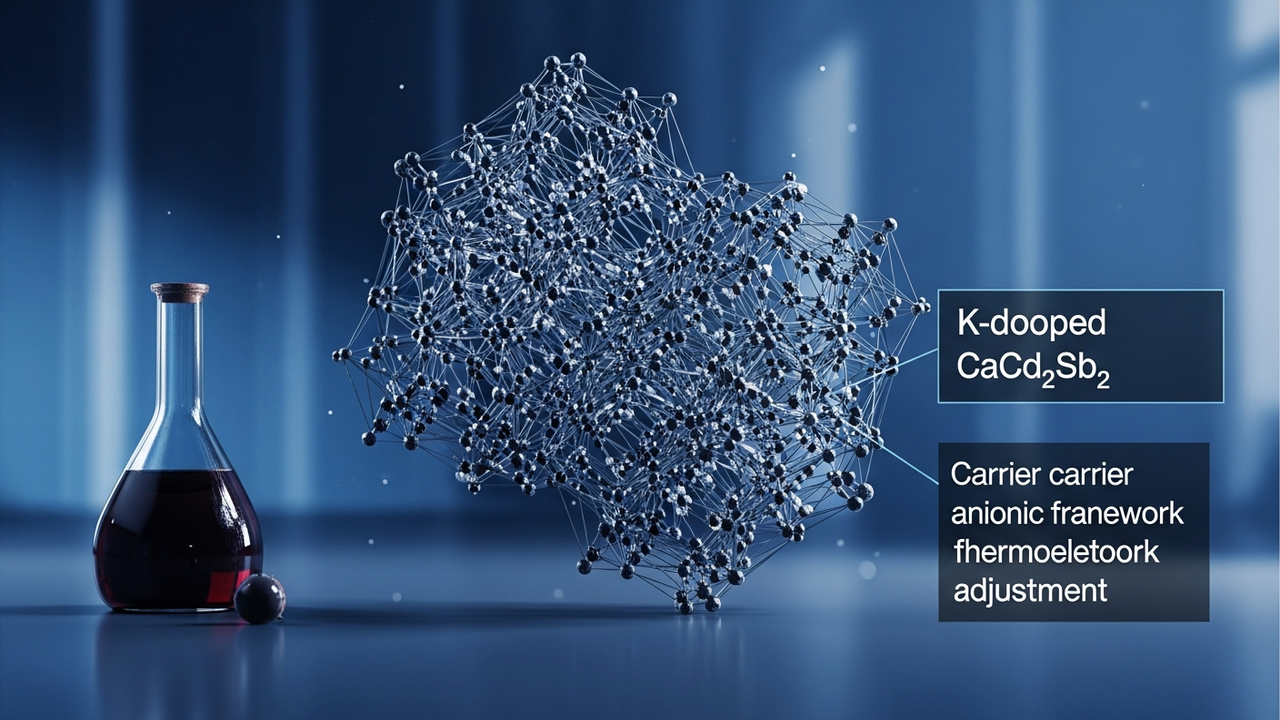
This research announces the successful achievement of remarkably high thermoelectric performance in the CaCd2Sb2 Zintl phase through the precise tuning of both carrier concentration and the anionic framework. This accomplishment reiterates the significant potential of Zintl-phase compounds as next-generation thermoelectric materials.
Technical / Clinical Details
Zintl-phase compounds are known for exhibiting intermediate properties between metals and covalently bonded compounds, often displaying excellent thermoelectric performance. In this study, potassium (K) was specifically introduced into the CaCd2Sb2 Zintl phase to effectively optimize the material’s carrier concentration. Notably, at a K content of x = 0.02, the room-temperature carrier concentration dramatically increased from a baseline of 0.44 × 10^19 cm–3 to 8.31 × 10^19 cm–3. This adjustment in carrier concentration directly correlates with improved electrical conductivity and, consequently, an enhanced thermoelectric figure of merit (ZT value). The K doping also influenced the anionic framework of the material, suggesting potential for further optimization of lattice thermal conductivity through subtle changes in the atomic structure. This precise doping and structural control led to a significant improvement in electrical transport properties, dramatically boosting the material’s thermoelectric performance.
Background & Context
Thermoelectric generation technology, which directly converts waste heat into electricity, is playing an increasingly crucial role in improving energy efficiency and building sustainable energy systems. However, the relatively low conversion efficiency of thermoelectric materials has been a primary obstacle preventing their widespread adoption. Developing high-performance thermoelectric materials requires simultaneously achieving high electrical conductivity, low thermal conductivity, and a high Seebeck coefficient. Zintl-phase compounds are actively researched as promising candidates for next-generation thermoelectric materials because their unique crystal structures allow them to balance these often-conflicting properties.
Strategic Significance & Outlook
The realization of high thermoelectric performance in K-doped CaCd2Sb2 Zintl phase expands its applicability across various fields, including waste heat recovery, power generation, and sensors. Its performance will be particularly valuable in applications requiring efficient thermoelectric conversion in low to medium temperature ranges, such as automotive waste heat utilization, industrial waste heat recovery, and power supply for wearable devices. Future research will focus on further optimizing K doping, exploring other dopant elements, reducing thermal conductivity through nanostructuring, and developing large-scale synthesis processes. This technology represents a crucial step toward achieving high-performance thermoelectric materials essential for the advancement of sustainable energy conversion technologies.
Get our weekly technology intelligence — free
Receive an infographic that lets you judge at a glance whether each field’s analysis report is worth reading.
Subscribe Free — Weekly Tech Intelligence
By subscribing, you’ll receive Troy-Technical’s weekly technology intelligence newsletter.
- Your email and selected fields are used only to deliver the newsletter.
- We never share your information with third parties.
- You can unsubscribe anytime via the link in each email.
See our Privacy Policy for details.
Takes about a minute · Unsubscribe anytime