Key Findings
The synergy of AI and autonomous laboratories is set to fundamentally transform semiconductor material discovery, shifting from linear, manual trial-and-error to advanced closed-loop systems capable of rapidly exploring multidimensional property requirements. This groundbreaking approach promises to break through the physical limitations currently encountered in chip manufacturing, providing an essential foundation for the development of future high-performance semiconductors.
Technical / Clinical Details
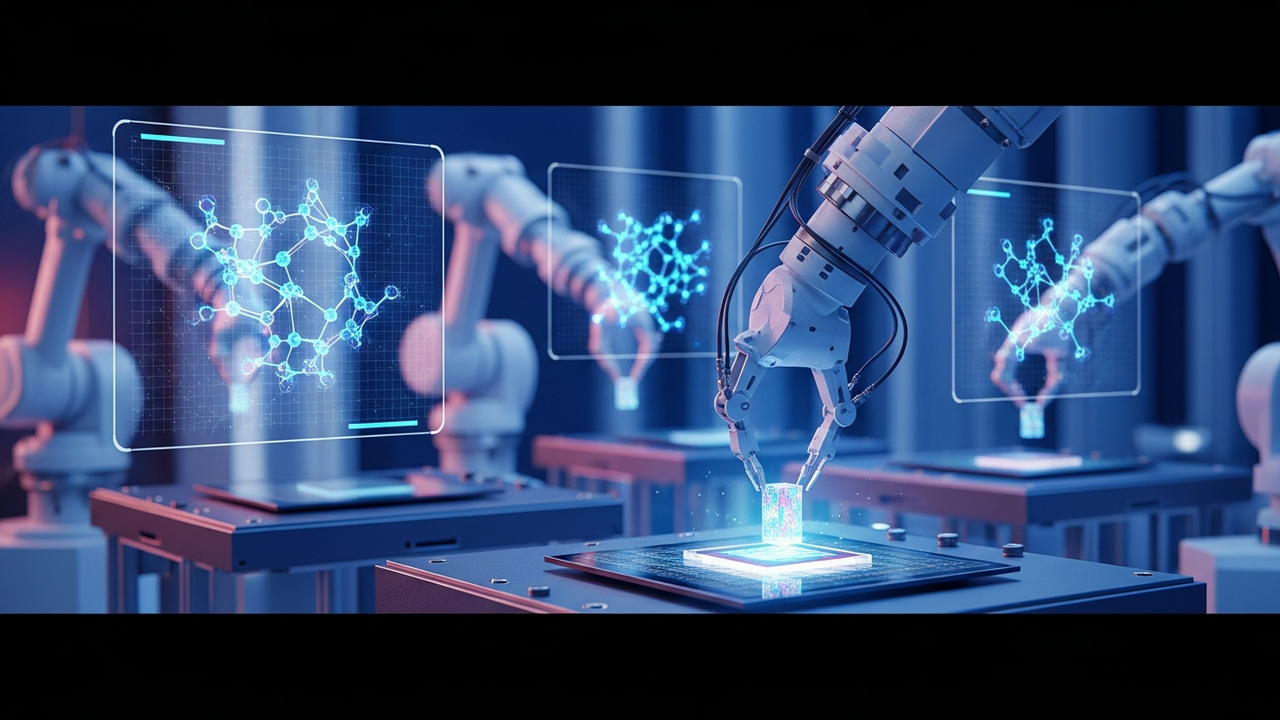
Traditional material discovery has relied on a linear sequence of hypothesis, experimentation, and analysis. AI-driven autonomous labs radically advance this by using AI to predict novel material candidates from vast datasets, while robotic systems synthesize and test these candidates in a self-driving lab environment. The resulting data is then fed back to the AI, creating a continuous, rapid, human-free cycle of discovery. This is particularly crucial in semiconductors where miniaturization limits and demands for new functionalities necessitate novel materials. The system excels in efficiently exploring materials with diverse properties, including thermal, electrical, and mechanical stability, crucial for next-generation devices.
Background & Context
The semiconductor industry faces significant challenges in sustaining performance improvements and cost reductions amidst the deceleration of Moore’s Law. To overcome these hurdles, the discovery of entirely new materials, beyond mere circuit scaling, is paramount. AI and autonomous laboratories are emerging as powerful tools to surmount this ‘materials wall.’ AI-driven material design holds the potential to reduce development times from years to months or even weeks. Major technology players like Google and IBM are actively investing in this domain, indicating a significant paradigm shift in material science research.
Strategic Significance & Outlook
This transformative technology extends its impact far beyond semiconductors, with broad applications in energy, medicine, and aerospace—any field demanding advanced functional materials. In the future, this approach is expected to drastically reduce the search space for materials, enabling faster and more cost-effective realization of innovative materials. While regulatory frameworks and data sharing challenges remain, AI and autonomous labs are set to become a core technology driving the next wave of scientific and technological innovation. Concrete products and technologies leveraging this approach are anticipated to enter the market within the next 5-10 years.
Get our weekly technology intelligence — free
Receive an infographic that lets you judge at a glance whether each field’s analysis report is worth reading.
Subscribe Free — Weekly Tech Intelligence
By subscribing, you’ll receive Troy-Technical’s weekly technology intelligence newsletter.
- Your email and selected fields are used only to deliver the newsletter.
- We never share your information with third parties.
- You can unsubscribe anytime via the link in each email.
See our Privacy Policy for details.
Takes about a minute · Unsubscribe anytime