Key Findings
This research successfully demonstrates an enhanced power generation capability for thermoelectric generators (TEGs) through a synergistic thermal management strategy. By utilizing soldered copper foam/paraffin wax composite heat sinks, the study achieved a significant boost in TEG performance, marking a critical advancement for waste heat recovery applications.
Technical / Clinical Details
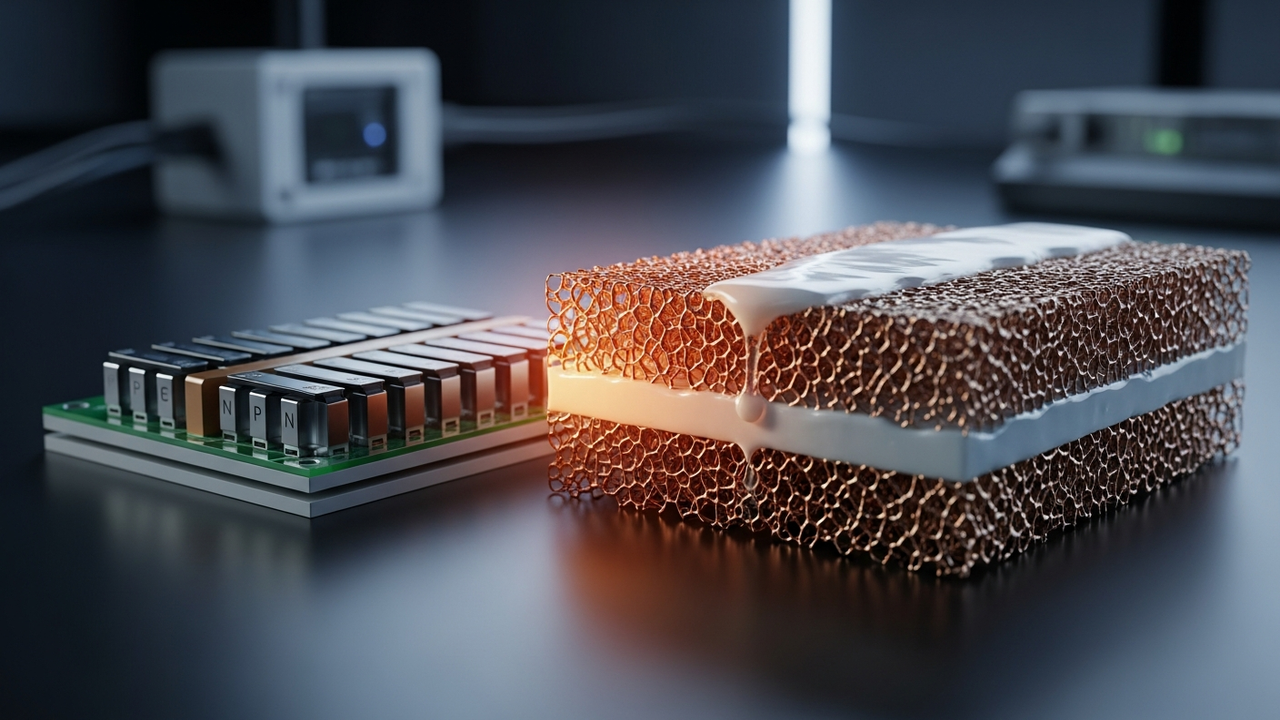
Since the output power of a TEG is proportional to the square of the temperature difference across its thermoelectric legs, maximizing this temperature differential is key to improving power generation. This study focused on enhancing heat dissipation efficiency, particularly on the cold side of the TEG. Specifically, copper foam heat sinks were directly soldered onto the TEG’s cold side using SnBi (tin-bismuth) solder. This direct soldering technique drastically reduced interfacial thermal resistance between the TEG and the heat sink, optimizing the heat transfer pathway. Furthermore, copper foam, known for its high thermal conductivity and extensive surface area, combined with paraffin wax, allowed for both efficient thermal energy storage and rapid heat diffusion. This setup enabled quick and efficient heat removal from the cold side, increasing the overall temperature difference across the TEG and, consequently, dramatically improving power generation.
Background & Context
Waste heat recovery is increasingly vital for improving industrial efficiency and building sustainable energy systems. Thermoelectric generators, as a solid-state, quiet, and reliable waste heat recovery technology, have garnered attention. However, their relatively low conversion efficiency has been a significant barrier to widespread adoption. To improve conversion efficiency, beyond material advancements, effective thermal management—especially maximizing the temperature difference across the TEG’s hot and cold sides—is indispensable. This research addresses the efficiency challenge through optimized thermal management, holding crucial implications for the practical application of TEGs.
Strategic Significance & Outlook
This thermal management technology, employing copper foam/paraffin wax composite heat sinks, is expected to expand the application potential of TEGs across various fields, including automotive waste heat recovery, industrial waste heat utilization, data center cooling systems, and even power supply for wearable devices. Future research will focus on scaling up the manufacturing process of composite heat sinks, evaluating long-term reliability, and optimizing performance under diverse heat source conditions. The widespread adoption of this technology is expected to promote the effective utilization of waste heat energy and significantly contribute to improved energy efficiency and reduced environmental impact.
Get our weekly technology intelligence — free
Receive an infographic that lets you judge at a glance whether each field’s analysis report is worth reading.
Subscribe Free — Weekly Tech Intelligence
By subscribing, you’ll receive Troy-Technical’s weekly technology intelligence newsletter.
- Your email and selected fields are used only to deliver the newsletter.
- We never share your information with third parties.
- You can unsubscribe anytime via the link in each email.
See our Privacy Policy for details.
Takes about a minute · Unsubscribe anytime




