Key Findings
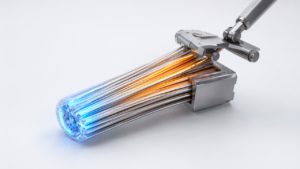
This research announces the successful realization of a highly efficient hybrid cooler that integrates both radiative and phase change cooling (RPC) capabilities, fabricated using advanced electrospinning and microencapsulation techniques. This RPC cooler exhibits a remarkable combination of high phase change enthalpy, measured at 108.64 J·g–1, and an ideal thermal conductivity of 0.506 W·m–1·K–1, positioning it as a revolutionary technology for advanced thermal energy storage and regulation in electronics.
Technical / Clinical Details
The RPC cooler achieves its superior performance through the synergistic effects of radiative cooling and phase change cooling. Radiative cooling is a passive mechanism that releases heat from a surface into the cold outer space as electromagnetic radiation, offering the potential to cool objects below ambient temperature even under direct sunlight. Phase change materials (PCMs), on the other hand, absorb a large amount of latent heat during their phase transition (e.g., solid to liquid), effectively buffering and suppressing device temperature increases. This hybrid cooler demonstrated a maximum transient temperature drop of 6.8°C under a heat flux of 500 W·m–2. Furthermore, even under strong solar radiation conditions, it successfully reduced the steady-state device temperature by an average of 4.5°C and achieved an average temperature difference of 8.3°C from the ambient. This combined performance enhancement, difficult to achieve with single cooling mechanisms, is particularly promising for cooling high-heat-generating components in mobile devices and data centers.
Background & Context
As electronic devices become more powerful and compact, increasing heat generation presents a significant challenge. Effective thermal management is crucial for preventing device performance degradation, reliability issues, and shortened lifespans. Traditional cooling systems often rely on active mechanisms like fans, which introduce problems such as noise, power consumption, and space constraints. Passive cooling technologies are garnering attention as a promising approach to overcome these challenges. RPC, by enabling efficient cooling without electricity consumption, is in high demand for energy-efficient applications such as IoT devices, wearable electronics, and autonomous systems.
Strategic Significance & Outlook
This RPC hybrid cooler technology holds the potential to establish new standards in electronics thermal management. Future applications are anticipated across a wide range of high-heat-generating devices, including smartphones, laptops, data center servers, and even electric vehicle batteries and power electronics. Going forward, research and development will focus on scaling up manufacturing processes, assessing the long-term stability of the materials, and optimizing performance under various environmental conditions. This technology is expected to significantly contribute to the advancement of sustainable technologies by enhancing energy efficiency and strengthening device reliability.
Get our weekly technology intelligence — free
Receive an infographic that lets you judge at a glance whether each field’s analysis report is worth reading.
Subscribe Free — Weekly Tech Intelligence
By subscribing, you’ll receive Troy-Technical’s weekly technology intelligence newsletter.
- Your email and selected fields are used only to deliver the newsletter.
- We never share your information with third parties.
- You can unsubscribe anytime via the link in each email.
See our Privacy Policy for details.
Takes about a minute · Unsubscribe anytime