Background
The relentless advance of AI and high-performance computing (HPC) demands exponentially greater data processing capabilities, rendering advanced memory technologies like High Bandwidth Memory (HBM) indispensable. HBM achieves its characteristic high-bandwidth, high-speed data transfer by vertically stacking multiple DRAM dies, which are then connected to an interposer using extremely fine-pitch flip-chip bonds. Protecting these intricate, tightly-packed structures and ensuring their long-term reliability under operational stress necessitates highly sophisticated underfill materials. Namics’ latest underfill material is specifically engineered to meet the stringent demands of this critical market segment, positioning it as a pivotal enabler for the ongoing expansion of the AI era.
Key Findings
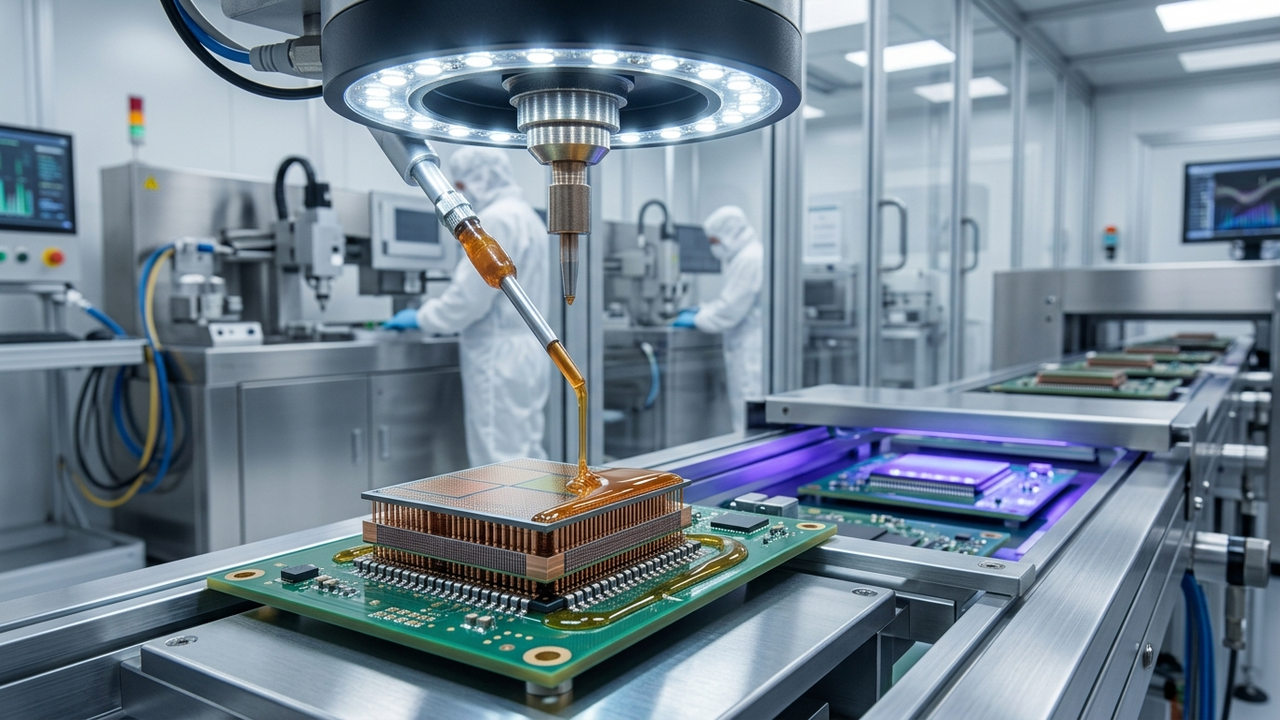
Namics has developed and launched a new capillary underfill material precisely engineered for ultra-fine-pitch flip-chip interconnections within High Bandwidth Memory (HBM) stacks. This advanced material combines ultra-low viscosity with rapid curing properties, essential for achieving the high performance and reliability demanded by the evolving landscape of AI and High-Performance Computing (HPC).
- Ultra-Low Viscosity and Excellent Penetration: Advanced packaging architectures, particularly HBM, present formidable challenges for uniform underfill dispensing due to the exceedingly narrow gaps between stacked dies and the substrate. Leveraging proprietary technology, Namics’ new material boasts ultra-low viscosity, facilitating rapid and uniform penetration into these minute spaces. This critical property effectively prevents void formation and significantly reduces the risk of bonding defects. The result is complete encapsulation, even within the most densely packed HBM configurations.
- Rapid Cure Characteristics: Enhanced productivity remains a constant imperative across semiconductor manufacturing. This underfill material features rapid curing characteristics, directly contributing to reduced tact times on high-volume production lines. This translates to significant improvements in cost efficiency and throughput for high-volume manufacturing, critically impacting time-to-market for next-generation products.
- High Reliability and Mechanical Integrity: Components operating in high-performance computing environments are subjected to considerable mechanical stress, primarily stemming from thermal expansion and contraction cycles. Namics’ new material offers robust resistance to thermal cycling, effectively mitigating stress transfer between the chip and substrate. This capability is crucial for preserving long-term connection reliability and mechanical integrity, thereby guaranteeing the extended lifespan and stable operation of HBM modules even under extreme conditions.
Strategic Significance & Outlook
This advanced underfill material from Namics is poised to meet significant demand across critical sectors where HBM adoption is pervasive, including next-generation AI accelerators, data center GPUs, and high-performance servers. The company plans strategic further development of this technology, focusing on optimizing material properties and expanding its product lineup to proactively address future advancements in packaging technology. This strategic focus is expected to contribute substantially to the sustained growth and innovation within the broader semiconductor industry.
Source: https://www.namics.co.jp/en/news/2026/underfill-hbm
Get our weekly technology intelligence — free
Receive an infographic that lets you judge at a glance whether each field’s analysis report is worth reading.
Subscribe Free — Weekly Tech Intelligence
By subscribing, you’ll receive Troy-Technical’s weekly technology intelligence newsletter.
- Your email and selected fields are used only to deliver the newsletter.
- We never share your information with third parties.
- You can unsubscribe anytime via the link in each email.
See our Privacy Policy for details.
Takes about a minute · Unsubscribe anytime