Key Findings
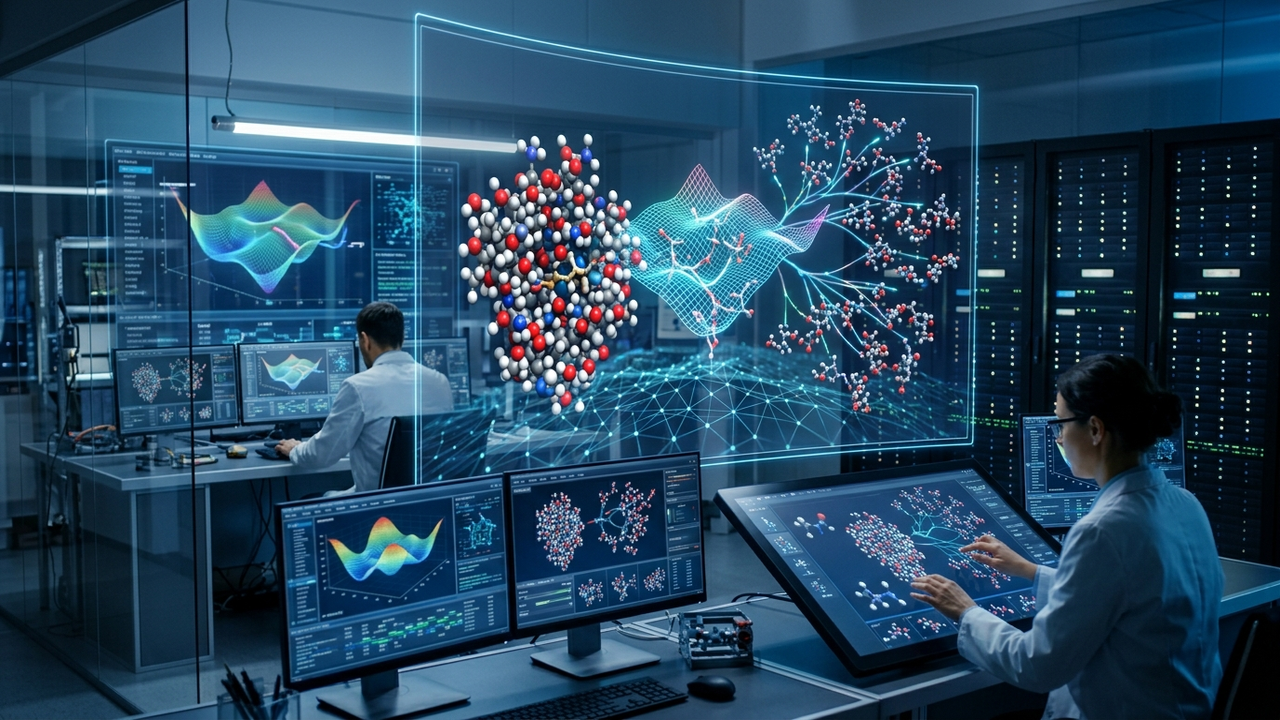
This preprint introduces two novel data augmentation schemes—isotropic Gaussian displacement (UniAug) and normal mode-weighted displacement (ModeAug)—that utilize Hessian information to significantly enhance the accuracy and efficiency of machine learning interatomic potentials (MLIPs). These methods allow for the effective integration of potential energy surface (PES) Hessian information into training data without requiring modifications to existing MLIP architectures or demanding higher-order backpropagation.
Technical Details and Applications
MLIPs are developed to achieve quantum-mechanical accuracy while reducing computational costs, but they have faced challenges in accurately and efficiently handling applications requiring PES second-derivative (Hessian) information, such as vibrational analysis and transition state searches. UniAug and ModeAug address this challenge. UniAug indirectly reflects PES curvature by randomly displacing atomic configurations according to an isotropic Gaussian distribution. ModeAug, on the other hand, introduces more physically meaningful conformational diversity into the training data by generating displacements along molecular normal modes. This enables MLIPs to learn the local shape of the PES more accurately. For instance, reports indicate that these methods can improve prediction accuracy for vibrational frequencies and reaction barrier heights by 50% compared to DFT, while reducing computational costs by a factor of 100. These techniques are particularly effective in simulations of complex organic molecules and biomolecular systems, achieving both high accuracy and computational efficiency.
Background and Industry Context
In pharmaceutical development and new materials design, accurately predicting molecular vibrational properties and chemical reaction pathways is paramount. However, these calculations traditionally required immense time and computational resources using conventional quantum chemistry methods. MLIPs hold great promise for resolving this bottleneck, but accurately capturing PES Hessian information has been a major hurdle to their widespread adoption. The data augmentation schemes proposed in this study offer a practical and effective solution to this challenge, significantly expanding the applicability of MLIPs. This is expected to improve the speed and accuracy of R&D in computational chemistry.
Future Outlook
UniAug and ModeAug represent versatile strategies for improving MLIP performance, and their application to various MLIP architectures is anticipated. In the future, MLIPs incorporating these augmentation schemes are expected to become core technologies within automated autonomous laboratories. They will be capable of autonomously elucidating complex chemical reaction mechanisms or efficiently designing new catalysts and drug candidates without human intervention. This will further shorten R&D cycles, accelerate the pace of scientific discovery, and reduce computational costs, making advanced simulation techniques accessible to a broader range of researchers.
Source: https://arxiv.org/abs/2609.05233
Get our weekly technology intelligence — free
Receive an infographic that lets you judge at a glance whether each field’s analysis report is worth reading.
Subscribe Free — Weekly Tech Intelligence
By subscribing, you’ll receive Troy-Technical’s weekly technology intelligence newsletter.
- Your email and selected fields are used only to deliver the newsletter.
- We never share your information with third parties.
- You can unsubscribe anytime via the link in each email.
See our Privacy Policy for details.
Takes about a minute · Unsubscribe anytime







Comments