Background
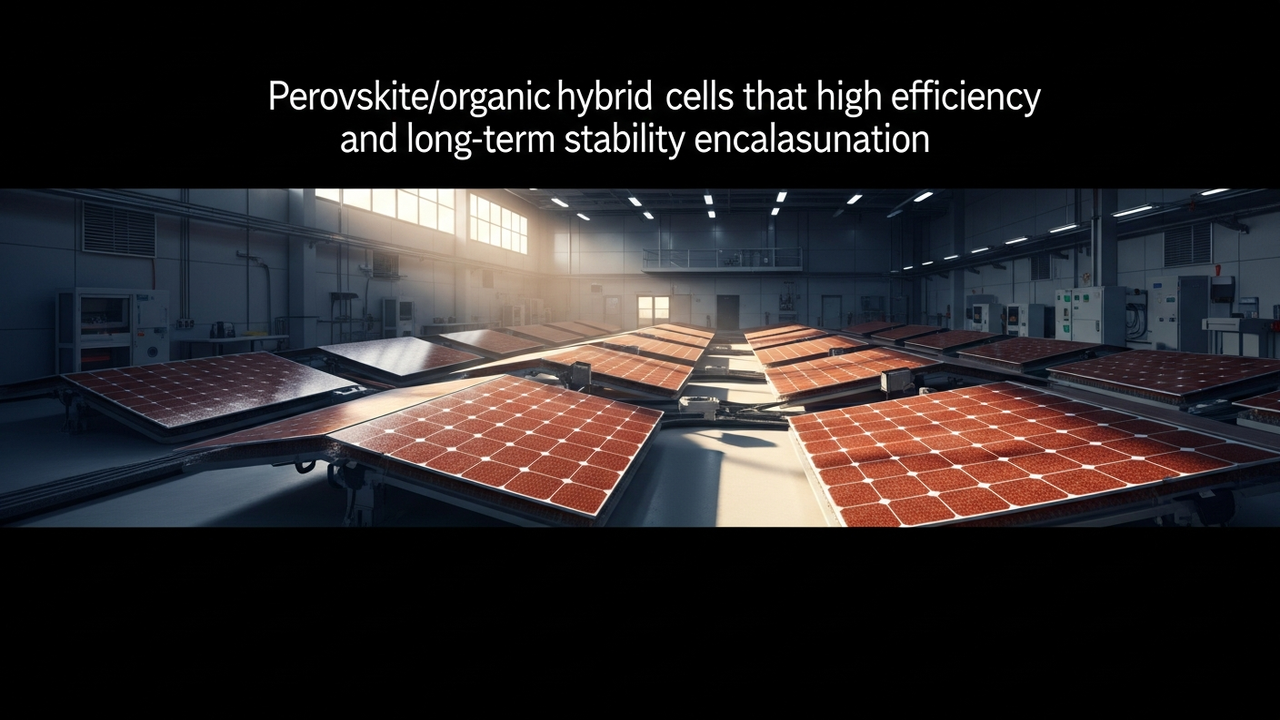
Perovskite solar cells (PSCs) have demonstrated remarkable power conversion efficiencies (PCEs), rapidly approaching and even surpassing conventional silicon technologies in laboratory settings. However, a major hurdle for their widespread commercialization has been their susceptibility to environmental degradation, particularly from moisture and heat. To counteract this, expensive and complex encapsulation layers are typically employed, adding to manufacturing costs, increasing device thickness, and limiting flexibility. The development of encapsulation-free, highly stable PSCs is thus a critical pathway to achieving cost-effective and versatile perovskite photovoltaic solutions.
Key Findings / Results
A collaborative research effort by institutions in South Korea, including Ulsan National Institute of Science and Technology (UNIST) and KAIST, has yielded a groundbreaking hybrid perovskite/organic solar cell. This device leverages a sophisticated cascade hole-transfer design to achieve an impressive certified power conversion efficiency of 26.71%, with a peak recorded efficiency of 27.18%. This efficiency ranks among the highest for single-junction perovskite solar cells.
- Record Efficiency: The certified 26.71% PCE is a significant achievement, demonstrating the high performance potential of the hybrid architecture. The cascade hole-transfer design optimizes charge carrier transport and minimizes interfacial recombination, crucial for maximizing efficiency.
- Unprecedented Encapsulation-Free Stability: The most striking aspect of this research is the device’s exceptional long-term operational stability without any encapsulation. Under accelerated aging tests, the cell maintained over 95% of its initial efficiency after 3,000 hours at 85°C and 85% relative humidity (85/85 conditions). This level of stability is highly competitive with conventional photovoltaic technologies and far exceeds typical unencapsulated perovskite device performance.
- Material and Interface Engineering: The researchers employed meticulous material and interface engineering to create robust charge transport layers and a stable perovskite active layer, which collectively contribute to both high efficiency and environmental resilience.
Technical Significance & Outlook
The achievement of high efficiency and, more importantly, long-term stability without encapsulation, represents a paradigm shift for perovskite photovoltaics. Eliminating the need for encapsulation drastically simplifies manufacturing processes, reduces material consumption, and lowers overall production costs. This makes PSCs more economically viable and broadens their application scope to areas where encapsulation might be impractical, such as building-integrated photovoltaics (BIPV), flexible electronics, and transparent or semi-transparent modules for windows. The estimated T80 lifetime (time to 80% of initial efficiency) exceeding four years is a critical metric for industry adoption. This breakthrough addresses one of the most persistent challenges in perovskite technology, paving the way for accelerated commercialization and widespread deployment of these next-generation solar cells in diverse environments globally.


Comments