Background
Japan faces the dual challenge of ensuring food security and expanding renewable energy generation within its limited land area. Traditional solar farms often compete with agricultural land, making “agri-photovoltaics” (Agri-PV) or “solar sharing” an increasingly vital strategy. Perovskite solar cells (PSCs), with their advantageous properties such as lightweight, flexibility, and tunable transparency, are exceptionally well-suited for Agri-PV applications. They can allow sufficient sunlight to reach crops while simultaneously generating electricity, offering a synergistic solution to land use conflicts and accelerating the energy transition.
Key Findings / Results
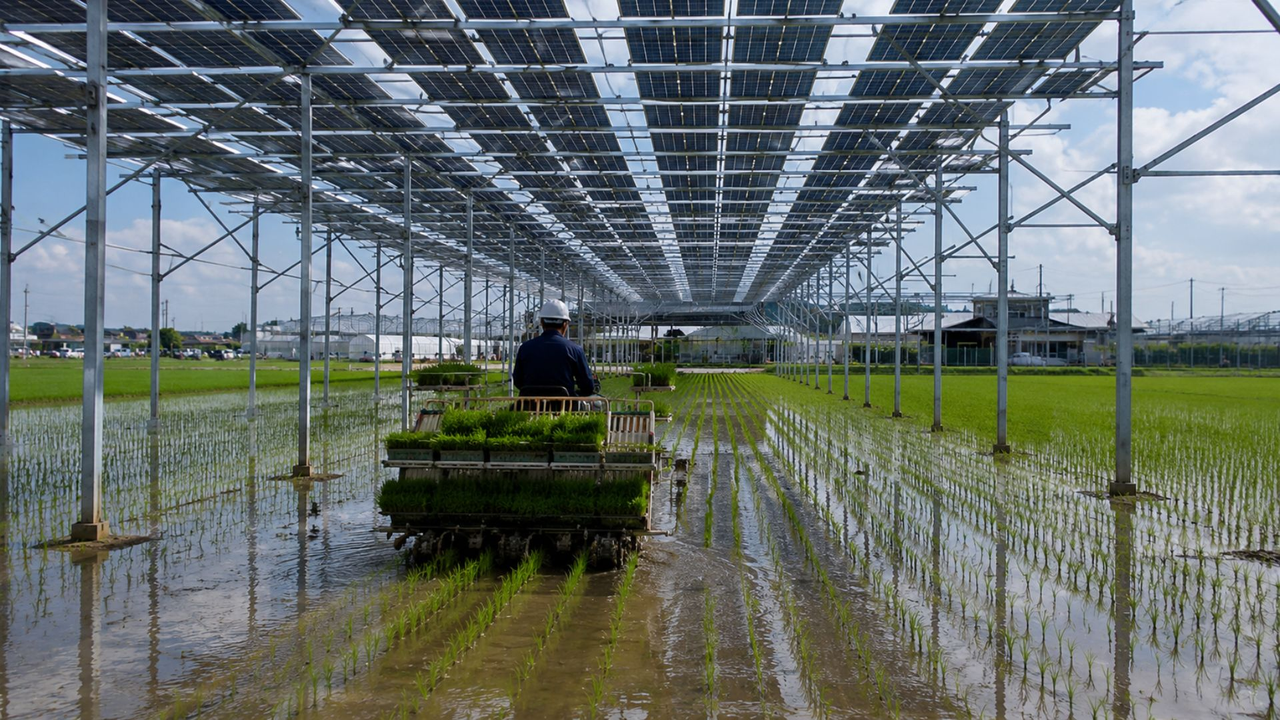
Chiba University, in collaboration with Sekisui Chemical Co., has inaugurated an innovative Agri-PV demonstration project utilizing perovskite solar cells, commencing on May 11, 2026. This pioneering project involves installing perovskite PV modules above active rice paddies on the university’s campus, aiming to achieve concurrent electricity generation and rice cultivation.
- Integrated System: Lightweight, transparent perovskite solar modules, developed by Sekisui Chemical, are strategically positioned above the rice fields. The generated electricity will directly power campus facilities.
- Comprehensive Assessment: The three-year experimental phase is designed for a thorough evaluation of several critical aspects:
- Agricultural Impact: Detailed monitoring of rice growth, yield, and quality to understand the effects of reduced direct sunlight.
- PV Performance & Durability: Assessment of the perovskite modules’ long-term reliability and stability under Japan’s diverse and often challenging climate conditions (high humidity, heat, typhoons).
- Environmental and Economic Viability: Quantitative analysis of the system’s economic feasibility and its contribution to greenhouse gas emission reduction.
Technical Significance & Outlook
This Agri-PV project leveraging perovskite technology is a crucial step towards integrating renewable energy with sustainable agriculture, particularly pertinent for land-scarce nations like Japan. Perovskite solar cells’ unique properties, such as their adaptability to light transparency and mechanical flexibility, make them superior to conventional silicon panels for Agri-PV where light spectrum management for crops is essential. The success of this demonstration could serve as a blueprint for wider adoption of solar sharing across Japan’s agricultural landscape, fostering both energy independence and food security. For Sekisui Chemical Co., a prominent Japanese chemical manufacturer, this initiative represents a strategic entry into the nascent perovskite solar market and an opportunity to validate their technology’s robustness in real-world scenarios. Globally, this project contributes valuable data and insights into the potential of Agri-PV to maximize land utility and drive the transition to a more sustainable energy and food system.





Comments