Background
Perovskite/silicon tandem solar cells are widely regarded as the most promising next-generation photovoltaic technology, capable of surpassing the theoretical Shockley-Queisser limit of single-junction silicon cells (around 29.4%). By layering a wide-bandgap perovskite cell on top of a narrow-bandgap silicon cell, the tandem device can more efficiently convert a broader range of the solar spectrum into electricity. However, a critical challenge lies in managing the interface between the two sub-cells, particularly given the often-textured surfaces of industrial silicon substrates. Defects at this interface lead to significant charge recombination losses, hindering both efficiency and long-term stability.
Key Findings / Results
A research team spearheaded by the Chinese Academy of Sciences Ningbo Institute of Materials Technology and Engineering has introduced a novel passivation strategy that has substantially improved the efficiency and operational stability of perovskite/silicon tandem solar cells. Their method addresses the complex interface challenges inherent in these devices.
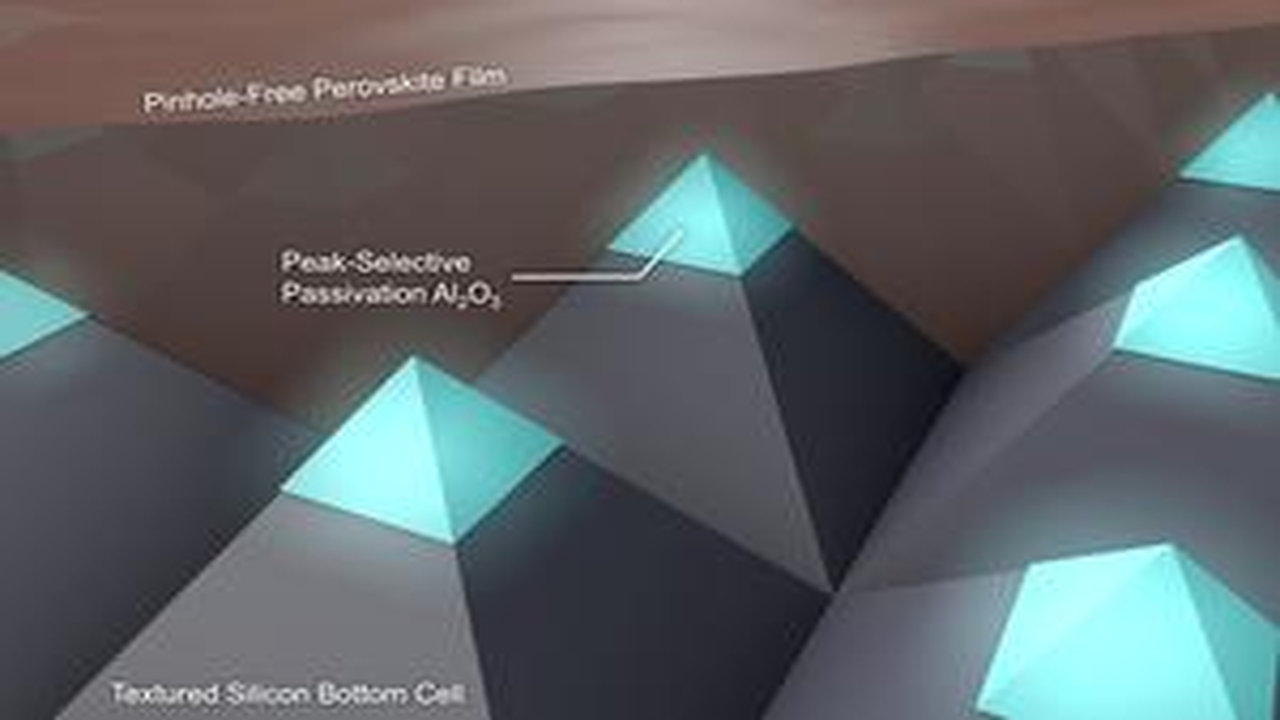
- Template-Assisted Passivation: The innovation involves using polystyrene nanospheres as a precise template on the pyramid-textured surface of industrial silicon substrates. This technique allows for the selective and uniform deposition of a passivation layer, even on non-planar surfaces.
- Localized Aluminum Oxide (Al₂O₃) Deposition: By leveraging the nanosphere template, a thin, insulating layer of aluminum oxide (Al₂O₃) was precisely deposited primarily on the peaks of the silicon pyramids. This selective deposition effectively passivates surface defects, significantly reducing charge recombination losses at the critical perovskite/silicon interface.
- Record-Breaking Efficiency: This sophisticated passivation approach enabled the tandem solar cell to achieve an outstanding power conversion efficiency of 33.33%, with a certified efficiency of 32.89%. This marks one of the highest efficiencies reported globally for perovskite/silicon tandem solar cells.
- Enhanced Operational Stability: Beyond efficiency, the devices demonstrated remarkable operational stability. They maintained approximately 90% of their initial efficiency after 1,000 hours of continuous operation, a crucial metric for practical applications and commercial viability.
Technical Significance & Outlook
This novel passivation strategy is a significant advancement for perovskite/silicon tandem technology, pushing the boundaries of solar cell efficiency well beyond the limits of single-junction devices. Achieving over 33% efficiency on an industrial silicon substrate signifies a major step towards scalable manufacturing and cost-effectiveness. The ability to precisely manage defects on textured surfaces is a critical technical achievement, as it addresses a fundamental challenge in heterojunction device integration. For a Western technical audience, this research from China highlights the country’s growing prowess in advanced PV material science and device engineering, positioning it as a key player in the next generation of solar energy. Future research will focus on further increasing the active area of these high-efficiency cells, reducing manufacturing costs, and conducting long-term outdoor reliability tests to meet international standards (e.g., IEC 61215) for widespread deployment.






Comments