

Key Findings
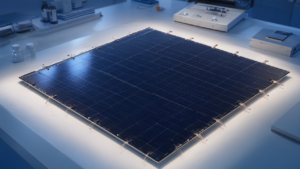
A simulation study published in Frontiers of Optoelectronics demonstrates that replacing flat interfaces with periodic, sawtooth-like serrated microstructures can push the power conversion efficiency of all-perovskite tandem solar cells to approximately 31.13%. This represents a 3.41% increase over the flat baseline. The dual serrated design reduces the photocurrent lost to reflection from 4.47 to 3.65 milliamperes per square centimeter, marking an 18.34% reduction in reflection loss.
Technical Details
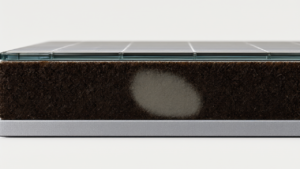
The researchers, led by Wenjiang Ye and Aoyue Chen of Huazhong University of Science and Technology, utilized COMSOL Multiphysics to model a device featuring a wide-bandgap perovskite (1.8 electronvolts, 400 nanometers thick) and a narrow-bandgap perovskite (1.25 electronvolts, 1200 nanometers thick). The optimization occurred in two stages:
- Front Interface: A periodic serrated texture with a 1 micrometer period and 400 nanometer height was applied. This acted as microscopic lenses, boosting the electric field intensity at the front interface to 100 volts per meter (four times the flat structure) and reducing reflection-loss current density to 3.77 milliamperes per square centimeter.
- Back Electrode: Because front textures alone left reflection peaks near 950 nanometers, the team added a similar serrated structure to the back electrode, which can be realized via nanoimprinting the perovskite layer before depositing the metal cathode.
Background & Context
All-perovskite tandem cells stack a wide-bandgap top cell for high-energy photons and a narrow-bandgap bottom cell for redder and near-infrared light. While real devices have reached 30.1% efficiency, the theoretical maximum is near 45%. The gap is primarily due to optical losses; previous analysis indicates optical losses account for roughly 31.15% of total energy loss, with reflection alone contributing up to 19.64%.
Significance & Outlook
By mitigating refractive index mismatch at the interfaces, the serrated design optimizes the balance of photocurrents between the two subcells. This approach targets the specific wavelengths—including 350, 550, 750, and 950 nanometers—where flat devices typically exhibit reflection peaks exceeding 20%.
Get our weekly technology intelligence — free
Receive an infographic that lets you judge at a glance whether each field’s analysis report is worth reading.
Subscribe Free — Weekly Tech Intelligence
By subscribing, you’ll receive Troy-Technical’s weekly technology intelligence newsletter.
- Your email and selected fields are used only to deliver the newsletter.
- We never share your information with third parties.
- You can unsubscribe anytime via the link in each email.
See our Privacy Policy for details.
Takes about a minute · Unsubscribe anytime