Background: Optical Design Challenges for Extremely Large Telescopes
Modern astronomy necessitates telescopes with increasingly larger apertures to observe fainter and more distant cosmic phenomena. However, realizing massive apertures with a single monolithic mirror presents formidable challenges related to manufacturing costs, transportation logistics, as well as thermal expansion and gravitational deformation. Consequently, ‘segmented mirror’ technology, which combines numerous smaller mirror segments to form a single large primary mirror, has emerged as a viable solution. The success of this approach fundamentally relies on positioning and controlling each segment with nanometer precision, demanding highly advanced optical systems and functional materials.
Groundbreaking Optical System for the M1 Primary Mirror
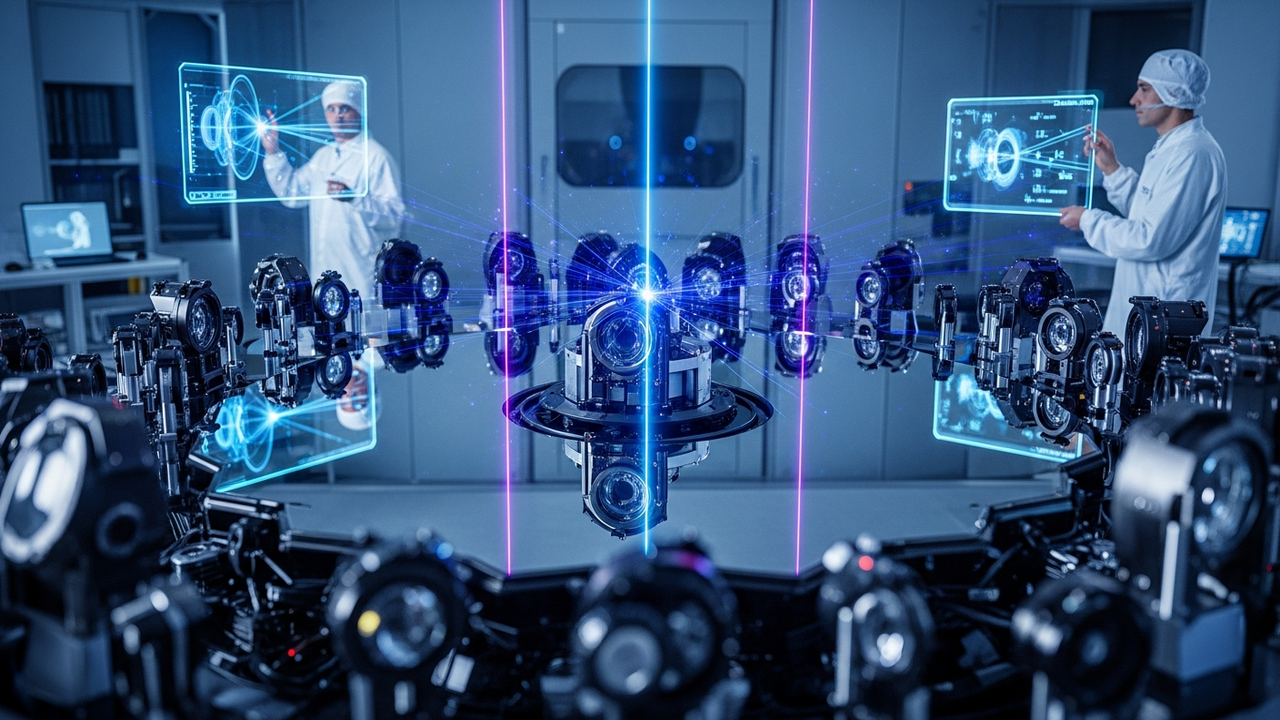
For one of the world’s largest telescopes, a groundbreaking optical system has been constructed for its ‘M1 Primary Mirror,’ as reported by Spain’s Smart Factory Magazine. This primary mirror is composed of an impressive 798 hexagonal mirror segments, each approximately 1.5 meters in diameter. For these numerous segments to function cohesively as a single, colossal mirror, a system capable of real-time, precise adjustment of each segment is essential. The core of this system comprises the following technological elements:
- Approximately 2,500 Actuators: Multiple actuators are positioned behind each mirror segment. These actuators precisely fine-tune the tilt and position of the segments to optimize telescope performance. Their adjustment precision operates on the nanometer scale, equivalent to less than 1/10,000th of a human hair’s thickness.
- 9,000 Sensors: To monitor the relative positions between segments and minute deformations caused by temperature changes in real-time, 9,000 high-precision sensors are strategically installed. These sensors continuously collect data and provide feedback to the control system.
- High-Precision Control via Optical Interferometer: The collected sensor data is processed by advanced control algorithms that utilize an optical interferometer. This algorithm calculates the optimal position for each segment and sends precise commands to the actuators, ensuring the entire primary mirror consistently maintains its ideal optical shape. The Fraunhofer Institute is reported to have contributed significantly to this field, underscoring the indispensability of their advanced measurement and control technologies.
Technical Significance and Future Outlook
This optical system represents the culmination of state-of-the-art technologies essential for enabling extremely large telescopes, clearly demonstrating significant advancements in functional materials and precision control. Its technical significance and future outlook are outlined below:
- Leap Forward in Astronomical Research: With immense light-gathering power and exceptionally high resolution, this telescope will enable observations previously impossible. These include studying the formation of the early universe, resolving detailed structures of distant galaxies, and conducting atmospheric analyses of exoplanets, thereby revolutionizing astronomy.
- Versatility of Optical Technology: The nanometer-precision positioning and control technologies developed for this system are applicable not only to astronomical telescopes but also to a range of other precise optical instruments. These applications span Earth observation satellites, high-precision laser systems, and semiconductor manufacturing equipment (lithography).
- Advancement in Smart Structural Materials: This system, where individual segments autonomously cooperate to achieve optimal overall performance, can be considered the ultimate realization of ‘smart structures.’ It is expected to accelerate the development of functional materials capable of actively adjusting their shape and properties in response to changes in the external environment.
- Symbol of International Collaboration: Such large-scale projects also serve as potent symbols of international cooperation, where multiple countries, research institutions, and companies collaborate to push technological boundaries. They demonstrate that breakthroughs unattainable through individual efforts can emerge from the fusion of diverse expertise.
This telescope is poised to open a new window for humanity’s understanding of the cosmos and will serve as a critical milestone in continuously pushing the limits of science and technology.









Comments