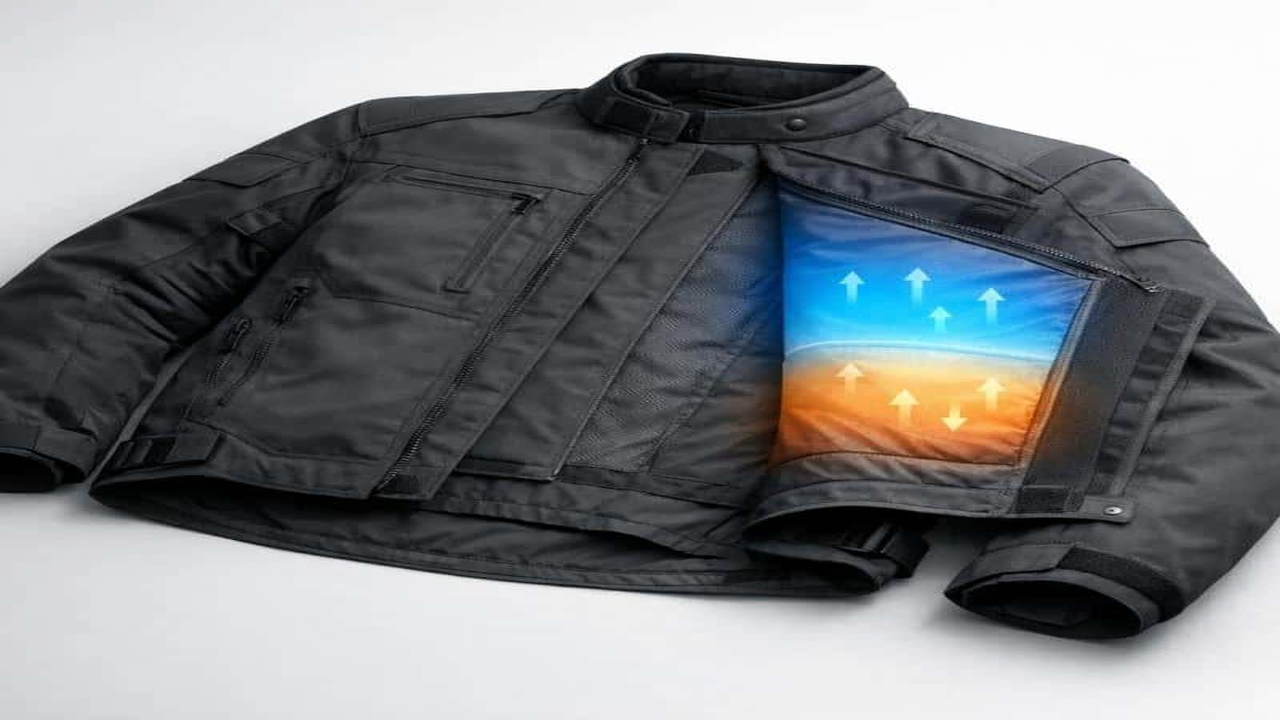
Background: Thermal Comfort Challenges for Motorcycle Riders
Motorcycle riders face significant thermoregulation challenges due to varying weather conditions encountered during rides. Especially during hot daytime conditions or strenuous long-distance journeys, heat can build up inside jackets, leading to discomfort, increased fatigue, and reduced concentration. Conversely, cold conditions pose a risk of heat loss. While traditional motorcycle jackets have addressed these issues with breathable materials or insulation, their ability to actively regulate body temperature without external power has been limited. More advanced thermal management solutions were thus needed to enhance rider performance and safety.
Overview of PCM-Based Thermal Management Solution
To address this challenge, SmartEx Yarn has developed an innovative thermal management solution that integrates Phase Change Materials (PCMs) into the inner layer of motorcycle jackets. PCMs are materials that absorb or release a large amount of heat (latent heat) when undergoing a phase transition (solid to liquid, or vice versa) at a specific temperature. In this system, PCMs function as follows:
- Microencapsulated PCMs: Liquid PCMs are encapsulated in extremely small capsules, enabling their incorporation into synthetic fibers. This enhances material durability and eliminates the risk of PCM leakage.
- Thermal Buffering Effect: When a rider’s body temperature rises and the jacket interior becomes hot, the PCMs transition from a solid to a liquid phase, absorbing ambient heat. This moderates the temperature increase inside the jacket, providing a cooling sensation to the rider. Conversely, when the body temperature drops and it gets cold, PCMs release latent heat as they revert from liquid to solid, warming the rider.
- Passive System: This PCM-based system requires no external power supply. Heat is managed by the material’s inherent physical properties, eliminating the need for batteries or complex electronic circuits, thus maintaining the jacket’s lightweight and simple structure.
This solution allows for the maintenance of a comfortable temperature range for riders with minimal added bulk or weight. As a result, riders can concentrate on their ride in optimal thermal conditions, regardless of season or riding conditions.
Technical Significance and Future Outlook
The integration of PCMs into motorcycle jackets represents a significant advancement in wearable technology and smart textiles. The technical significance and future outlook are:
- Enhanced Comfort and Safety: Appropriate body temperature maintenance directly contributes to reducing rider fatigue, sustaining concentration, and consequently lowering accident risks. For professional racers and long-distance touring enthusiasts, this comfort significantly impacts performance.
- Versatile Applications: Beyond motorcycle jackets, applications are anticipated across a wide range of fields requiring thermoregulation, including sportswear, outdoor wear, workwear, and bedding. It also has potential contributions to patient temperature management in the medical field and enhancing comfort for soldiers in military applications.
- Energy Efficiency and Sustainability: Passive thermal management systems requiring no power are noteworthy as energy-saving and environmentally friendly solutions. The recyclability of PCMs themselves is also a consideration, promising contributions to the circular economy.
- Fusion of Materials Science and Textile Engineering: The technology of incorporating microencapsulated PCMs into fibers symbolizes a sophisticated fusion of materials science and textile engineering. Future developments are expected to lead to new smart textiles through even higher-performance PCMs and combinations with different functional materials.
This technology hints at a future where clothing is not merely protective gear or adornment, but a ‘functional interface’ that actively manages heat between the body and the environment, thereby extending human capabilities.





Comments