
Background
The manufacturing of modern processors is an exceptionally complex endeavor, relying on highly sophisticated equipment and intricate processes to fabricate nanoscale semiconductor devices. Historically, Moore’s Law has driven continuous miniaturization, but the industry now faces fundamental physical limits and escalating manufacturing costs. Extreme Ultraviolet (EUV) lithography has become a cornerstone technology for leading-edge processor nodes, enabling the patterning of features at resolutions down to a few nanometers. However, the immense capital investment and operational complexity of EUV systems have intensified the search for complementary or alternative nanofabrication techniques.
Key Findings / Results
Processor manufacturing machines are specialized industrial tools designed to perform precise physical and chemical operations at the nanoscale. While EUV lithography systems are currently the most critical machines for advanced processor fabrication, the industry is actively exploring next-generation patterning technologies to push performance boundaries further. Among these, Nanoimprint Lithography (NIL) and Directed Self-Assembly (DSA) are considered pivotal:
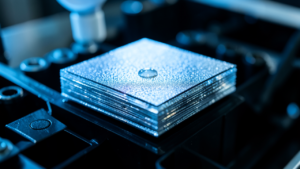
- Nanoimprint Lithography (NIL): NIL is a mechanical patterning technique where a rigid mold (stamp) directly presses into a resist layer to transfer a pattern. This process bypasses optical diffraction limits, theoretically offering ultra-high resolution (sub-10 nm) at potentially lower costs than photon-based lithography. While still primarily in the research and development phase, challenges such as high-precision alignment, defect control, and mold durability are being actively addressed to bring NIL to high-volume manufacturing.
- Directed Self-Assembly (DSA): DSA harnesses the ability of block copolymers to spontaneously self-organize into highly ordered nanoscale patterns when guided by sparse pre-existing templates. This approach promises to simplify lithography steps and achieve high-density patterns cost-effectively. Similar to NIL, DSA is also in the R&D stage, but its innovative method is garnering significant attention as a future microfabrication technology.
- Impact on Processor Performance: These technologies are recognized as essential for pushing the physical limits of future chip performance, power efficiency, and artificial intelligence (AI) capabilities. Finer transistors enable faster switching speeds and lower power consumption, drastically enhancing the computational power of AI accelerators and general-purpose processors.
Technical Significance & Outlook
The technical significance of NIL and DSA, despite their current R&D status, is immense. If matured, these technologies could complement or even partially replace existing EUV lithography, leading to reductions in semiconductor manufacturing costs and enabling further miniaturization. This would allow for the deployment of higher-performance, more power-efficient processors across a wider range of applications. Specifically, nanoscale innovations are critical for emerging fields such as IoT devices, edge AI, and ultimately, quantum computing. However, successfully transitioning these technologies to production-ready status requires overcoming significant engineering challenges. These include developing defect-free molds for NIL, achieving sub-nanometer alignment accuracy, improving process yield, and seamlessly integrating these new steps into existing complex manufacturing lines. International research institutions and semiconductor manufacturers are actively collaborating to address these hurdles, anticipating that nanotechnology will play a key role in redefining the future of computing beyond the current silicon-centric paradigms.






Comments