Key Findings
A recent report by market intelligence firm TrendForce reveals that liquid cooling technology is rapidly becoming the new standard for high-end AI infrastructure. The report projects that by 2026, the penetration rate of liquid cooling in AI chips will reach 53%, further climbing to approximately 60% by 2027. This dramatic acceleration is primarily attributed to the escalating Thermal Design Power (TDP) of advanced AI chips from leading manufacturers such as NVIDIA, AMD, and Google, which now routinely exceed 1kW. Notably, Google is a significant driver of this industry trend, having already implemented liquid cooling systems in over 80% of its AI servers.
Technical / Clinical Details
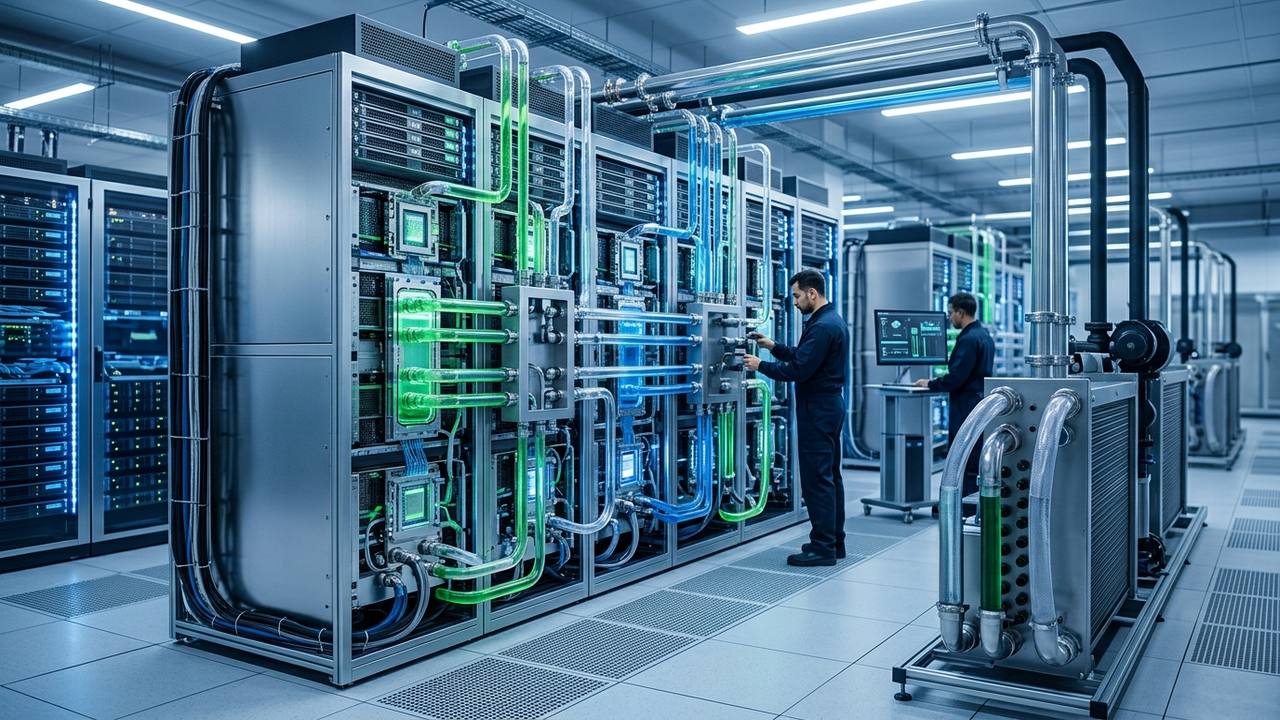
When AI chip TDPs surpass 1kW, traditional air-cooling systems become severely inefficient in dissipating the generated heat. Liquid cooling, utilizing highly conductive fluids (such as water or dielectric fluids) in direct contact with heat sources, is significantly more effective at absorbing and transferring heat than air. Primary liquid cooling methods include ‘direct-to-chip liquid cooling’ (cold plate technology), where coolant circulates directly over the chip, and ‘immersion cooling,’ where entire server racks are submerged in dielectric fluid. Cold plate systems are widely adopted, particularly in high-density GPU clusters, with hyperscalers like Google actively deploying them. This enables a substantial increase in power density per server rack, optimizing data center footprint while drastically enhancing computational capacity. Furthermore, liquid cooling contributes to improved data center Power Usage Effectiveness (PUE) by reducing operational energy consumption compared to air-cooling.
Background & Context
The explosive growth of AI workloads has presented unprecedented challenges for data center power consumption and thermal management. As AI models grow more complex and larger in scale, the performance of AI chips continues to advance, leading to a relentless increase in heat generation. Traditional data center designs primarily relied on air cooling, which imposed limitations on rack power density. However, with the exponential rise in demand for AI servers, data center operators are compelled to fundamentally rethink existing infrastructures and seek new cooling solutions capable of supporting high-density AI computing. The widespread adoption of liquid cooling by industry leaders like Google signifies that this technology is no longer a niche solution but is becoming mainstream for AI infrastructure.
Strategic Significance & Outlook
As predicted by TrendForce, liquid cooling technology will become an indispensable component of AI infrastructure, and its market size is expected to continue expanding. Future technological development will focus on further enhancing the efficiency, reliability, and ease of deployment of liquid cooling systems. This will make liquid cooling more accessible to a broader range of enterprises, potentially further accelerating the adoption of AI technologies. Data center operators are tasked with strategically implementing liquid cooling solutions to meet the demands of AI workloads while simultaneously achieving energy efficiency and sustainability goals. This presents substantial investment and innovation opportunities across the entire data center industry, forming the bedrock for next-generation AI technologies.
Get our weekly technology intelligence — free
Receive an infographic that lets you judge at a glance whether each field’s analysis report is worth reading.
Subscribe Free — Weekly Tech Intelligence
By subscribing, you’ll receive Troy-Technical’s weekly technology intelligence newsletter.
- Your email and selected fields are used only to deliver the newsletter.
- We never share your information with third parties.
- You can unsubscribe anytime via the link in each email.
See our Privacy Policy for details.
Takes about a minute · Unsubscribe anytime