Key Findings
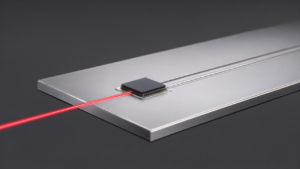
A significant breakthrough has been achieved in integrated photonics with the demonstration of a compact lumped-electrode Michelson interferometer modulator (MIM) on a thin-film lithium niobate (TFLN) platform. This innovative MIM has set a new record for efficiency, achieving an ultralow half-wave voltage-length product (VπL) of just 0.48 V·cm. Despite its remarkably compact footprint of 1.3 mm × 0.36 mm, the device exhibits an impressive 3-dB bandwidth of 25.0 GHz and a high extinction ratio of 28.2 dB, making it a compelling solution for next-generation optical communication systems.
Technical / Clinical Details
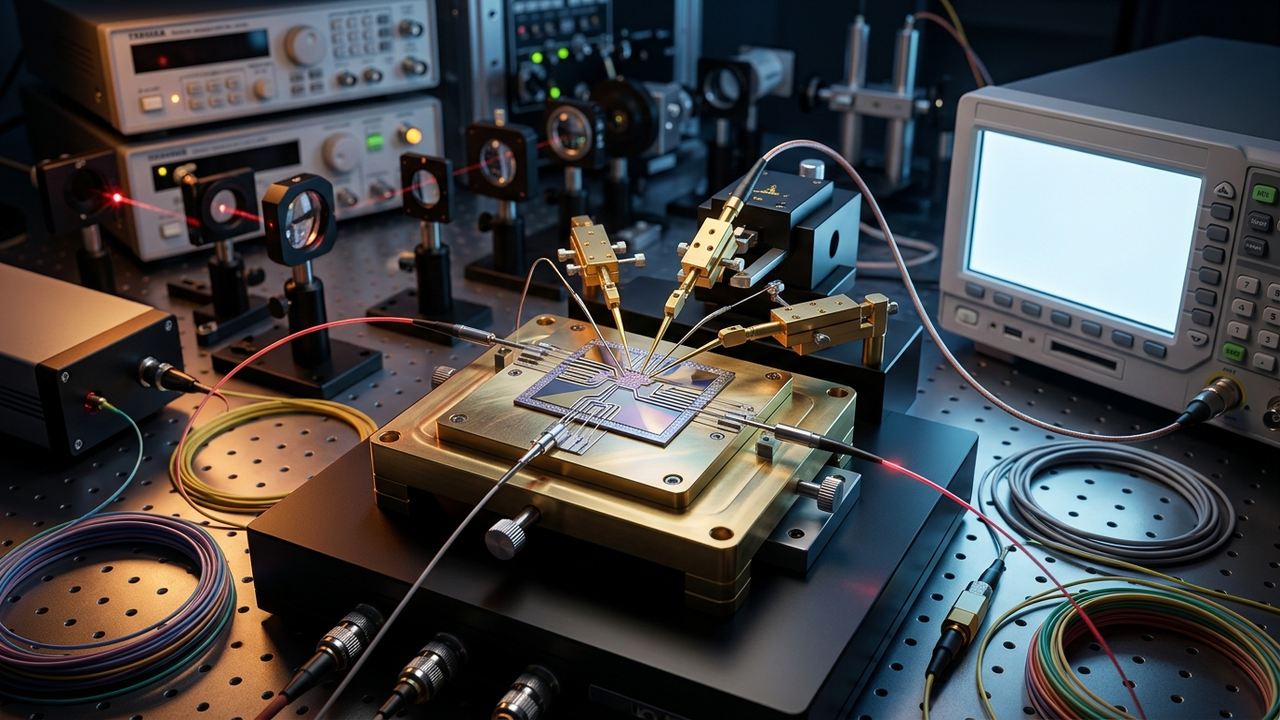
The TFLN MIM leverages the exceptional electro-optic properties of lithium niobate, which are significantly enhanced in a thin-film geometry, allowing for strong optical confinement and efficient modulation at low voltages. The record-low VπL indicates that the modulator requires minimal power to achieve a full π phase shift, directly translating to lower power consumption in optical transceivers. The broad 25.0 GHz bandwidth ensures compatibility with high-speed data formats, while the high 28.2 dB extinction ratio guarantees clean, high-fidelity signal transmission. Critically, this device successfully demonstrated the generation of 4-level pulse amplitude modulation (PAM-4) signals at an impressive 120 Gbit/s, showcasing its capability to meet the stringent demands of high-density, power-efficient optical interconnects in the rapidly evolving AI era. TFLN’s large electro-optic coefficient, low propagation loss, and wide transparency window position it as a promising integrated photonics platform for high-speed, low-power electro-optic tuning systems on chip.
Background & Context
The exponential growth of data traffic driven by AI and high-performance computing (HPC) necessitates optical interconnects with ever-increasing bandwidth and energy efficiency. Traditional silicon-based modulators, while benefiting from CMOS compatibility and miniaturization, often suffer from relatively weak electro-optic effects, leading to higher VπL and limitations in high-speed, broadband performance. Thin-film lithium niobate has emerged as a disruptive technology that combines the benefits of integration with superior electro-optic performance, overcoming many of the limitations of conventional platforms. This research marks a critical step towards realizing the next generation of optical transceivers, particularly for 1.6T and 3.2T data rates, which are essential for future data center architectures.
Strategic Significance & Outlook
The achievement of a record-low VπL and high-speed data transmission with this TFLN MIM represents a major advancement for high-density and power-efficient optical interconnects in the AI age. Such high-performance modulators have the potential to revolutionize various applications, including intra-data center communications, long-haul coherent optical networks, and even future quantum communication systems. This research accelerates the transition of TFLN technology from academic laboratories to commercial deployment, positioning it as an indispensable component in shaping the future of optical communications. Further R&D efforts are expected to lead to even more compact and highly integrated TFLN photonic circuits, further extending their impact across the information technology landscape.
Source: https://www.researching.cn/Articles/OJ4c5992283055abd9
Get our weekly technology intelligence — free
Receive an infographic that lets you judge at a glance whether each field’s analysis report is worth reading.
Subscribe Free — Weekly Tech Intelligence
By subscribing, you’ll receive Troy-Technical’s weekly technology intelligence newsletter.
- Your email and selected fields are used only to deliver the newsletter.
- We never share your information with third parties.
- You can unsubscribe anytime via the link in each email.
See our Privacy Policy for details.
Takes about a minute · Unsubscribe anytime