Key Findings
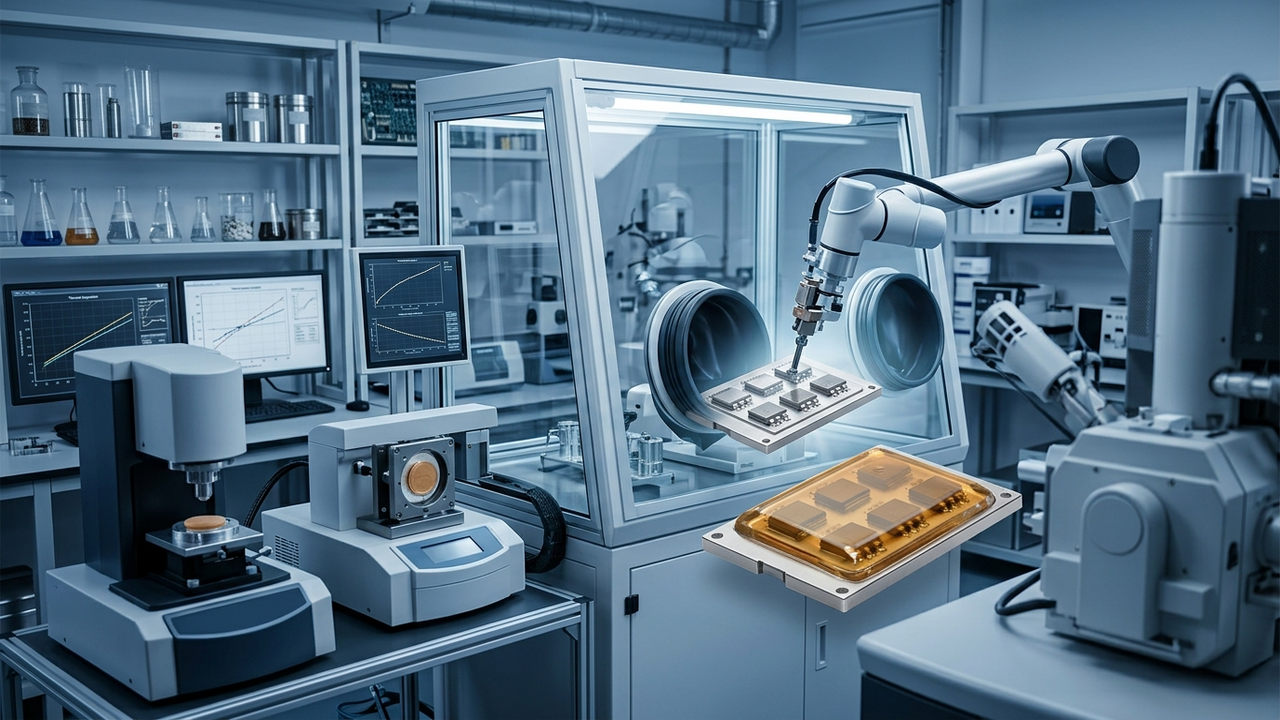
A novel epoxy composite material, utilizing bisphenol-A (BPA) modified silica (SiO2) as a filler, has been developed to meet the stringent requirements of next-generation power device packaging. This material achieves an exceptionally high glass transition temperature (Tg) of 205.6°C and an ultralow coefficient of thermal expansion (CTE) of 25.81 × 10⁻⁶/°C, while also demonstrating superior thermal shock resistance. This breakthrough offers a practical and highly reliable encapsulation strategy for power electronics, poised to significantly enhance device longevity and performance.
Technical / Clinical Details
The success of this high-performance epoxy composite lies in a synergistic material design strategy, which precisely blends di- and trifunctional epoxy resins with BPA-modified SiO2 fillers. The BPA modification significantly improves the interfacial adhesion between the SiO2 and the epoxy matrix, mitigating thermal expansion anisotropy. The difunctional epoxy provides excellent flow characteristics and processability, while the trifunctional epoxy increases crosslinking density, contributing to the high Tg and mechanical strength. This combination enables the simultaneous achievement of high Tg, low CTE, and thermal shock stability—properties difficult to realize with conventional materials. The reported Tg of 205.6°C and CTE of 25.81 × 10⁻⁶/°C are highly advantageous for the operational temperature range and reliability assurance of power devices.
Background & Context
Modern power electronics, found in electric vehicles, renewable energy systems, and industrial power converters, demand ever-higher power density, efficiency, and reliability. Consequently, power devices operate at elevated temperatures and are subjected to increased thermal cycling and shock. Encapsulation materials in device packaging are critical for protecting semiconductor chips and maintaining performance under these harsh conditions, necessitating low thermal expansion, high heat resistance, and excellent thermal shock durability. Traditional encapsulants have struggled to meet all these requirements, leading to reliability issues and shortened product lifespans.
Strategic Significance & Outlook
The development of this BPA-modified SiO2/epoxy composite represents a major advancement in power device packaging technology. It will enable the full performance and reliability potential of next-generation SiC (silicon carbide) and GaN (gallium nitride) power semiconductor devices. In the future, this technology is expected to contribute to the realization of smaller, more powerful, and longer-lasting power modules, accelerating innovation across various sectors, including extending electric vehicle range, improving renewable energy system efficiency, and enhancing industrial equipment durability. Furthermore, this material design strategy has potential applications in the development of other high-performance electronic packaging materials.
Get our weekly technology intelligence — free
Receive an infographic that lets you judge at a glance whether each field’s analysis report is worth reading.
Subscribe Free — Weekly Tech Intelligence
By subscribing, you’ll receive Troy-Technical’s weekly technology intelligence newsletter.
- Your email and selected fields are used only to deliver the newsletter.
- We never share your information with third parties.
- You can unsubscribe anytime via the link in each email.
See our Privacy Policy for details.
Takes about a minute · Unsubscribe anytime