Background and Warpage Challenges in High-Performance Electronics
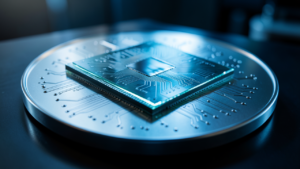
Modern electronic devices such as AI processors, High-Performance Computing (HPC) chips, smartphones, and tablets are becoming smaller, more integrated, and multifunctional. Correspondingly, semiconductor packaging technology has evolved towards 2.5D/3D stacking, chiplet integration, and heterogeneous material integration. However, different materials within a package (silicon die, interposer, substrate, mold compound, etc.) possess varying coefficients of thermal expansion (CTE). This difference leads to dimensional changes known as “warpage” during thermal cycles in manufacturing processes and temperature fluctuations during operation. Warpage is a primary cause of assembly defects, interconnect breakage, reduced device reliability, and performance degradation, making its suppression an urgent challenge.
Leading Companies’ Low-Warpage Solutions
Samsung and Intel are employing advanced technologies and approaches to address the warpage challenge in electronics packaging:
- Samsung’s I-Cube Technology: Samsung utilizes its proprietary “I-Cube” technology and advanced substrate engineering capabilities to provide low-warpage packaging solutions. I-Cube integrates multiple dies and HBM (High Bandwidth Memory) onto a single interposer, employing package stack designs optimized to match thermal expansion characteristics. This minimizes overall package CTE mismatch and effectively suppresses warpage during thermal cycling.
- Intel’s EMIB and Foveros 3D Technologies: Intel focuses on “EMIB (Embedded Multi-die Interconnect Bridge)” and “Foveros 3D Packaging” technologies to achieve low warpage. EMIB connects dies fabricated with different process nodes using high-performance bridges, mitigating warpage associated with larger interposers. Foveros is a technology for stacking chips in 3D, which necessitates advanced thermal interface materials (TIMs) and optimized package substrate designs. This minimizes warpage caused by thermal stress during assembly and operation.
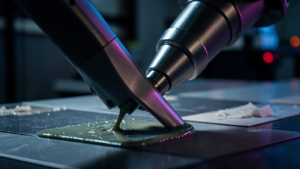
- Common Approach: Nanofiller-Reinforced Molding Compounds: Both companies commonly use advanced molding compounds with nanofillers to further reduce CTE mismatch. Nanofillers precisely tune the thermomechanical properties of mold compounds, managing overall package stress and warpage effectively through lower CTEs and optimized elastic moduli.
Technical Significance and Future Outlook
These low-warpage solutions driven by Samsung and Intel are indispensable for realizing next-generation high-performance semiconductor devices. Warpage suppression technology enables high-density integration and heterogeneous integration, contributing to improved product yield, enhanced reliability, and maximized performance. In the future, as packaging in finer process nodes, accommodation of ultra-high thermal density devices, and integration of even more diverse materials progress, warpage management technology will become increasingly complex and sophisticated. Innovative approaches such as AI-driven simulations, in-line monitoring, and the introduction of self-healing materials are anticipated. These technologies will form the foundation for the sustained growth of the electronics industry.
Source: https://eureka.patsnap.com/report-low-warpage-solutions-for-electronics-packaging-components





Comments