Background: Data Supply Challenges in AI-Driven Materials Science
Artificial intelligence (AI) is anticipated as a powerful tool to accelerate the process of discovering new materials in materials science. Particularly, the concept of “Self-Driving Labs,” where AI autonomously plans, executes, and learns from experiments, holds the potential to significantly transform the research and development paradigm. However, for these AI systems to function effectively and explore unknown territories, vast and high-quality datasets are indispensable. In traditional laboratory-scale experiments, generating the volume of data required to efficiently train AI has been a bottleneck, hindering rapid and comprehensive data acquisition. A new approach was needed to cover the vast design space of material compositions, structures, and properties.
Key Findings: High-Throughput Data Generation with Megalibraries
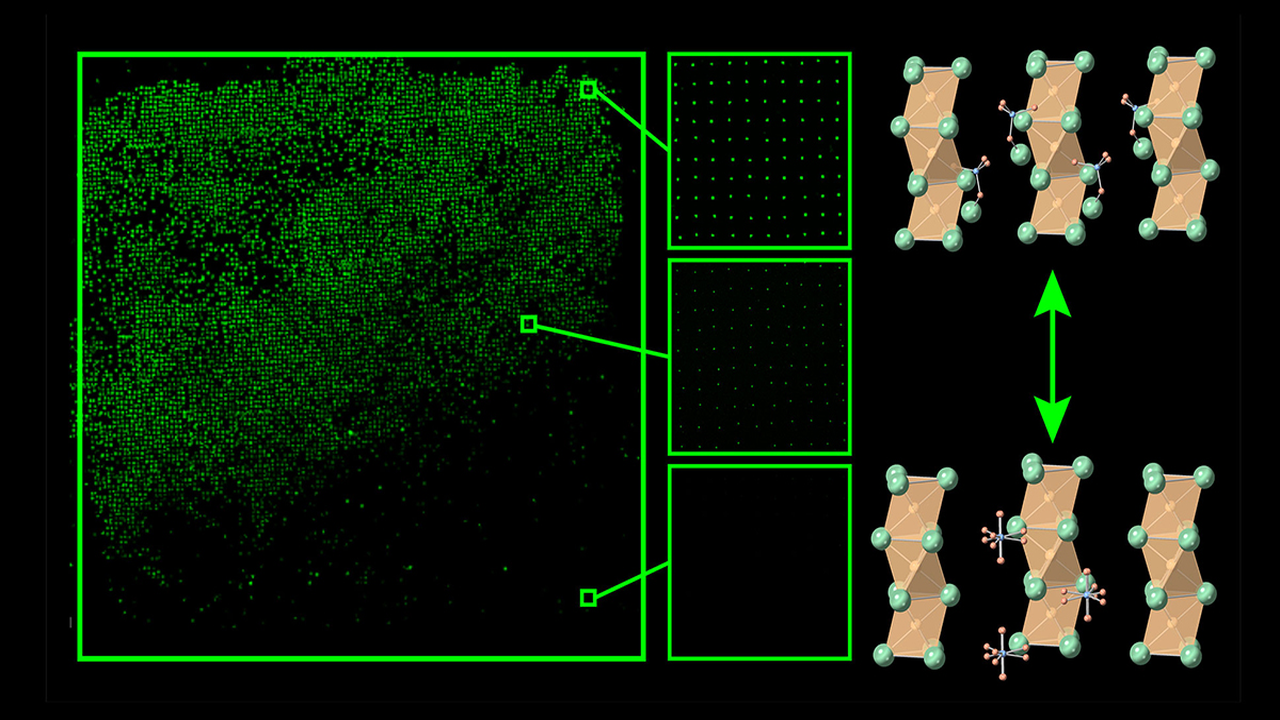
Addressing this data supply challenge, a research team led by Professor Chad Mirkin at Northwestern University demonstrated that a high-throughput materials platform known as “Megalibraries” offers a compelling solution. Megalibrary technology enables the simultaneous synthesis and evaluation of millions of different material compositions and structural candidates on a single, small chip. This capability allows for exhaustive exploration of the material compositional space at a scale physically impossible with conventional experimental methods, efficiently generating data on the properties of each material candidate. These extensive datasets serve as an ideal information source for training machine learning models within AI systems. The research team clarified that the high-quality data generated by megalibraries provides the foundation for AI to learn complex physicochemical laws of materials and autonomously predict and design new materials with desired properties. This suggests that megalibraries, as a data generation strategy, can complement and sometimes surpass the capabilities of self-driving labs in maximizing AI’s potential.
Technical Significance and Outlook
The integration of megalibrary technology with AI promises to dramatically enhance the speed and efficiency of discovery in materials science. High-throughput data generation capabilities provide crucial input for AI to build more robust and versatile material design models. This will accelerate the development of new materials in various fields, including high-performance alloys, efficient catalysts, next-generation electronic materials, and innovative pharmaceuticals. Particularly in the exploration of complex multi-component materials that were previously difficult to discover, or materials with unexpected functionalities, the combination of AI and megalibraries will be a powerful tool. This approach establishes a new research paradigm where materials scientists integrate physical experimentation, computational science, and AI insights to design materials more rapidly and rationally, contributing to shorter product development cycles in industry. In the future, further advancements in the synergy between megalibraries and autonomous AI systems could realize true “autonomous discovery,” designing, synthesizing, and evaluating entirely new materials without human intervention.








Comments