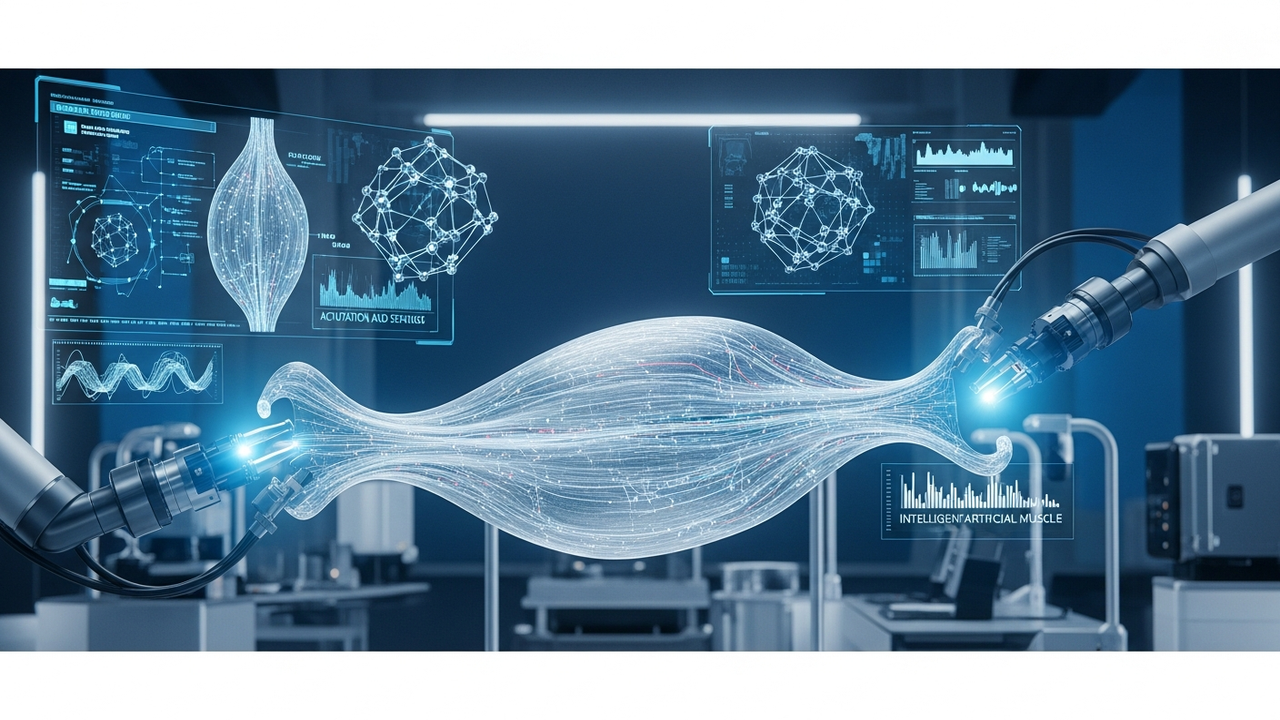
Background: The Challenge of Integrating Actuation and Sensing in Soft Robotics
Soft robots, owing to their flexibility and adaptability to environments, hold significant promise for diverse applications, including safe human interaction and delicate object manipulation. However, conventional actuators (moving parts) and sensors have typically been designed and integrated as separate components. This approach often increases system complexity, weight, and volume, while also limiting response speed and flexibility. To achieve the kind of natural, integrated movement and sensing characteristic of human muscles, fundamental innovation at the material level was required.
Key Findings: Integrated Artificial Muscle via LCEs and Liquid Metal Channels
A research team at Seoul National University has developed a groundbreaking “intelligent artificial muscle” that addresses this long-standing challenge. This system ingeniously combines “Liquid Crystal Elastomers (LCEs),” smart materials that deform significantly in response to thermal or electrical stimuli, with “liquid metals,” known for their high electrical conductivity. The researchers adopted a unique approach of integrating fine liquid metal channels within the LCE material. With this structure, when an electrical stimulus is applied to the artificial muscle, the LCE contracts, and simultaneously, the shape of the liquid metal channels changes. This change in shape, in turn, alters the electrical resistance in real-time. By measuring this change in electrical resistance, the system can precisely sense how much the artificial muscle has contracted or how much force is being exerted. In essence, both actuation and sensing functions are achieved simultaneously and seamlessly within a single material system.
Technical Significance and Outlook
The integration of actuation and sensing represents a paradigm shift in soft robotics engineering. This intelligent artificial muscle provides a foundation for robots to interact more intuitively with their environment. For example, in humanoid robots mimicking the human skeleton and muscles, it can enable more natural and smooth movements along with delicate haptic feedback. In rehabilitation devices, it allows for optimal assistive force provision while monitoring patient movement and muscle strength in real-time. Furthermore, soft robotic grippers can achieve more precise force adjustments to handle delicate objects like fruits without damage. This technology eliminates the need for complex and costly external sensors, simplifying soft robot design and contributing to lightweighting and reduced power consumption. In the future, this integrated artificial muscle is expected to be applied across a wide range of fields, including wearable devices, medical diagnostics, and exploration robots, becoming an indispensable component for next-generation human augmentation technologies and autonomous systems.








Comments