Background: Complexity and the Need for Automation in Quantum Material Development
Quantum materials, exemplified by graphene and other atomically thin two-dimensional (2D) materials, hold promise for transformative applications in next-generation electronics, photonics, and quantum computing. However, the processes of exploring, synthesizing, characterizing, and fabricating devices from these materials are incredibly complex, demanding significant time and specialized expertise. Particularly, the fabrication of nanodevices requiring atomic-level precision often relies heavily on skilled human labor, thereby limiting the pace of research and development. Against this backdrop, automating and intelligentizing research processes has become an urgent imperative for accelerating discovery in the field of quantum materials.
Key Findings: Autonomous AI Experimenter “Qumus” Fabricates Graphene Transistors
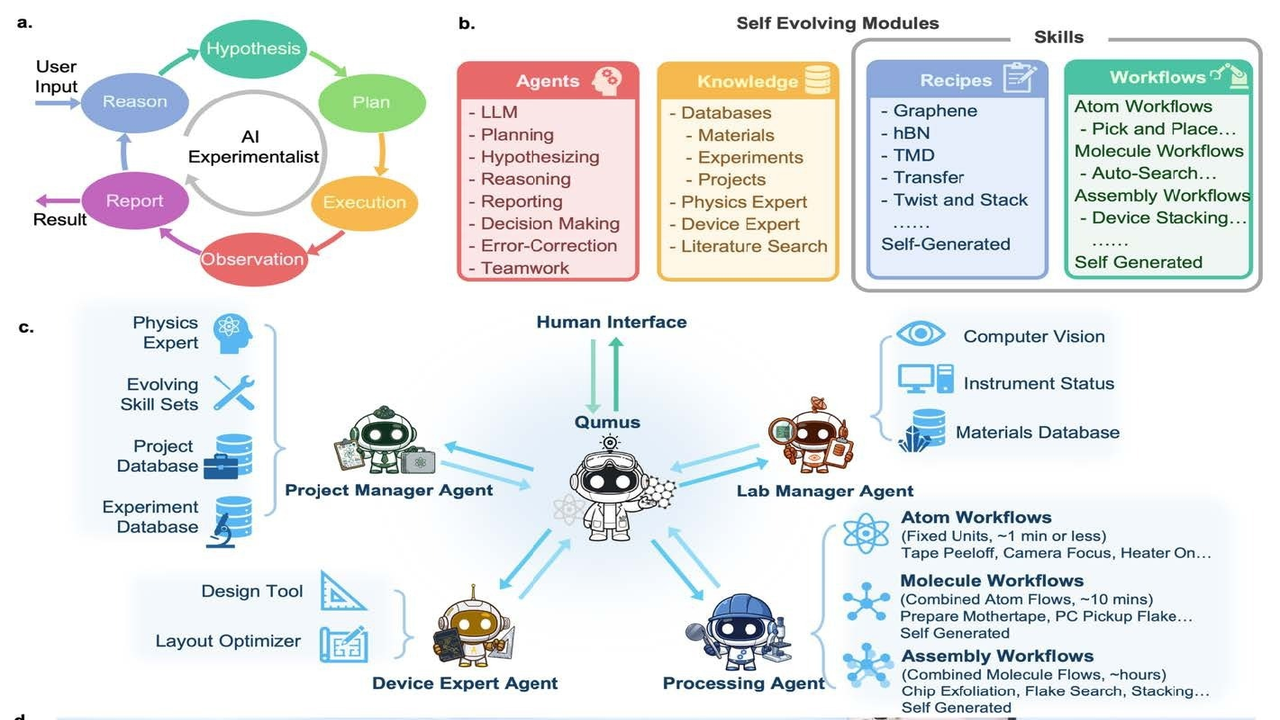
To address these challenges, researchers at Stanford University have developed and introduced “Qumus,” an autonomous AI experimenter, into quantum materials laboratories. Qumus is a system integrating generative AI with advanced robotics, capable of independently executing the entire scientific discovery cycle—from hypothesis generation, experimental planning, execution, data analysis, error correction, to generating new hypotheses—all without human intervention. Its most groundbreaking achievement is the first AI-driven fabrication of complex atomically thin nanodevices, including graphene field-effect transistors. This demonstrates that AI can function not merely as an analytical tool but as an autonomous “scientist” that physically operates in an experimental environment and produces results. Qumus has established a self-improving framework that refines its experimental strategies through trial and error, accelerating the discovery and optimization of quantum materials through efficient learning.
Technical Significance and Outlook
The introduction of Qumus holds the potential to fundamentally transform the research paradigm in quantum materials science. Its ability to autonomously conduct complex experiments and discover new materials and devices with minimal human intervention will dramatically increase the speed of research and development. This will accelerate the exploration of novel quantum materials such as graphene, topological insulators, and superconductors, contributing to the realization of high-performance sensors, energy-efficient devices, and future quantum computing systems. In the future, autonomous AI experimenters like Qumus are expected to be applied to fields beyond materials science (e.g., drug discovery and catalyst design), serving as a foundation to streamline the entire scientific discovery process. However, ethical considerations, the limits of AI’s “understanding,” and the optimization of human-AI collaboration will require continued careful consideration.









Comments