Key Findings
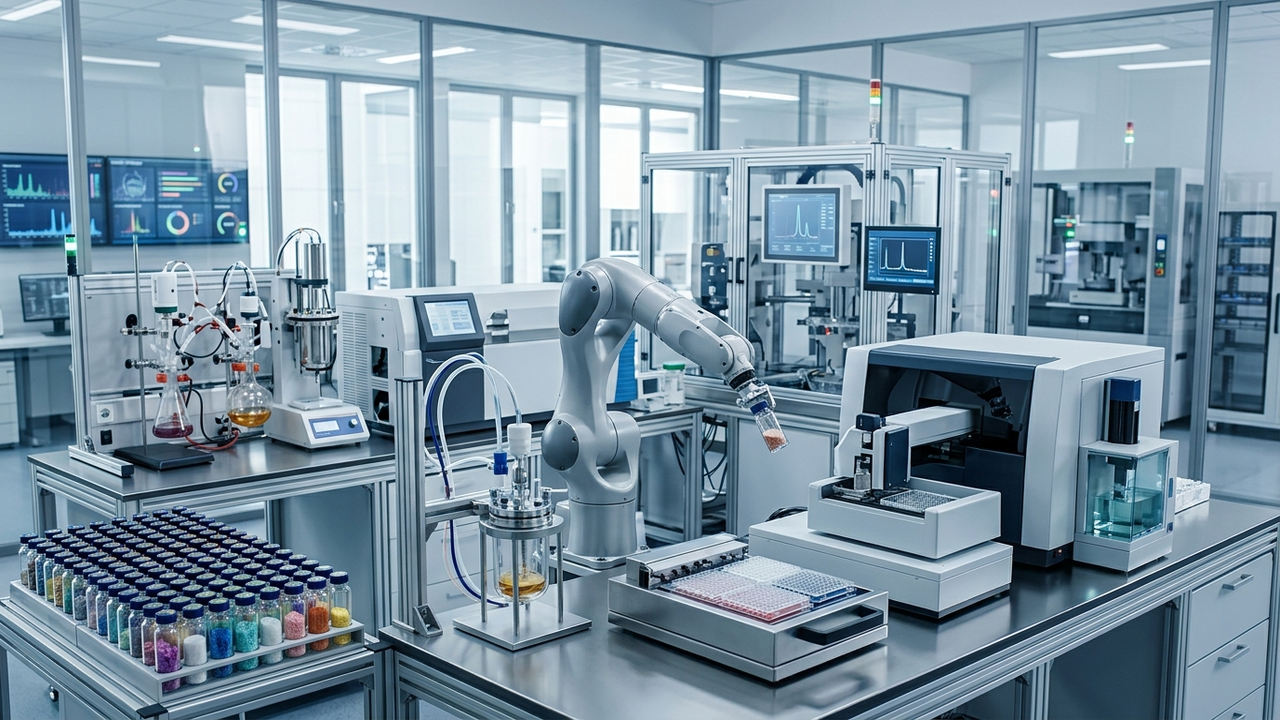
In the field of materials science, a novel paradigm known as Self-Driving Labs (SDLs) is automating the material discovery process itself, through the seamless integration of robotic experimentation and closed-loop artificial intelligence (AI) feedback. This transformative approach enables AI-driven robots to autonomously design, execute, analyze results, and determine subsequent experiments based on learned insights, all without continuous human intervention. This promises a dramatic acceleration in the speed of new material exploration and development, potentially reducing processes that traditionally took weeks down to just a few days.
Technical / Clinical Details
At the core of an SDL lies the sophisticated integration of robotics, advanced sensors, data analytics software, and machine learning algorithms. Initially, an AI model formulates hypotheses and designs experimental conditions to optimize specific material properties, leveraging initial datasets or theoretical predictions. Subsequently, physical hardware, such as robotic arms and automated liquid handlers, precisely execute these designed experiments. Upon completion, automated analytical instruments (e.g., spectrometers, X-ray diffractometers) characterize the synthesized materials in real-time, feeding this data back into the AI model. The AI then uses this new information to update its models and generate more refined hypotheses and experimental plans for the next round. This iterative, closed-loop process allows SDLs to explore vast material spaces far more rapidly and comprehensively than human researchers. For instance, Carnegie Mellon University’s Materials Innovation Cloud Lab (MICL) employs AI to autonomously optimize polymer synthesis conditions, efficiently discovering materials with targeted mechanical or electrical properties.
Background & Context
Traditional material discovery has been heavily reliant on scientists’ experience, intuition, and labor-intensive manual experimentation, often requiring immense time and effort. This method presented fundamental challenges due to the vastness of the exploration space and the complexity of interpreting experimental results, leading to very long development cycles for new materials. SDLs aim to resolve this ‘human bottleneck’ and elevate the discovery process to industrial-scale efficiency. Leading institutions such as the U.S. Department of Energy’s A-Lab at Lawrence Berkeley National Laboratory and the Acceleration Consortium at the University of Toronto are significant players in this domain. The technology is expected to find broad applications across various industries, including drug discovery, battery materials, catalysts, and high-performance composites. This direct correlation to reduced R&D costs and faster time-to-market contributes significantly to enhancing corporate competitiveness.
Strategic Significance & Outlook
SDLs are poised to extend their influence beyond materials science to other scientific domains, including chemistry, biology, and pharmaceuticals. In the future, these labs may collaborate globally via cloud platforms, fostering larger-scale joint research and data sharing. Furthermore, integration with generative AI could significantly enhance the AI’s ability to propose entirely novel material structures and then autonomously synthesize and evaluate them. This future holds the promise of unprecedented discoveries of breakthrough materials, realized at an exponential pace, opening up possibilities previously unimaginable by human researchers.
Source: https://www.architectmagazine.com/design/the-robots-are-inventing-materials-now/
Get our weekly technology intelligence — free
Receive an infographic that lets you judge at a glance whether each field’s analysis report is worth reading.
Subscribe Free — Weekly Tech Intelligence
By subscribing, you’ll receive Troy-Technical’s weekly technology intelligence newsletter.
- Your email and selected fields are used only to deliver the newsletter.
- We never share your information with third parties.
- You can unsubscribe anytime via the link in each email.
See our Privacy Policy for details.
Takes about a minute · Unsubscribe anytime








Comments