Key Findings
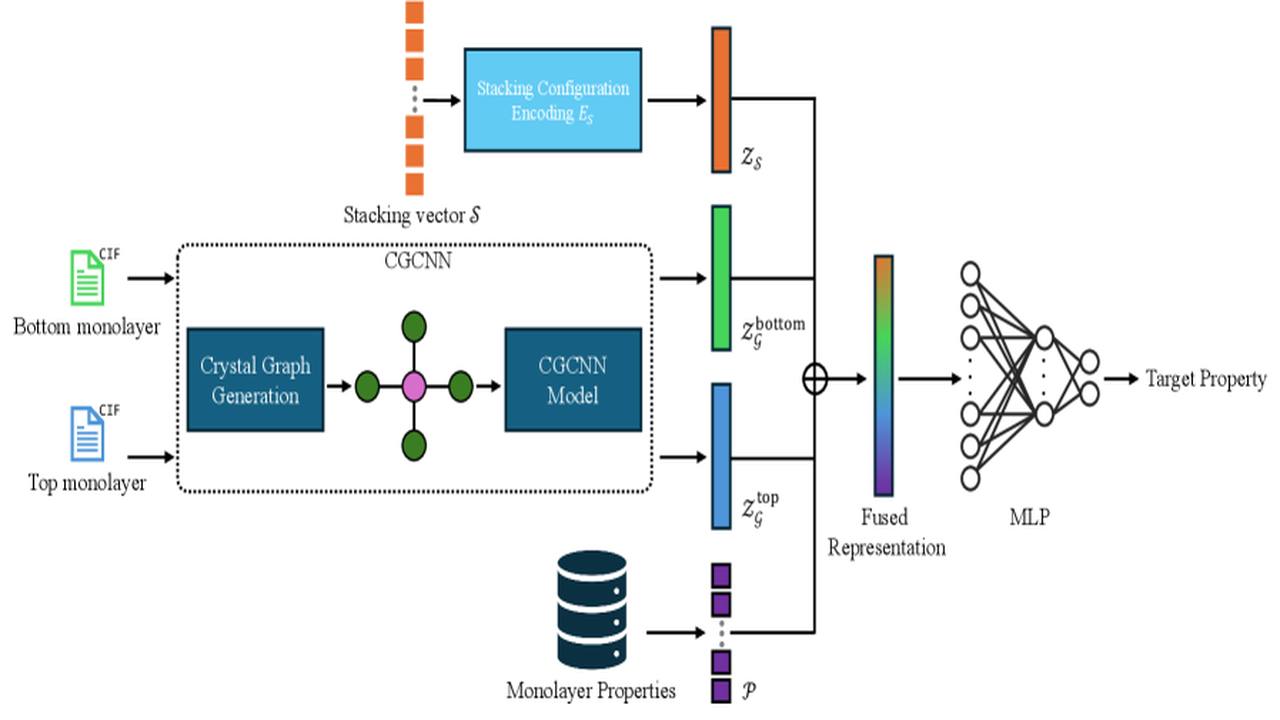
A recent research paper published on arXiv introduces “BiMat-ML,” an innovative multimodal learning approach designed for predicting the properties of stacked two-dimensional (2D) materials. This method significantly enhances predictive performance and computational efficiency by employing Graph Neural Networks (GNNs) for processing molecular and crystal data, thereby serving as a powerful alternative to computationally intensive Density Functional Theory (DFT). The BiMat-ML framework demonstrates its effectiveness and efficiency for both homostructural and heterostructural bilayer materials, proving broadly applicable across various GNN architectures and poised to considerably accelerate the design and discovery of next-generation 2D materials.
Technical / Clinical Details
- Multimodal Learning: BiMat-ML integrates multiple data modalities (e.g., atomic configurations, chemical bonds, electronic properties) to capture the complex characteristics of stacked 2D materials. This provides comprehensive insights that might not be obtainable from a single data source.
- Leveraging Graph Neural Networks (GNNs): GNNs represent the atomic structure of materials as a graph, efficiently propagating and aggregating information between nodes (atoms) and edges (bonds) to predict material properties. This enables detailed capture of local geometric features and electronic state interactions. The introduction of GNNs allows for significant reduction in computational cost compared to DFT while achieving comparable predictive accuracy.
- BiMat-ML Framework: The BiMat-ML framework developed in this study is specifically tailored for stacked 2D materials, predicting electronic properties such as band gaps, work functions, and charge transfer for both homostructural (e.g., MoS2/MoS2) and heterostructural (e.g., MoS2/WS2) bilayer configurations. The framework is highly flexible and can utilize different GNN models (e.g., GCN, GAT, DimeNet) as its backbone.
- Efficiency and Scalability: While DFT calculations can take hours to days even for small atomic systems, GNN-based BiMat-ML can provide predictions for tens of thousands of materials in a short time, making it an indispensable tool for large-scale material screening and inverse design.
Background & Context
2D materials have garnered significant attention across various fields, including next-generation electronics, energy storage, and catalysis, due to their unique physical and electronic properties. Heterostructures (stacked bilayer materials) formed by layering different 2D materials, in particular, hold infinite possibilities for designing materials with novel functionalities. However, the exploration space for these materials is vast, and traditional first-principles calculations (like DFT) have struggled to efficiently evaluate all possible combinations. AI-driven approaches like BiMat-ML are crucial for resolving this computational bottleneck and accelerating advancements in 2D materials research.
Strategic Significance & Outlook
Methods combining multimodal learning and GNNs, such as BiMat-ML, have the potential to revolutionize the design of stacked 2D materials. This will enable the efficient identification of 2D heterostructures with specific electronic properties, accelerating the development of high-performance transistors, sensors, solar cells, and thermoelectric materials. In the future, it is expected that this framework will further evolve to be applied to property prediction for multilayer structures and materials with more complex interfaces. This will further emphasize the importance of data-driven approaches in materials science.