Key Findings
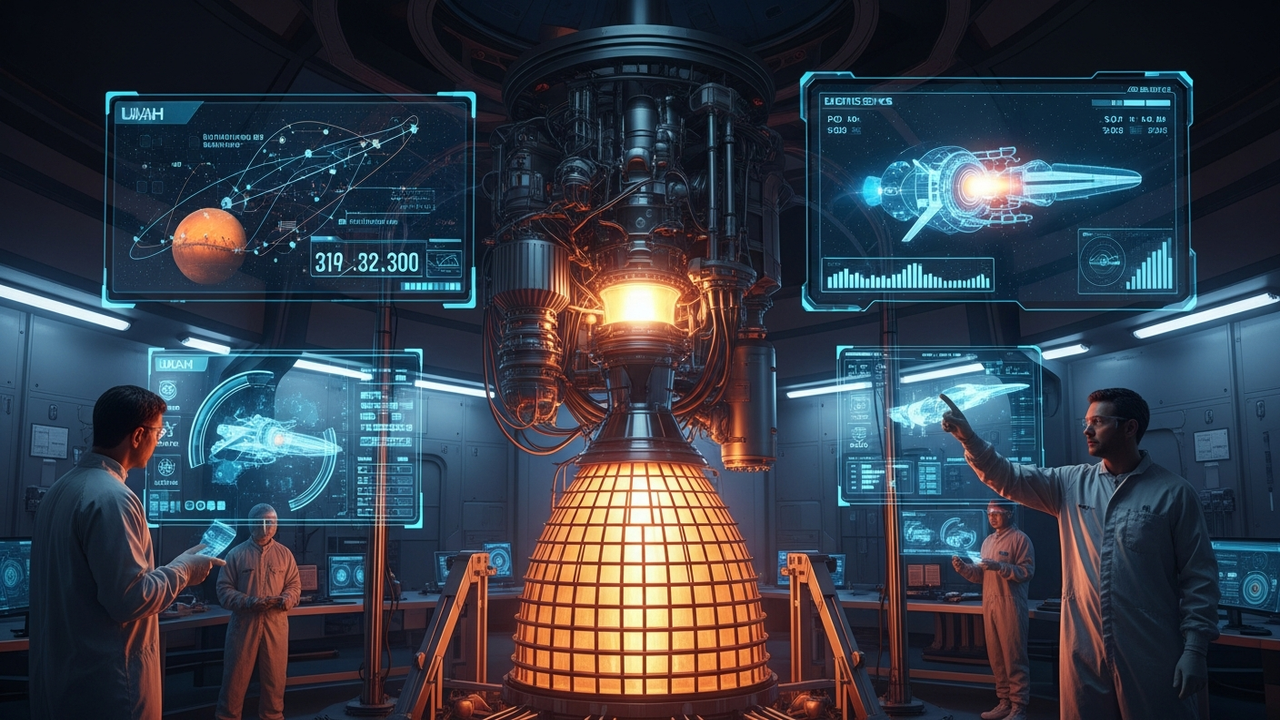
The University of Alabama in Huntsville (UAH) is accelerating the development of Nuclear Thermal Propulsion (NTP) systems through a strategic partnership with NASA Marshall Space Flight Center (MSFC). This collaboration is deemed pivotal for dramatically shortening transit times to distant destinations like Mars, thereby transitioning deep-space exploration from the realm of science fiction to a tangible engineering reality.
Technical & Clinical Details
Nuclear Thermal Propulsion (NTP) is a technology that utilizes a nuclear fission reactor as a heat source to superheat a lightweight propellant, such as hydrogen, to extremely high temperatures. The heated gas is then expelled through a nozzle to generate thrust. Compared to conventional chemical propulsion rockets, NTP achieves significantly higher exhaust velocities of the propellant (specific impulse), enabling greater changes in velocity (delta-V) with the same amount of fuel. As a result, spacecraft can reach destinations like Mars in substantially shorter periods. This technology originated from foundational research over 70 years ago, and UAH and NASA MSFC are now advancing its research and development, leveraging modern advancements in materials science, reactor design, and propulsion system engineering to enhance efficiency and reliability. Key research challenges include miniaturization, weight reduction, and optimization of radiation shielding technologies for the nuclear fission reactor.
Background & Industry Context
Human missions to Mars confront numerous technical and operational challenges due to the immense distance and extended travel times, including astronaut radiation exposure, life support system reliability, the cost of transporting supplies, and maintaining psychological well-being. The inherent limitations of chemical propulsion rockets exacerbate these challenges over long durations. NTP is being re-evaluated as the most promising technology to overcome these obstacles and shorten mission times, thereby enhancing astronaut safety and increasing the scientific payload capacity of missions. The UAH-NASA partnership exemplifies a model that combines academic expertise with governmental resources to accelerate the development of this complex and capital-intensive technology.
Future Outlook
The progress in NTP development by UAH and NASA MSFC holds the potential to profoundly reshape the future of human deep-space exploration. A significant reduction in Mars transit times will enable more frequent crewed missions, paving the way for the establishment of permanent bases on the Red Planet. Furthermore, this technology is applicable not only to Mars but also to high-speed exploration missions to other celestial bodies in the outer solar system (e.g., Jupiter’s moon Europa or Saturn’s moon Titan), thereby exponentially expanding the frontiers of human space exploration. This continuous research and development is expected to make the practical implementation of nuclear propulsion a reality and stimulate technological innovation across the entire space industry.





Comments