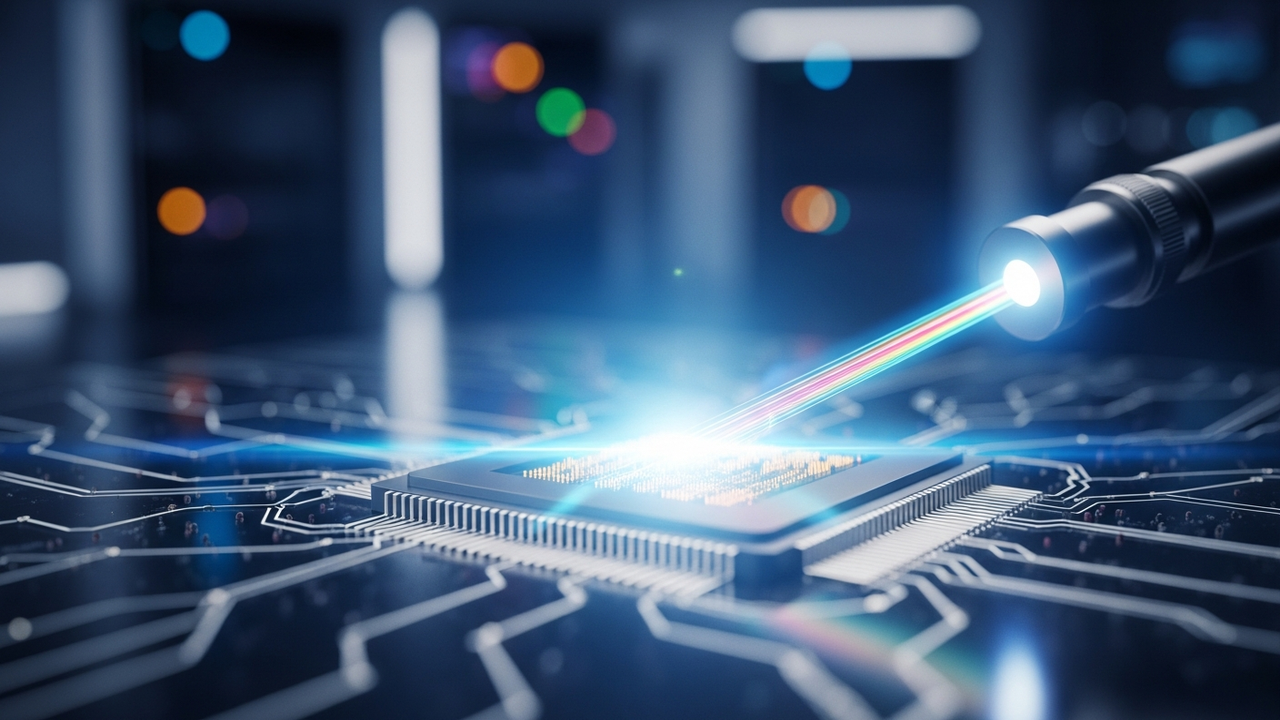
Background: The Interconnect Challenge in Silicon Photonics
Silicon photonics represents a groundbreaking advancement in semiconductor technology, leveraging light to process information at speeds and efficiencies far beyond what traditional electronic circuits can achieve. It holds immense promise for applications ranging from ultra-fast data communications within data centers and high-performance computing to advanced sensing and artificial intelligence accelerators. However, a significant inherent challenge for silicon photonics stems from silicon’s indirect bandgap nature, which makes it inefficient at generating light. Moreover, effectively multiplexing and demultiplexing optical signals of different wavelengths within silicon waveguides has presented a persistent bottleneck for developing fully integrated and high-performance photonic circuits. Efficient light sources and signal isolation techniques are crucial for realizing the full potential of this technology.
Key Findings / Results: Quantum Dot Lasers as the Enabling Solution
Recent research indicates that quantum dot (QD) lasers are emerging as a transformative solution to overcome the optical signal demultiplexing bottleneck in silicon photonics. Quantum dots are nanoscale semiconductor crystals that, due to quantum mechanical effects, emit light with extremely high efficiency and very narrow spectral linewidths at precisely controllable wavelengths. QD lasers leverage these characteristics to offer distinct advantages over conventional light sources for silicon photonic integration:
- High Emission Efficiency: QD lasers can generate powerful optical signals with significantly lower power consumption, enhancing the overall energy efficiency of silicon photonic systems.
- Precise Wavelength Control: By tuning the size and composition of the quantum dots, the emission wavelength can be precisely tailored. This enables the efficient multiplexing and demultiplexing of multiple optical signals without crosstalk, maximizing data throughput.
- Temperature Stability: QD lasers demonstrate remarkable stability across a wide range of operating temperatures, making them suitable for demanding environments such as data centers where temperature fluctuations can affect performance.
- Direct Integration Potential: The ability to grow or bond QD lasers directly onto silicon wafers allows for seamless integration with silicon waveguides, minimizing coupling losses and enabling highly compact and efficient on-chip optical circuitry.
This integrated approach facilitates end-to-end efficient operation from light generation to signal separation and detection, crucial for expanding optical communication bandwidth and reducing signal attenuation within photonic integrated circuits.
Technical Significance & Outlook: Powering Next-Generation AI and IoT
The resolution of the silicon photonics bottleneck through quantum dot lasers carries profound technical significance, promising to revolutionize next-generation information and communication technologies. For data centers, it enables ultra-high-speed, high-capacity data transfer, dramatically boosting the performance of cloud computing and big data analytics. In optical computing, leveraging light as the primary information processing medium can achieve processing speeds and energy efficiencies far exceeding electronic circuits, potentially revolutionizing AI accelerators. Furthermore, high-performance optical sensors incorporating QD lasers will find applications in autonomous vehicles (LiDAR), high-resolution medical imaging, and environmental monitoring, enabling precise and low-power data acquisition. This technological advancement is expected to become a foundational technology supporting the further development of artificial intelligence (AI) and Internet of Things (IoT) devices, accelerating the digital and smart transformation of our society. As manufacturing techniques for QD lasers become more refined and costs decrease, their application range will undoubtedly expand, positioning them as a central driver of 21st-century technological progress and a key enabler for a data-intensive future.




Comments