Background
Perovskite solar cells (PSCs) hold immense promise as a next-generation photovoltaic technology due to their high theoretical efficiency and potential for low-cost manufacturing. However, past research and development have primarily focused on achieving high efficiencies in small, laboratory-scale devices. Critical challenges for commercialization, such as uniform performance over large areas, long-term operational stability, and scalable mass production processes, have remained. To overcome these hurdles and elevate research findings to an industrial scale, an integrated approach, covering everything from material development to real-world demonstrations, became imperative.
Key Findings / Results
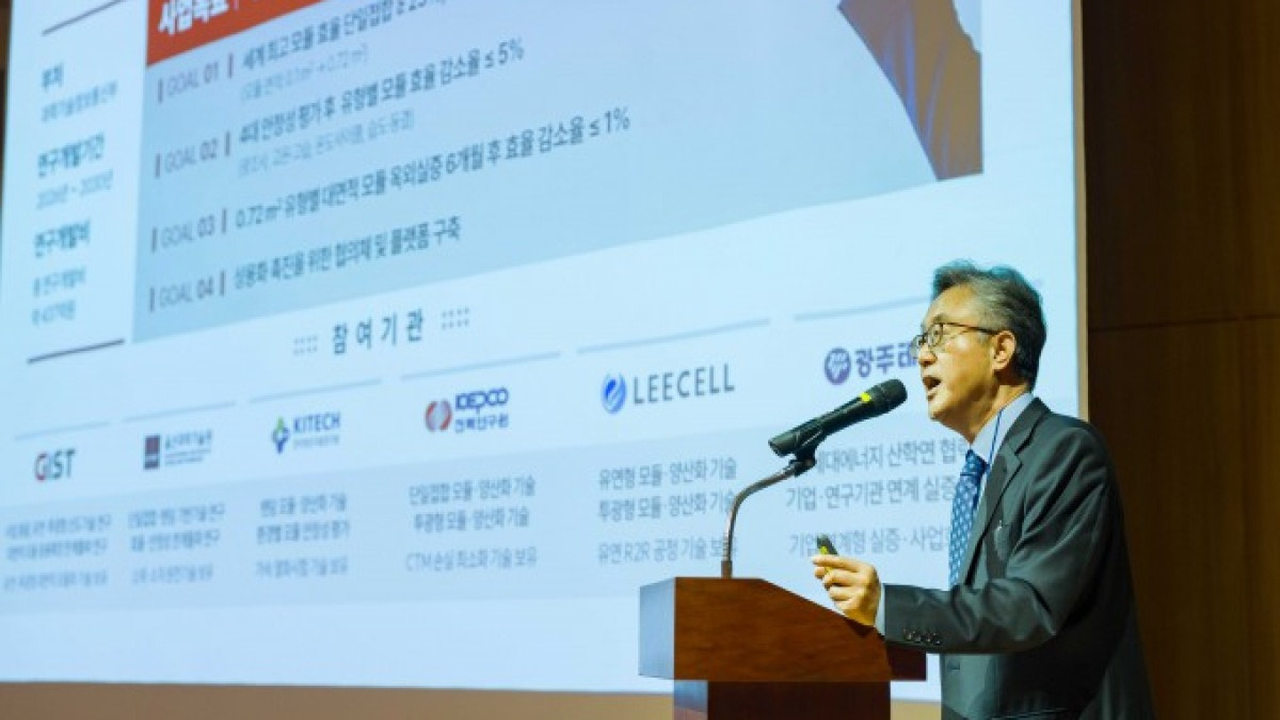
The Gwangju Institute of Science and Technology (GIST) has spearheaded the establishment of the “World’s First Perovskite Solar Cell Commercialization Strategic Research Consortium,” aiming to achieve global commercialization of PSCs. This consortium includes prominent institutions such as GIST, Ulsan National Institute of Science and Technology (UNIST), Korea Institute of Industrial Technology (KITECH), Korea Electric Power Research Institute, Gwangju Technopark, and the private company Leasel. They have forged an integrated research system encompassing the entire lifecycle of perovskite solar cell development: materials, devices, modules, processes, and field demonstrations. A primary focus is scaling up the high efficiencies demonstrated in laboratories to large-area modules, targeting 0.72 ㎡. Furthermore, ensuring long-term stability compliant with international standards, such as those from the International Electrotechnical Commission (IEC), is a top priority. Through rigorous demonstration tests and the establishment of mass production infrastructure, the consortium aims to secure global technological competitiveness.
Technical Significance & Outlook
This extensive collaboration, led by GIST and involving academia, industry, and government, signifies South Korea’s strong ambition to lead the world in perovskite solar cell commercialization. The integrated research framework, covering the entire development cycle, is expected to enable rapid identification and efficient resolution of challenges at each stage, significantly accelerating the pace of development. The specific target of 0.72 ㎡ for large-area module development and the commitment to achieving international standard stability provide a clear roadmap towards practical implementation. If successful, this initiative could unlock new markets previously inaccessible to conventional silicon solar cells (e.g., lightweight flexible, BIPV, IoT power sources) and provide a new growth engine for South Korea’s renewable energy industry. Moreover, it has the potential to establish South Korea’s technological leadership in global competition and influence international standardization efforts, making its progress a focus of global attention.






Comments