Background
All-perovskite tandem solar cells are gaining significant attention as a next-generation technology with the potential to surpass the efficiency limits of silicon-based photovoltaics. By stacking two perovskite layers with complementary bandgaps, these cells can utilize a broader range of the solar spectrum, leading to higher efficiencies. However, maximizing their performance requires effective control over film quality, especially minimizing interface defects, and enhancing both charge extraction efficiency and stability. Lead-tin-based perovskite bottom cells, in particular, have been limited by surface defects that compromise both efficiency and stability.
Key Findings / Results
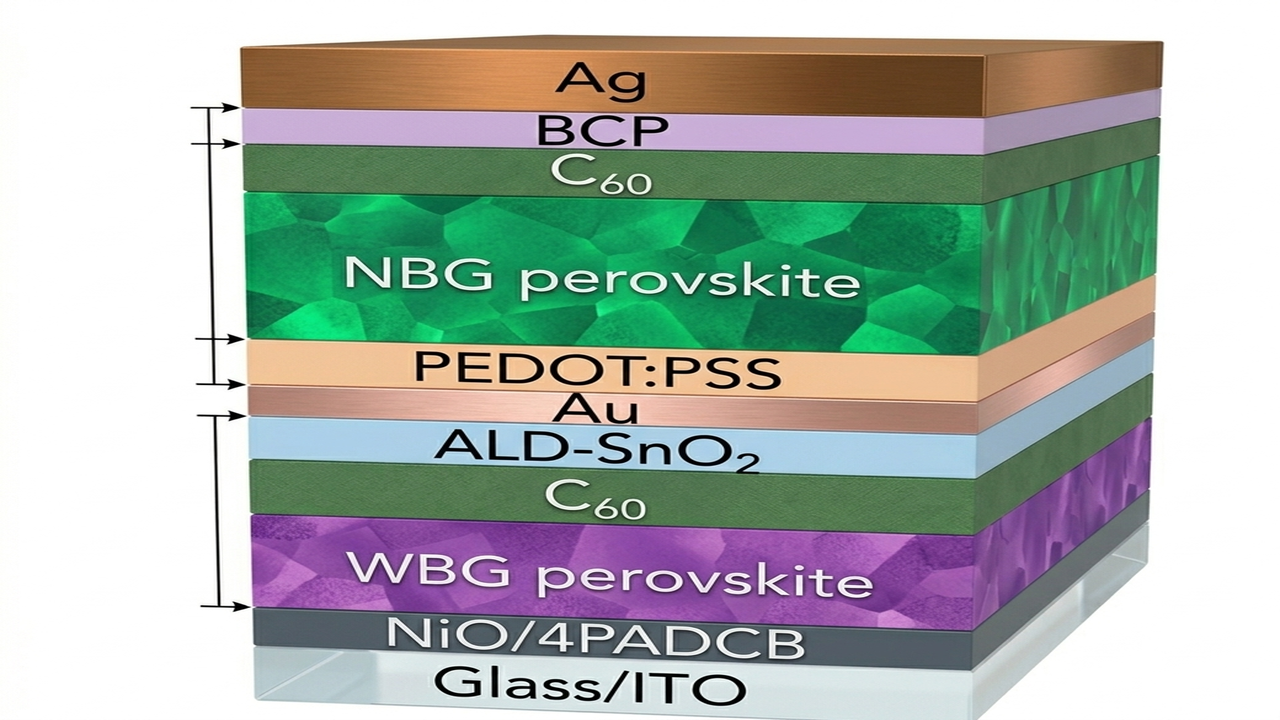
A research team from China’s Huazhong University of Science and Technology has introduced an innovative non-contact laser polishing strategy, elevating the power conversion efficiency of all-perovskite tandem solar cells to an impressive 29.80%. This technique aims to selectively and non-destructively remove surface defects present on lead-tin perovskite films. The laser polishing process effectively reduced rough surface layers, compositional non-uniformities, and Sn-related defects without causing damage to the underlying perovskite layer. Consequently, the efficiency of the tandem bottom cell significantly improved from 19.64% to 24.07%, leading to the achievement of a record-breaking overall champion conversion efficiency of 29.80%. Furthermore, the laser-polished devices demonstrated remarkable operational stability, maintaining approximately 80% of their initial performance after 650 hours of continuous operation under one-sun illumination.
Technical Significance & Outlook
The implementation of non-contact laser polishing technology by Huazhong University of Science and Technology marks a significant breakthrough in enhancing the performance of all-perovskite tandem solar cells. This surface modification strategy holds the potential to effectively mitigate performance bottlenecks caused by surface effects across various perovskite compositions, opening new avenues for achieving both high efficiency and stability. The 29.80% efficiency achieved is close to the current records for multi-junction solar cells, promising substantial contributions to large-scale energy generation. As this technology allows for precise control in the manufacturing process, it is also expected to contribute to future mass production and cost reduction. Future challenges include ensuring uniformity during scale-up to large-area modules and accumulating more long-term outdoor validation data. Nevertheless, this achievement positions laser polishing as a highly promising manufacturing approach that will play a crucial role in accelerating the transition of all-perovskite tandem solar cells from laboratory to commercial viability.









Comments