Key Findings
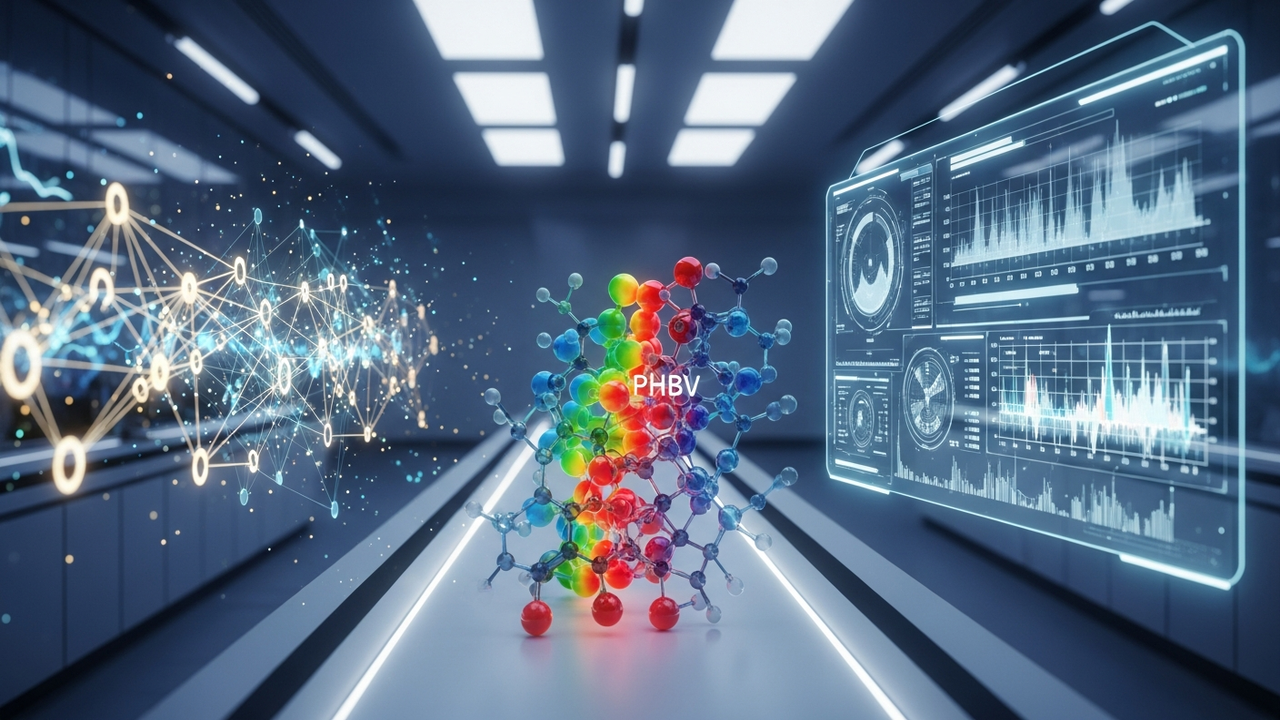
A novel machine learning (ML) approach has been reported for accurately predicting the thermal properties, specifically glass transition temperature (Tg), melting point (Tm), and crystallization temperature (Tc), of polyhydroxybutyrate (PHB) and its copolymer polyhydroxybutyrate-co-hydroxyvalerate (PHBV)-based materials. This study successfully built a comprehensive integrated polymer database comprising 572 data points from both literature and in-house experiments. By applying advanced feature engineering that combined chemistry-based descriptors with polymer-specific experimental variables, the research achieved a significant improvement in predictive performance compared to conventional models. This breakthrough holds the potential to substantially accelerate the design and development processes for biodegradable plastics.
Technical / Clinical Details
PHB and PHBV are naturally occurring biodegradable polyesters produced by microorganisms, drawing attention as alternatives to conventional petroleum-based plastics. However, their thermal properties vary significantly with composition, molecular weight, and processing history, making the ability to accurately predict these properties essential for designing optimal materials. This research adopted the following technical approaches:
- Construction of an Integrated Polymer Database: A comprehensive database was compiled, consisting of 572 data points on PHB/PHBV thermal properties gathered from global scientific literature, supplemented by in-house experimental data. This data integration provided the diversity and scale necessary for training the ML model.
- Advanced Feature Engineering: While conventional models often relied solely on material composition information, this study designed features by combining two types of descriptors:
- Chemistry-Based Descriptors: Features reflecting the fundamental chemical structure of the polymer, such as monomer type, copolymerization ratio, and molecular weight.
- Polymer-Specific Experimental Variables: Variables related to processing history and measurement conditions that influence thermal properties, such as molding method, annealing conditions, and measurement rate.
By combining these features, the ML model was able to learn deeper relationships between thermal properties and material characteristics.
- Application of Machine Learning Models: Multiple machine learning algorithms (e.g., Random Forest, Support Vector Regression, Neural Networks) were trained using the collected data and designed features, and their predictive performance was comparatively evaluated. The best-performing model demonstrated high accuracy in predicting Tg, Tm, and Tc, achieving superior results in metrics like coefficient of determination (R²) and mean absolute error (MAE) compared to traditional methods.
This approach enables rapid and accurate prediction of the thermal properties of PHB/PHBV materials that meet specific application requirements, without the need for repetitive experimentation.
Background & Context
Environmental pollution from single-use plastics is a pressing global issue, leading to a rapidly increasing demand for biodegradable plastics. PHB/PHBV, due to their biodegradability and biocompatibility, are expected to find applications in packaging materials, agricultural films, and medical materials. However, to accelerate the market penetration of PHB/PHBV, it is necessary to stabilize their physical properties and efficiently design materials tailored for specific applications. Traditional materials development has been a time-consuming and costly trial-and-error process, delaying the market introduction of new materials. The utilization of materials informatics and machine learning is expected to resolve this bottleneck, serving as a crucial tool for faster and more sustainable materials development.
Strategic Significance & Outlook
The ML-based thermal property prediction approach developed in this study will have a significant impact on the research and development of PHB/PHBV materials. Future research is expected to advance in the following directions:
- Expansion of Predicted Properties: Application to other important properties beyond thermal properties, such as mechanical strength, barrier properties, and biodegradability.
- Further Expansion of Datasets: Improving model generalizability by including PHB/PHBV data with more diverse compositions, molecular weights, processing histories, and data for other biodegradable polymers.
- Integration with Generative Models: Integration with generative models where AI autonomously proposes PHB/PHBV material compositions and processing conditions that meet the optimal thermal properties predicted by ML.
- AI-Driven Closed-Loop Materials Development: Integration into systems where materials designed by ML models are automatically synthesized and evaluated by robots, with results fed back into the AI.
These advancements are expected to further accelerate the market introduction of biodegradable plastics, significantly contributing to reducing environmental impact and realizing a circular economy. PHB/PHBV-based materials will play a crucial role in various fields, contributing to building a sustainable future.
Source: https://www.mdpi.com/2073-4360/18/13/1559
Get our weekly technology intelligence — free
Receive an infographic that lets you judge at a glance whether each field’s analysis report is worth reading.
Subscribe Free — Weekly Tech Intelligence
By subscribing, you’ll receive Troy-Technical’s weekly technology intelligence newsletter.
- Your email and selected fields are used only to deliver the newsletter.
- We never share your information with third parties.
- You can unsubscribe anytime via the link in each email.
See our Privacy Policy for details.
Takes about a minute · Unsubscribe anytime