Key Findings
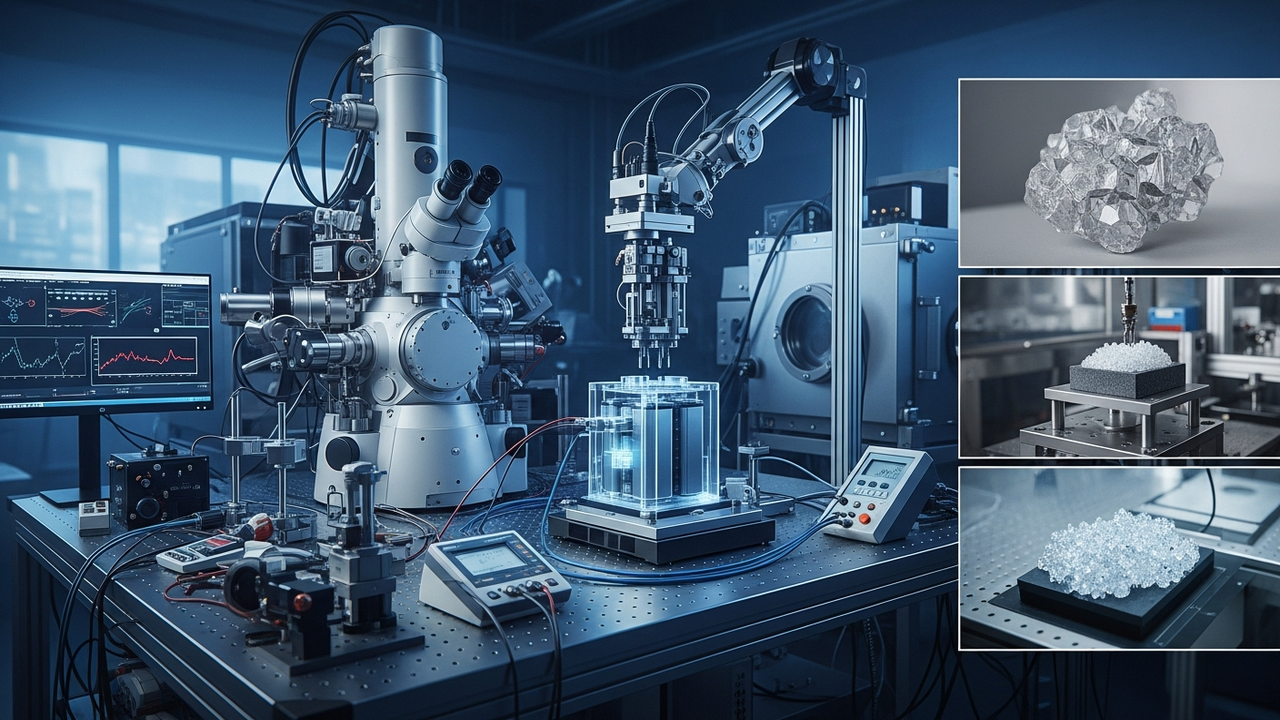
Groundbreaking research by Yan et al. (Journal of Colloid and Interface Science, 2026) has established a three-stage pressure optimization protocol for the manufacturing process of sulfide all-solid-state batteries. This protocol, comprising electrolyte pre-pressing (375 MPa), final compression after composite cathode addition (625 MPa), and operating pressure during cycling (125 MPa), successfully achieved high ionic conductivity of 1.54 mS/cm, an excellent initial capacity of 120 mAh/g, and a remarkable 97% capacity retention after 50 cycles for LPSCl and LGPS solid electrolytes. This technology significantly mitigates the issues of microcracks and delamination at the electrode-electrolyte interface.
Technical Details
Sulfide all-solid-state batteries hold promise for high energy density and fast charging, but inadequate physical contact between electrodes and solid electrolytes has historically led to increased interfacial resistance and reduced cycle life. Volume changes during charge and discharge cycles, in particular, induce mechanical stress at interfaces, prone to creating microcracks and delamination. The three-stage pressure optimization protocol proposed in this study is meticulously designed to address this problem. First, the solid electrolyte layer’s density is optimized with a pre-pressing of 375 MPa. Next, after introducing the composite cathode material, a final compression of 625 MPa maximizes adhesion between the electrodes and electrolyte. Finally, during actual battery operation, a lower operating pressure of 125 MPa is maintained to ensure ion conduction while avoiding excessive mechanical stress. This precise pressure management enabled batteries using LPSCl (lithium phosphorus sulfide chloride) and LGPS (lithium germanium phosphorus sulfide) electrolytes to achieve both excellent ionic conductivity and stable cycle performance.
Background & Context
All-solid-state batteries are the subject of intense global research and development as next-generation battery technology that fundamentally improves the safety, range, and charging speed of electric vehicles (EVs). However, solid-solid interface challenges have been one of the main barriers to their commercialization. Ensuring good physical and electrochemical contact at the electrode-electrolyte interface is essential for realizing high-performance all-solid-state batteries. The pressure optimization approach presented in this research offers a practical solution to this complex manufacturing challenge and represents a significant step towards the mass production of sulfide all-solid-state batteries.
Strategic Significance & Outlook
This three-stage pressure optimization protocol has the potential to become a standard method in the manufacturing of sulfide all-solid-state batteries. The results, demonstrating 1.54 mS/cm ionic conductivity and 97% capacity retention over 50 cycles, suggest practical-level performance and durability, making them promising for EV and other high-power applications. Future research will focus on applying this protocol to longer cycle durations and different material systems to verify its versatility and durability. If this technology can be adapted for large-scale production, it is expected to significantly contribute to cost reduction and performance improvement of all-solid-state batteries, potentially revolutionizing the global energy storage market.
Source: https://iestbattery.com/sulfide-solid-state-batteries-stepwise-pressure/
Get our weekly technology intelligence — free
Receive an infographic that lets you judge at a glance whether each field’s analysis report is worth reading.
Subscribe Free — Weekly Tech Intelligence
By subscribing, you’ll receive Troy-Technical’s weekly technology intelligence newsletter.
- Your email and selected fields are used only to deliver the newsletter.
- We never share your information with third parties.
- You can unsubscribe anytime via the link in each email.
See our Privacy Policy for details.
Takes about a minute · Unsubscribe anytime






Comments