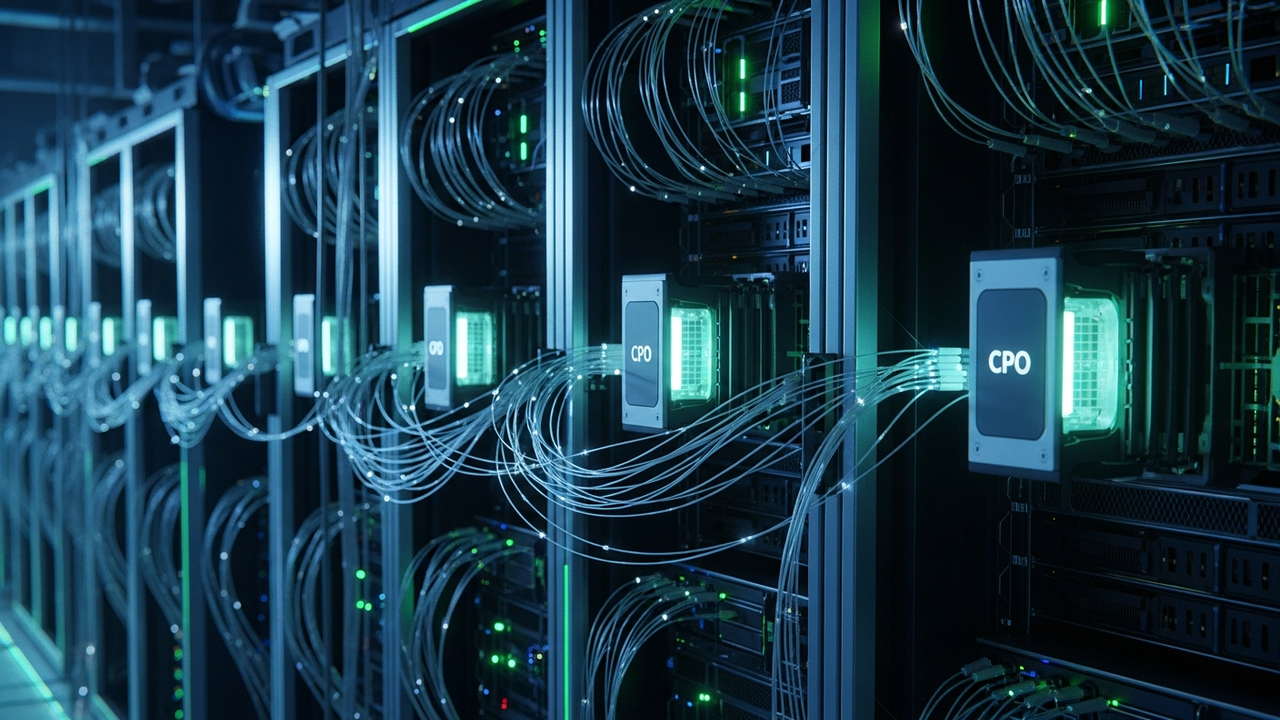
AI Data Center Power Challenges and the Need for Optoelectronic Integration
Power consumption stands as one of the most critical challenges for AI data center operational costs and environmental impact. The immense computational and data transfer demands of large-scale AI workloads, in particular, expose the limitations of traditional electrical signal interconnects, leading to increased heat generation and reduced power efficiency. To resolve these issues, “optoelectronic integration technology,” which merges the advantages of light and electricity, is gaining prominence as a foundation for next-generation data centers.
Huawei’s Drive for Co-Packaged Optics (CPO)
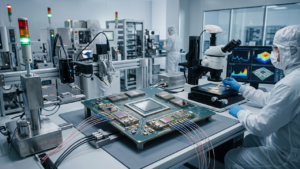
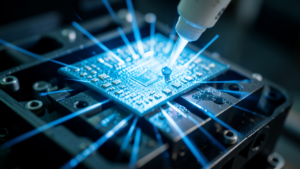
Huawei is focusing its development efforts on Co-Packaged Optics (CPO) as a core of this optoelectronic integration technology. CPO involves the tight integration of the ASIC (Application-Specific Integrated Circuit), central to data center switching, with the optical engine that transmits and receives optical signals, all within the same package. This integration dramatically shortens the electrical signal path, yielding the following benefits:
- Significant Improvement in Power Efficiency: Reduced electrical signal transmission losses lead to substantial power savings across the entire data center.
- Enhanced Bandwidth Density: Allows for the integration of more optical channels at higher densities, dramatically increasing switching capacity.
- Reduced Latency and Improved Signal Quality: For GPU-to-GPU connections within AI clusters, it lowers latency and suppresses signal degradation, thereby improving the training efficiency of AI models.
Through the commercialization of CPO, Huawei aims to build next-generation AI data center infrastructure and contribute to the realization of a sustainable information society. With joint verifications already underway with some data center operators, early market deployment is in sight, suggesting that CPO technology is increasingly likely to become a standard connectivity method for AI data centers.
Future Outlook and Challenges
While CPO adoption resolves power consumption and performance bottlenecks, it also introduces new technical challenges, such as thermal management within CPO packages, manufacturing yields of optical engines, and maintainability in case of failure. Huawei’s efforts are expected to play a crucial role in addressing these challenges through cutting-edge optoelectronic integration technology and manufacturing process optimization, thereby accelerating the evolution of AI data centers.
Source: #



Comments