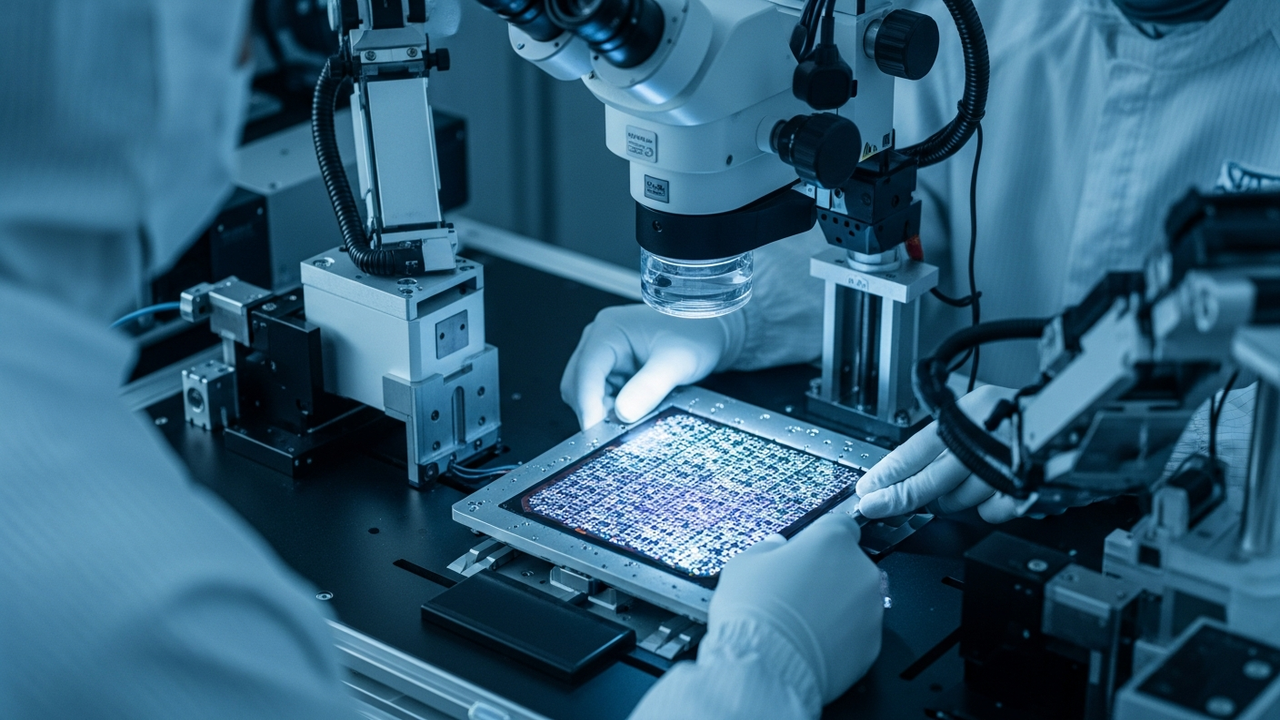
Challenges in Quantum Photonics Chip Manufacturing
Quantum photonics chips are indispensable for manipulating and transmitting quantum states in quantum communication and computing. However, manufacturing these chips faces significant challenges, particularly regarding the efficient generation of single-photon sources, high integration density, and scalability. Traditional manufacturing methods have struggled to meet these requirements simultaneously, hindering the practical deployment of quantum devices.
KAIST’s Novel Manufacturing Method
A research team at the Korea Advanced Institute of Science and Technology (KAIST) has announced the development of a groundbreaking new manufacturing method for quantum photonics chips, designed to overcome these challenges. This new technology represents a significant leap forward in several aspects:
- High-Efficiency Photon Generation: It enables a substantial improvement in the photon generation efficiency of single-photon sources, which is crucial for enhancing the reliability of quantum information processing.
- High Integration Density: The method allows for greater integration density of photon sources on a chip, opening the door to realizing more complex quantum circuits in compact form factors.
- Scalability: It provides a scalable process for the mass production of quantum devices, accelerating the transition from laboratory research to industrial applications.
The research team emphasized that this method allows for the efficient construction of complex quantum circuits, capable of manipulating multiple qubits, on smaller chips than previously possible.
Contribution to the Future of Quantum Technology
This novel manufacturing method from KAIST is a critical achievement, directly contributing to enhanced information security in quantum communication and a dramatic leap in computational power for quantum computing. The mass production of integrated quantum photonics chips is an essential factor in accelerating the societal implementation of quantum technology. Looking ahead, it is expected to significantly contribute to the development of a wide range of quantum photonic devices, including more practical quantum sensors and the construction of distributed quantum computing networks. This technology is set to elevate South Korea’s presence in the field of quantum technology.
Source: #






Comments