AI Compute Challenges and the Potential of Optical Computing
The increasing complexity and scale of deep learning models pose significant challenges for conventional electronic AI accelerators. Specifically, AI computations, which are heavily reliant on matrix operations, entail enormous power consumption, and their speed is hitting the physical limits of electrical signals. Optical computing, which performs calculations using light, is gaining attention as a promising solution to this challenge. Light inherently possesses high parallelism and superior power efficiency, offering the potential to revolutionize AI acceleration.
National Taiwan University’s Photonic AI Accelerator Prototype
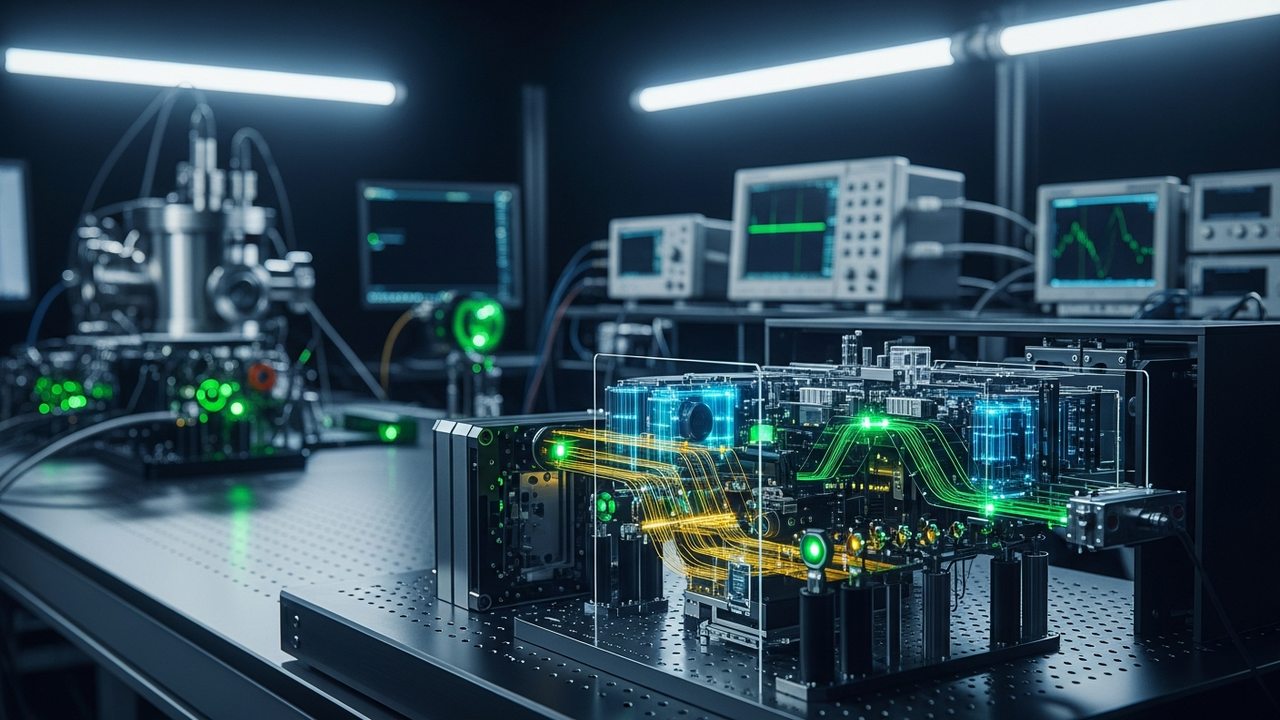
A research team at National Taiwan University (NTU) in Taiwan has announced the successful prototyping of a ‘photonic AI accelerator’ that applies this optical computing technology. This prototype accelerator features several key characteristics:
- Optical Matrix Operations: By performing matrix operations using optical signals instead of electrical signals, it minimizes power loss associated with data transfer and enhances computational efficiency.
- Significant Power Reduction: It is expected to dramatically reduce power consumption for AI workloads compared to traditional electronic circuits. For instance, research from the National University of Singapore demonstrated a 20-fold energy reduction and 40% space saving with similar technology.
- Improved Computational Speed: By fully leveraging the speed of light and its parallel processing capabilities, it aims to achieve high throughput for AI workloads such as deep learning.
This technology also suggests the potential for realizing photonic AI accelerators with nearly 1 TOPS (tera-operations per second) computational power on a silicon photonics platform, using a new tensor core architecture integrated with WDM (Wavelength Division Multiplexing).
Future Outlook and Impact on AI Data Centers
While currently in the prototype stage, NTU’s research achievement is attracting international attention as one of the promising solutions to the power and performance challenges facing AI’s evolution. Future considerations include its potential integration into large-scale AI data centers and HPC (High-Performance Computing) systems, which could dramatically enhance AI computing capabilities and contribute to reducing data center operational costs. Although optical computing is still an evolving technology, breakthroughs of this kind hold the potential to fundamentally transform the future of AI and information processing.
Source: #




Comments