Emergence of Next-Generation Battery Technologies
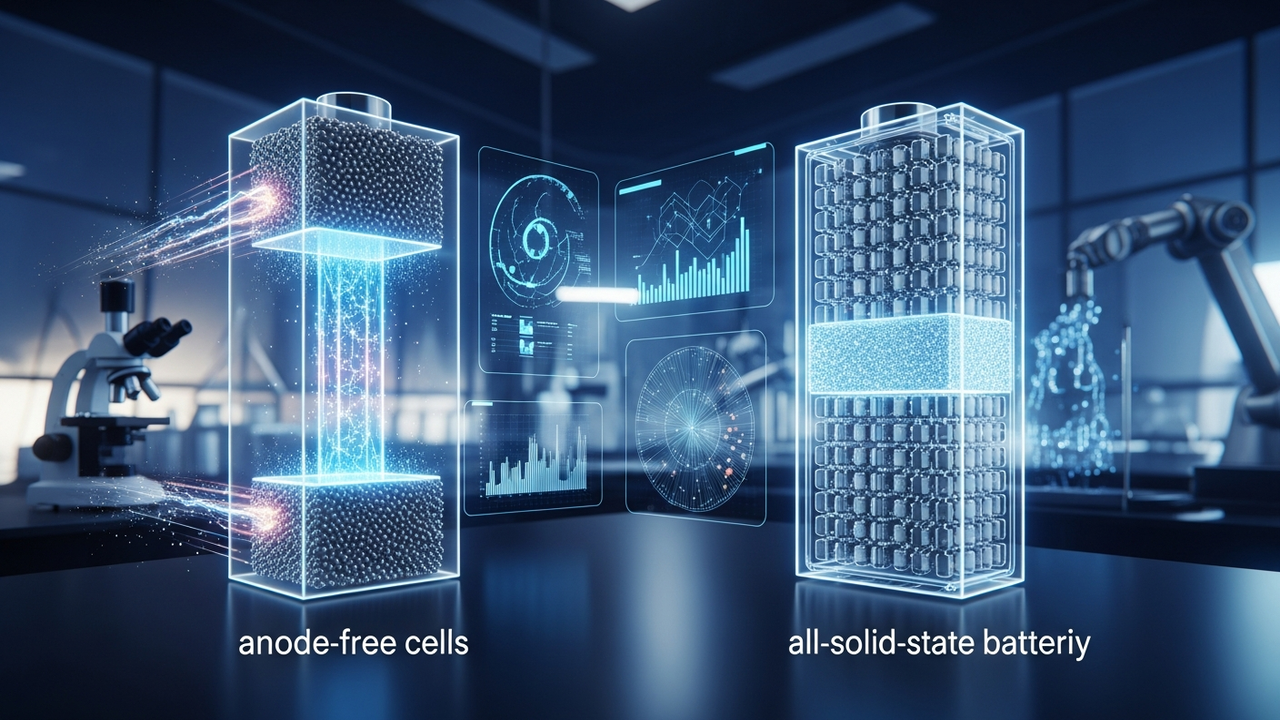
The pursuit of higher energy density, enhanced safety, and superior performance has propelled anode-free cells (AFCs) and all-solid-state batteries (SSBs) to the forefront of next-generation battery research. These technologies aim to transcend the limitations of conventional liquid-electrolyte lithium-ion batteries, enabling advancements across a wide spectrum of applications, including electric vehicles (EVs), portable electronics, and grid-scale energy storage systems. While employing distinct architectures, both AFCs and SSBs share the overarching goal of delivering safer and more performant energy storage solutions to meet escalating global demands.
Comparative Analysis of Energy Density and Performance
Anode-free cells theoretically possess the potential to achieve exceptionally high energy densities, exceeding 400 Wh/kg, by eliminating the need for inactive anode materials like graphite and directly utilizing a lithium metal anode. However, practical implementations often encounter challenges related to initial lithium plating/stripping efficiency and dendrite formation, which typically restrict their delivered energy density to the 250-300 Wh/kg range. In contrast, solid-state batteries, by replacing flammable liquid electrolytes with solid counterparts, inherently offer superior safety and thermal stability. Current SSB technology reliably achieves energy densities between 280-320 Wh/kg. Notably, SSBs utilizing sulfide solid electrolytes exhibit excellent performance even in cold environments, maintaining functionality at temperatures as low as -20°C, a significant advantage for automotive applications in diverse climates.
Common Challenges and Future Research Directions
Both AFCs and SSBs confront critical technical hurdles that demand concerted research efforts. A primary challenge involves suppressing the formation and growth of lithium dendrites during charge-discharge cycles. Dendrites can lead to internal short circuits, severely compromising battery safety and cycle life. The second major obstacle is the reduction of interfacial resistance between the electrodes and solid electrolytes. Achieving good contact across solid-solid interfaces is inherently difficult, leading to higher resistance that impedes ion transport and diminishes the battery’s power performance. Overcoming these challenges necessitates a multi-faceted approach, including the development of novel solid electrolyte materials, advanced interfacial engineering techniques, and optimized electrode architectures. Continuous innovation in these areas is crucial for accelerating the commercialization of these promising next-generation battery technologies.
Source: https://eureka.patsnap.com/report-anode-free-cells-vs-solid-state-batteries-performance-review








Comments