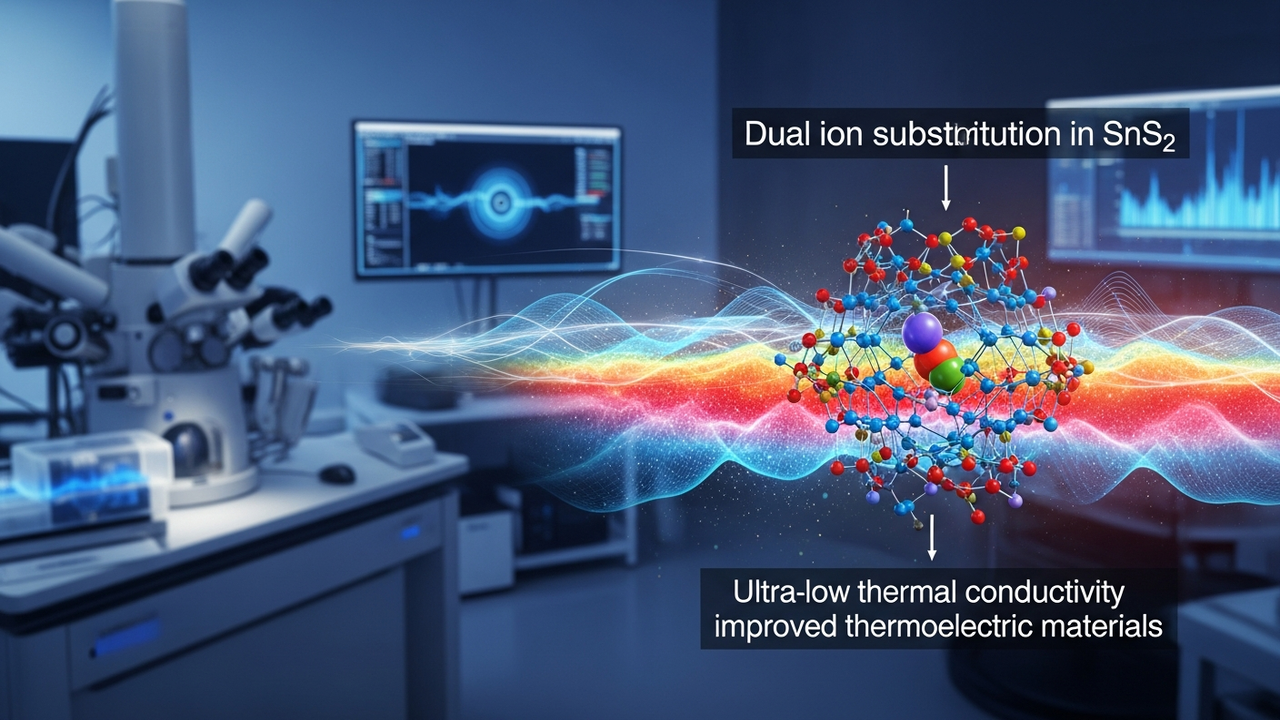
Background: Importance of Thermoelectric Materials and Challenges in Thermal Conductivity
Thermoelectric materials, capable of directly converting temperature differences into electrical energy and vice-versa, are gaining attention as clean energy technologies in fields like waste heat recovery, solid-state cooling, and sensors. A crucial metric for thermoelectric material performance is the dimensionless figure of merit (ZT), and to maximize it, achieving both high electrical conductivity and low thermal conductivity is ideal. Specifically, reducing thermal conductivity is essential to suppress heat flow within the material and efficiently utilize temperature differences. However, since electrical and thermal conductivities are often correlated, simultaneously optimizing both has been a significant challenge in material design.
Key Findings: Dual-Ion Substitution and Ultralow Thermal Conductivity in SnS2
This first-principles study, published in ACS Publications, focused on tin disulfide (SnS2), a layered semiconductor material, and explored a new strategy to improve its thermoelectric properties. The research team adopted an approach called “dual-ion substitution,” where two different types of ions are simultaneously substituted into the crystal lattice of SnS2. Theoretical calculations and simulations revealed that this dual-ion substitution induces significant changes in the material’s lattice structure:
- Lattice Softening: Substituted ions create inhomogeneities in the bonding with surrounding atoms, reducing the overall stiffness of the crystal lattice. This impedes the propagation of lattice vibrations (phonons).
- Anion Dimerization: Under specific conditions, anions (negatively charged ions) form pairs, causing local structural distortions and irregularities. This also effectively increases phonon scattering.
These synergistic effects dramatically reduce the thermal conductivity of SnS2, demonstrating that “ultralow thermal conductivity,” previously difficult to achieve, can be realized. This reduction in thermal conductivity is primarily attributed to the significant increase in phonon scattering caused by differences in atomic mass and disorder in bonding introduced by the substitutions.
Technical Significance and Outlook
These research findings open new avenues for the design principles of high-efficiency thermoelectric materials. The elucidation of the mechanisms of lattice softening and anion dimerization through dual-ion substitution provides specific design guidelines for reducing thermal conductivity while maintaining electrical properties. This insight could be applied to optimize thermoelectric performance not only in SnS2 but also in other layered compounds and semiconductor materials. Materials with ultralow thermal conductivity will have a significant impact in areas such as:
- Waste Heat Recovery Systems: Efficiently converting untapped thermal energy from factories and vehicles into electricity, improving energy efficiency.
- Energy Conversion Technologies: Expanding the utilization of renewable energy sources through the realization of high-efficiency thermoelectric power generation devices.
- Solid-State Cooling Devices: Applied to environmentally friendly cooling technologies that do not use refrigerants like CFCs.
In the future, based on the design principles presented in this study, the development of higher-performance and practical thermoelectric materials is expected to accelerate, contributing to the realization of a sustainable energy society.






Comments