Key Findings
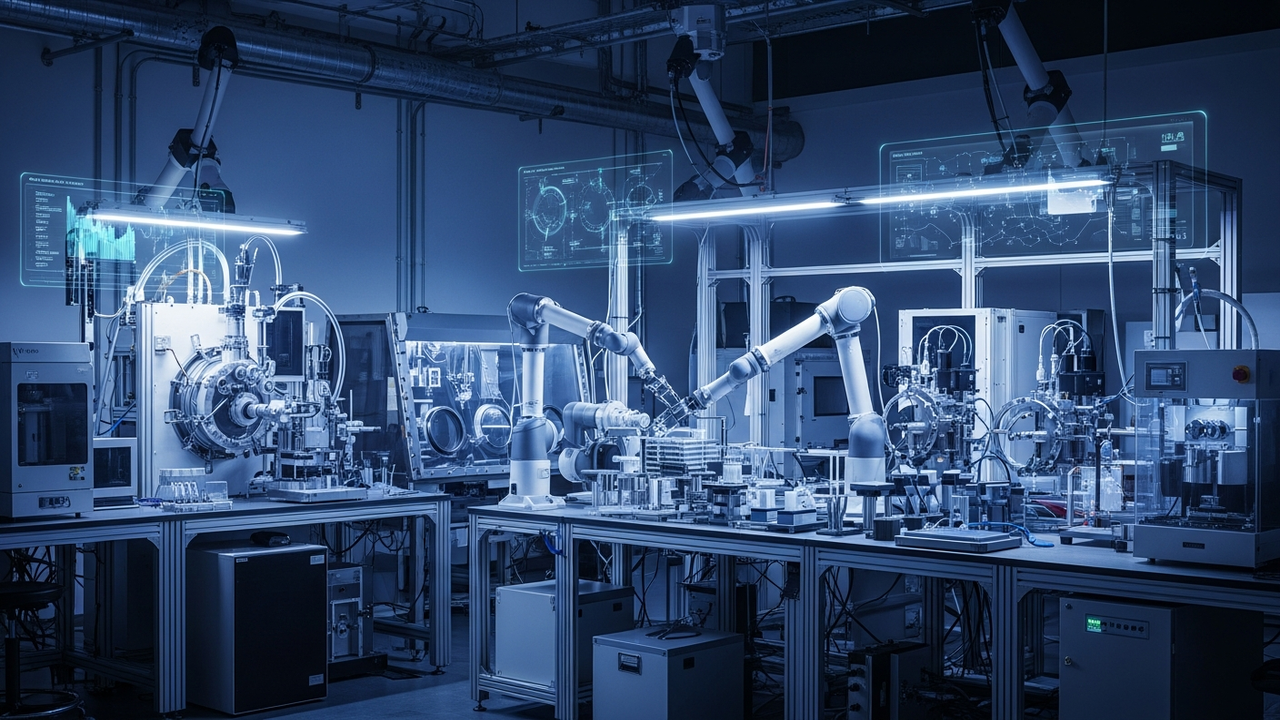
A team of researchers at Argonne National Laboratory has unveiled an ambitious technical roadmap for applying Large Language Models (LLMs) to the forefront of battery research. Central to this roadmap is the integration of LLMs into AI-driven autonomous laboratories (SDLs) to automate the entire battery material discovery process. This is expected to seamlessly execute a cycle encompassing literature review, screening of material property databases, proposal of promising new battery chemistries, robotic material synthesis and characterization, and experimental data analysis, thereby dramatically enhancing the speed and efficiency of research and development.
Technical / Clinical Details
- LLM Integration: Large Language Models possess the ability to extract information from vast scientific literature and databases, comprehend and summarize complex concepts, and generate new ideas. By combining this with battery science expertise, AI will be able to propose novel battery material candidates and synthesis routes based on existing knowledge.
- AI-Driven Autonomous Labs (SDLs): SDLs are systems that merge AI with robotics and advanced sensor technologies. Based on hypotheses and plans generated by LLMs, robotic arms autonomously perform material synthesis, processing, and characterization, feeding the results back to the AI. This ‘closed-loop’ process accelerates experimental cycles and optimizes them with minimal human intervention.
- Process Automation: LLMs are capable of automating a series of tasks, not just generating ideas, but also creating experimental protocols, identifying necessary reagents, verifying safety procedures, interpreting results, and even designing subsequent experiments. This could potentially reduce battery research lead times from months to weeks, or even days.
- Data Management and Analysis: SDLs collect and organize large volumes of generated experimental data in real-time, providing it in a format easily analyzable by AI. LLMs extract new patterns and trends from this data, continuously improving the models to contribute to more accurate and efficient material discovery.
Background & Context
High-performance batteries are indispensable for the proliferation of electric vehicles, storage of renewable energy, and evolution of mobile electronic devices. However, existing battery technologies still face challenges regarding energy density, safety, cost, and lifespan. Traditional battery material development has largely relied on time-consuming manual labor, which has become a bottleneck for innovation. Argonne National Laboratory’s initiative aims to resolve this bottleneck by applying the powerful capabilities of AI, particularly LLMs, to materials science, thereby strengthening U.S. leadership in clean energy technologies.
Strategic Significance & Outlook
If the vision of AI-driven autonomous labs powered by LLMs is realized, battery research will advance with unprecedented speed and efficiency. This is expected to lead to the rapid development of higher-performance, safer, cheaper, and longer-lasting batteries, significantly contributing to the adoption of electric vehicles, construction of smart grids, and realization of a sustainable society. This roadmap also holds potential as a model for AI-driven discovery in other materials science fields, such as catalysts, pharmaceuticals, and polymers. Researchers will be able to delegate routine tasks to AI, allowing them to focus on more complex problem-solving and creative research.
Source: https://www.anl.gov/article/turbocharging-battery-research-ai-an-ambitious-vision