Key Findings
The World Economic Forum (WEF) has announced the groundbreaking achievements of the third cohort of its Machine Learning in Design and Science (MINDS) initiative, aimed at accelerating AI adoption in industry. According to the report, closed-loop autonomous platforms, by integrating robotics, AI-driven experiment selection, simulation, and real-time learning, have increased industrial experiment throughput by up to 5,500%. This has dramatically shortened materials research and development (R&D) timelines from months to mere weeks. Specifically, one company successfully reduced battery electrolyte discovery lead times from approximately two years to just three months using an AI-driven materials discovery platform, cutting physical experiments by up to 70%. This provides definitive evidence of AI transitioning from experimental pilot phases to full-scale production applications.
Technical / Clinical Details
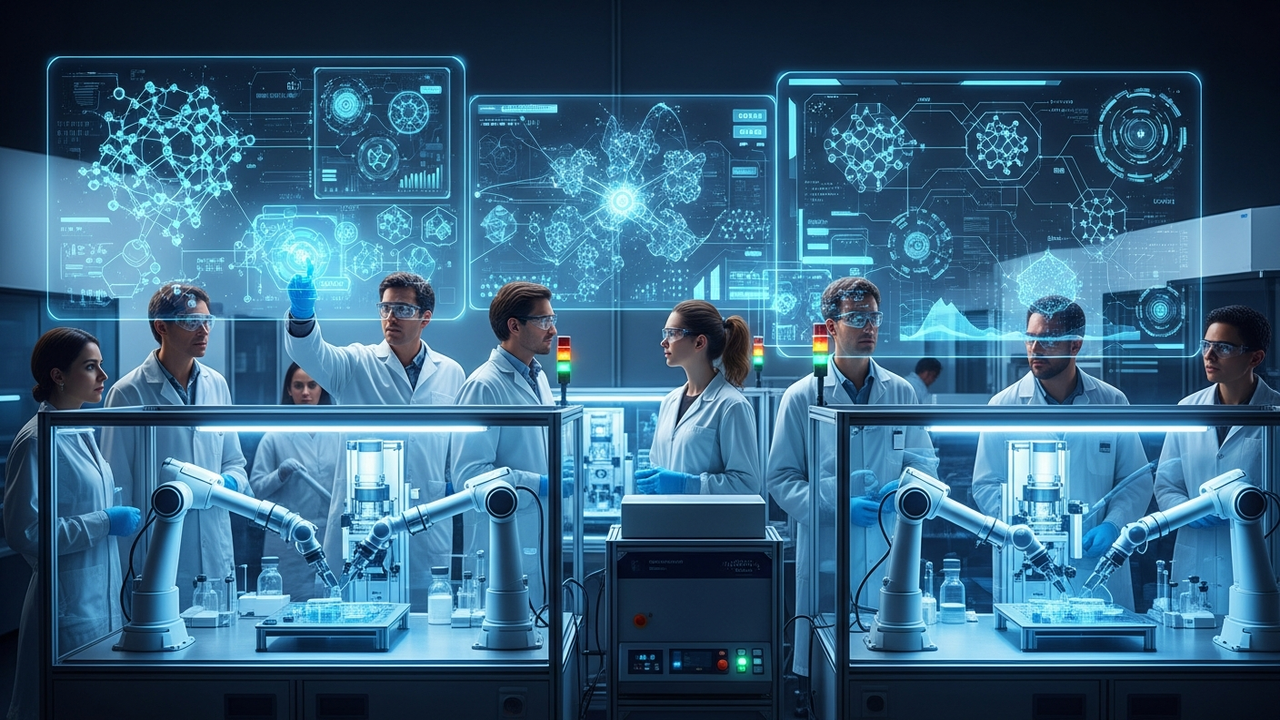
- Closed-Loop Autonomous Platforms: These platforms operate autonomously, with AI generating hypotheses, robots executing experiments, and results fed back to the AI in real-time to optimize subsequent steps. This minimizes human intervention while accelerating the discovery process.
- Dramatic Throughput Increase: The reported throughput increase of up to 5,500% over traditional experimental methods signifies a massive expansion in the number of experiments that can be processed and the rate of data generation. This enables efficient exploration of vast material design spaces.
- Reduced R&D Timelines: The example of battery electrolytes, where development time was cut from two years to three months, demonstrates a significant reduction in time-to-market and an acceleration of the innovation cycle. This is a crucial advantage in competitive industrial sectors.
- Reduced Physical Experimentation: Precision prediction and optimization by AI can reduce the number of necessary physical experiments by up to 70%. This contributes to lower experimental costs, resource savings, and reduced environmental impact.
- Diverse Application Areas: These technologies are not only accelerating battery material discovery but also driving innovation in a wide range of materials research, including catalysts, pharmaceuticals, and polymers across various industries.
Background & Context
While AI has long been recognized as promising in R&D, its practical implementation faced numerous challenges. The WEF’s MINDS cohort aims to bridge this gap by integrating AI into actual industrial processes and demonstrating its effectiveness. These results clearly indicate that AI has matured from being merely a research tool to a entity that delivers concrete business value and competitive advantage to companies. Particularly in the current era demanding sustainability and high performance, rapid development of new materials is key to economic growth and solving environmental problems.
Strategic Significance & Outlook
The success of the MINDS cohort is expected to incentivize more companies to adopt AI-driven platforms in their R&D. This will accelerate AI-led transformations not only in materials science but also in broader fields such as chemistry, pharmaceuticals, and manufacturing. In the future, the role of “AI co-scientists,” collaborating with human experts, is expected to further expand, potentially leading to unprecedented breakthroughs. Closed-loop autonomous platforms will fundamentally change the pace of innovation, forming the foundation for achieving both economic growth and sustainable development.
Source: https://www.weforum.org/stories/2026/06/ai-pilot-to-production-minds-cohort/