Key Findings
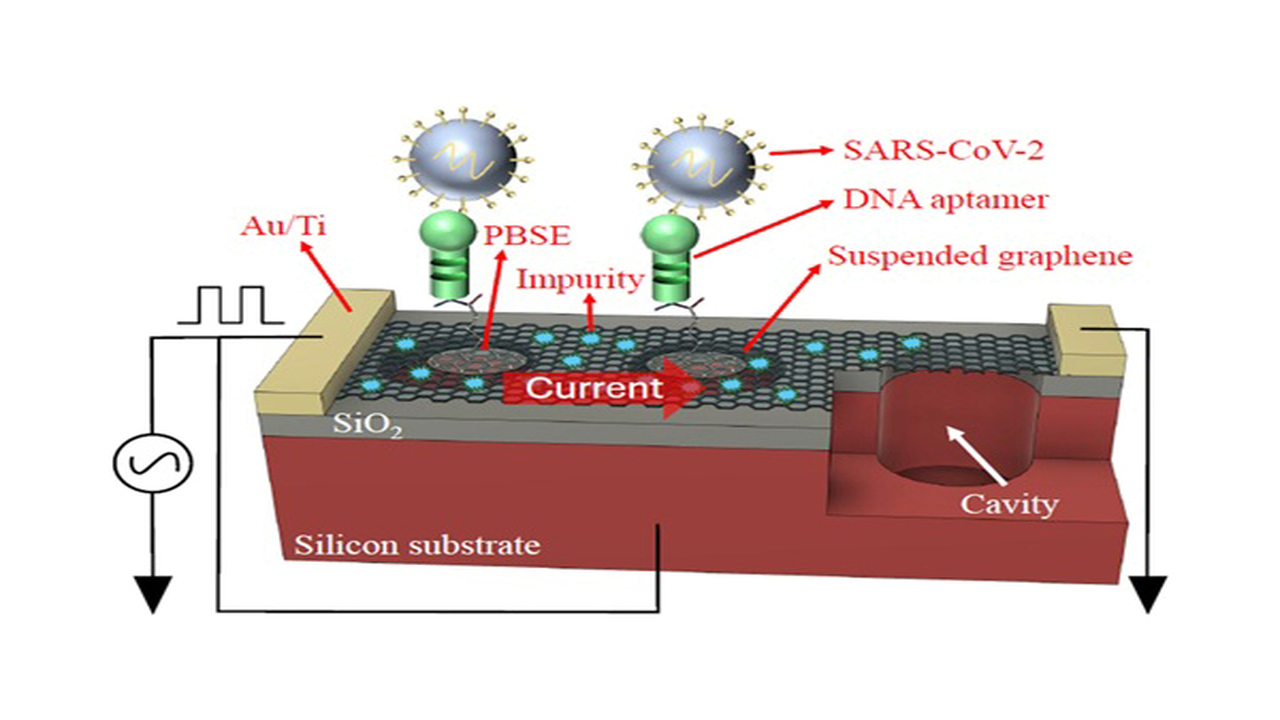
A collaborative research team from Toyohashi University of Technology, the National Institute of Advanced Industrial Science and Technology (AIST), and Toyo University in Japan has developed a multifunctional biosensor integrating Micro-Electro-Mechanical Systems (MEMS) and monolayer graphene. This innovative current-driven resonant sensor possesses the unique ability to simultaneously and sensitively measure two distinct physical quantities—the ‘total mass’ (at the zeptogram level) and ‘particle count’ of virus particles adsorbed on the graphene surface. This enables specific detection of target viruses like coronaviruses even in complex samples, opening new avenues for infectious disease diagnosis and environmental monitoring.
Technical / Clinical Details
The core of this biosensor lies in the integration of the following key technological elements:
- MEMS Technology: The system forms micro-resonators, typically cantilever or bridge structures. When virus particles adsorb onto these resonators, their increased mass causes a shift in the resonant frequency. Detecting this frequency shift allows for the measurement of the total adsorbed mass (at the zeptogram level). MEMS technology is well-suited for miniaturization, high sensitivity, and mass production.
- Monolayer Graphene: The MEMS resonator surface is coated with monolayer graphene. Graphene, with its exceptionally high surface-area-to-volume ratio, excellent electrical conductivity, and sensitive surface properties, efficiently adsorbs virus particles and contributes to detecting minute mass changes. Additionally, graphene’s bandgap and electrical conductivity can change based on the charge and type of adsorbed molecules, potentially providing information beyond just mass.
- Current-Driven Resonance: The sensor is resonated by electrical excitation rather than external physical vibrations, which improves overall system miniaturization and stability. Beyond changes in resonant frequency, changes in the Q-factor (quality factor) of the resonance and energy dissipation also provide additional information regarding particle count and adsorption mechanisms.
- Multifunctionality: This sensor not only measures the total mass of virus particles but also infers information about the number of adsorbed virus particles from localized interactions on the graphene surface. This allows for a more detailed understanding of “how much” is present, not just “if” it is present.
- Specific Detection: By functionalizing the graphene surface with specific antibodies or aptamers, the sensor can selectively adsorb and detect only specific target viruses, such as coronaviruses. This enables accurate identification of the desired virus even in the presence of other contaminants in the sample.
Compared to conventional virus detection methods (e.g., PCR, ELISA), this technology offers advantages in terms of speed, portability, and cost-effectiveness. Its detection limit accommodates very low virus concentrations (e.g., tens of particles/µL), contributing to early-stage infection diagnosis and trace virus detection in the environment.
Background & Context
Infectious disease pandemics have highlighted the critical importance of rapid and accurate diagnostic technologies. There is a growing demand for low-cost, highly sensitive virus detection technologies that can be deployed on-site, outside of hospitals and laboratories. Traditional detection methods are often time-consuming, require complex equipment and specialized expertise, and have limitations for large-scale screening and real-time monitoring. The convergence of MEMS and nanomaterials, particularly graphene, is a key trend addressing these challenges and accelerating the development of next-generation biosensors.
Strategic Significance & Outlook
This multifunctional biosensor is expected to find wide-ranging applications in medical diagnostics (especially POCT for infectious diseases), environmental monitoring (virus detection in water), food safety, and even biodefense. Future challenges will include integrating multiplexing capabilities for detecting various viruses and bacteria, enhancing sensor durability and reliability, and improving data analysis and cloud connectivity through smartphone integration. If commercialized and widely adopted, this technology will significantly strengthen capabilities for responding to public health crises, becoming a powerful tool for early intervention and preventing the spread of infectious diseases. This Japan-originated technology holds the potential to play a crucial role in international healthcare innovation.



Comments