Key Findings
Lunar In-Situ Resource Utilization (ISRU) technologies are establishing a comprehensive process chain to convert abundant lunar materials into essential supplies for future lunar bases and deep-space missions. This technology makes it possible to produce water, oxygen, fuel, and construction materials locally, thereby significantly reducing the reliance on high-cost transportation from Earth.
Technical & Clinical Details
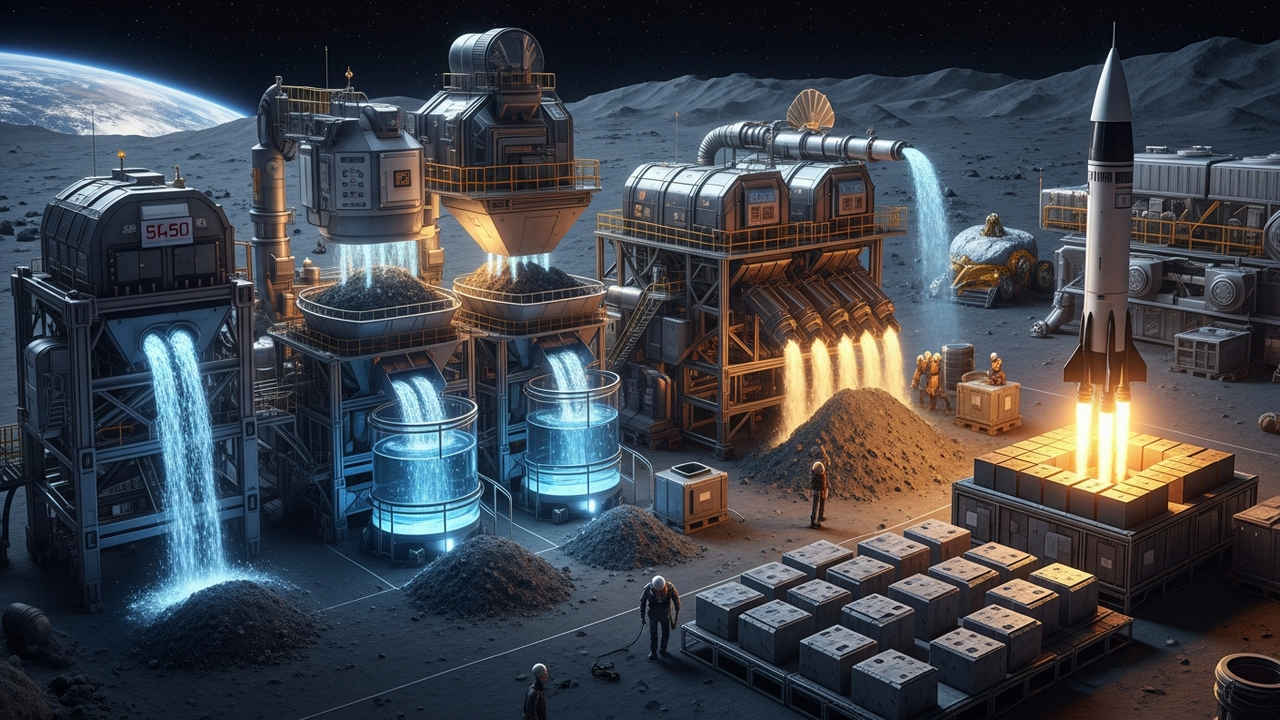
Lunar ISRU begins with “exploration” to locate resources. Lunar water exists as ice, hydroxyls, mineral-bound hydrogen, and trapped volatiles, with its form and quantity depending on geological factors, temperature, depth, concentration, and power access. Subsequently, “excavation” retrieves these materials, followed by “heating” to sublimate water ice and volatiles. “Capture” and “refining” processes then separate pure water and oxygen, which are safely stored in “storage” systems. Oxygen production from regolith is also critical, supplying breathable oxygen and rocket propellants (liquid oxygen and liquid hydrogen). Commercial viability hinges not only on laboratory successes but on large-scale demonstrations under actual lunar conditions. Despite environmental differences, lunar ISRU also offers opportunities to test excavation, processing, autonomy, power, storage, and surface construction methods for future Mars missions. A multifaceted approach includes co-production of water and oxygen, and plans to use regolith for construction materials and radiation shielding.
Background & Industry Context
The next frontier of space exploration involves establishing a permanent human presence on the Moon and Mars. To achieve this goal, the current model of transporting all supplies from Earth is neither economically nor logistically sustainable. ISRU is key to changing this paradigm and making space exploration sustainable. Since the Apollo program, NASA and other space agencies have recognized the potential of ISRU technologies, and recent advancements, coupled with the rise of the commercial space sector, have accelerated their practical application. The abundant water ice located at the lunar South Pole, in particular, significantly enhances the feasibility of this technology.
Future Outlook
The development of lunar ISRU technologies is critically important for determining the self-sufficiency of future lunar bases. As this technology matures, it will enhance the capabilities for lunar base construction, scientific research, resource mining, and serving as a fueling hub for lunar orbit and deep-space missions. Furthermore, ISRU technologies will dramatically reduce transportation costs from Earth, creating new business opportunities in the burgeoning space economy. This progress significantly expands humanity’s capacity to live and operate in space, ultimately paving the way for the ambitious goal of making humanity a multi-planetary species.



Comments