Key Findings
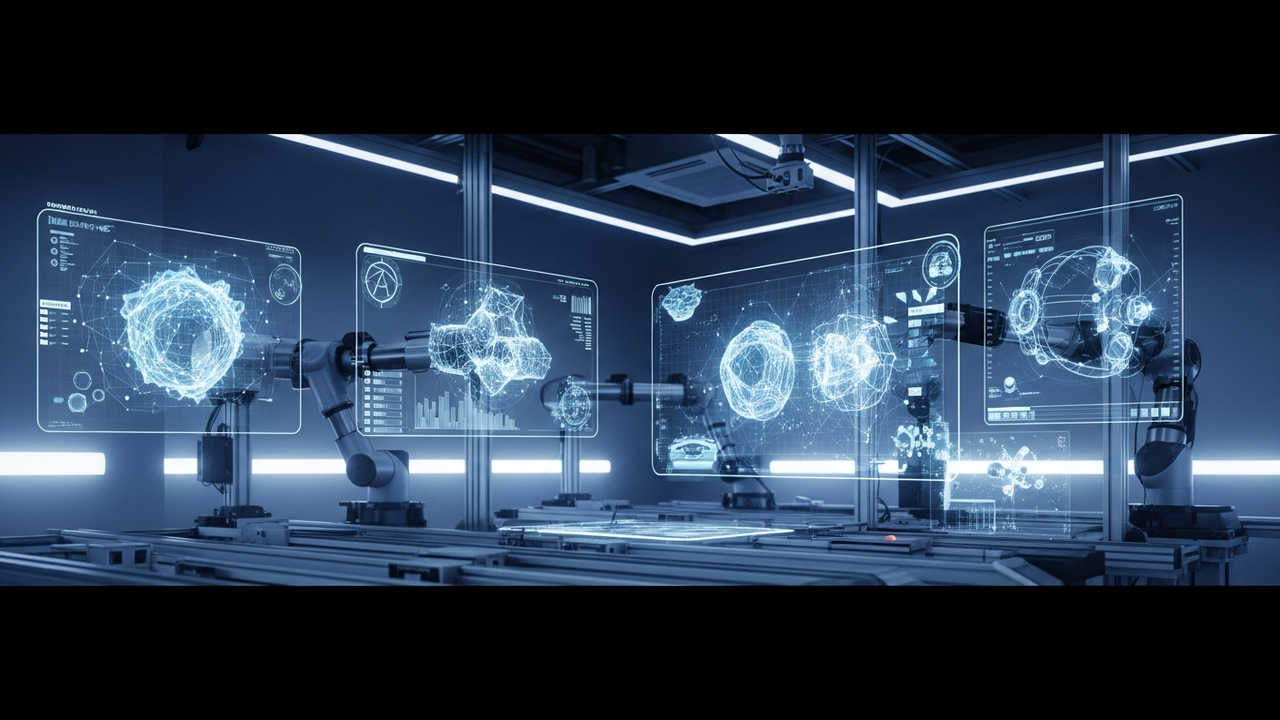
Groundbreaking advancements in light-based technology are anticipated to dramatically enhance 3D machine vision by allowing physical surroundings to function dynamically as “virtual screens.” This innovative approach has the potential to fundamentally transform how systems perceive and interact with their environments in applications such as robotics, augmented reality (AR), and virtual reality (VR). By providing more detailed and dynamic three-dimensional information in real-time, it will significantly improve the accuracy and efficiency of decision-making in autonomous systems.
Technical / Clinical Details
This “virtual screen” technology is primarily achieved by combining the following technical elements:
- Structured Light Projection: Light patterns (e.g., grids or dots) are projected onto the environment, and their distortions or reflection patterns are analyzed to accurately measure object shapes and distances. This generates real-time 3D maps of the surroundings.
- High-Speed Optical Sensing: Ultra-fast responding photodetectors and image sensors capture changes in projected light patterns with sub-millisecond precision. This enables the system to respond to fast-moving objects and dynamic environmental changes.
- Advanced Image Processing and AI Algorithms: The collected optical data is analyzed in real-time by machine learning algorithms for object identification, tracking, motion prediction, and semantic understanding of space. This enables higher-level perception based on the information displayed on the “virtual screen.”
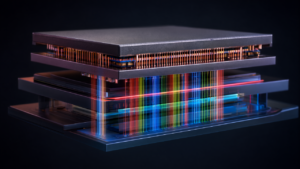
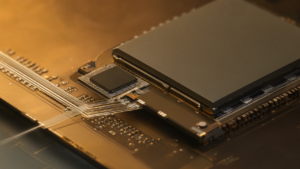
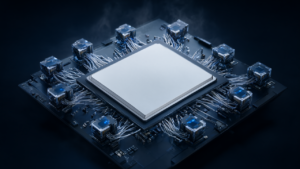
- Leveraging Silicon Photonics: Similar to the realization of cost-effective, chip-scale LiDAR, silicon photonics could be a foundational technology for integrating compact, high-performance optical projection and detection systems.
This technology has the potential to recognize not only depth information but also object materials, surface properties, and even transparent objects.
Background & Context
3D machine vision is an indispensable technology in many fields, including autonomous vehicles, industrial robots, smart manufacturing, security surveillance, and AR/VR devices. However, current 3D sensing technologies, particularly LiDAR and depth cameras, face challenges in terms of cost, size, resolution, and performance under adverse conditions (e.g., fog or rain). This “virtual screen” technology aims to address these challenges, offering more robust and widely adoptable 3D machine vision solutions. Especially when combined with AI, it opens up possibilities for extracting deeper insights from sensor data and achieving human-like environmental understanding.
Strategic Significance & Outlook
The advancement of optical technology that transforms surroundings into “virtual screens” has the potential to revolutionize the future of 3D machine vision. In robotics, it will enable robots to safely collaborate with humans in more complex environments, and in manufacturing, it will further enhance the automation of quality inspection and assembly tasks. In AR/VR, users will enjoy more realistic and interactive experiences that seamlessly merge the real and virtual worlds. For autonomous vehicles, it will enable more accurate obstacle detection and path planning, improving safety and reliability. This technology is expected to accelerate the convergence of AI and IoT, serving as a foundational element to fundamentally transform our lives and industries.
Source: https://www.photonics.com/Articles/Raytheon-and-GH-Build-Out-a-Domestic-TFLN-Supply/a71968