Key Findings
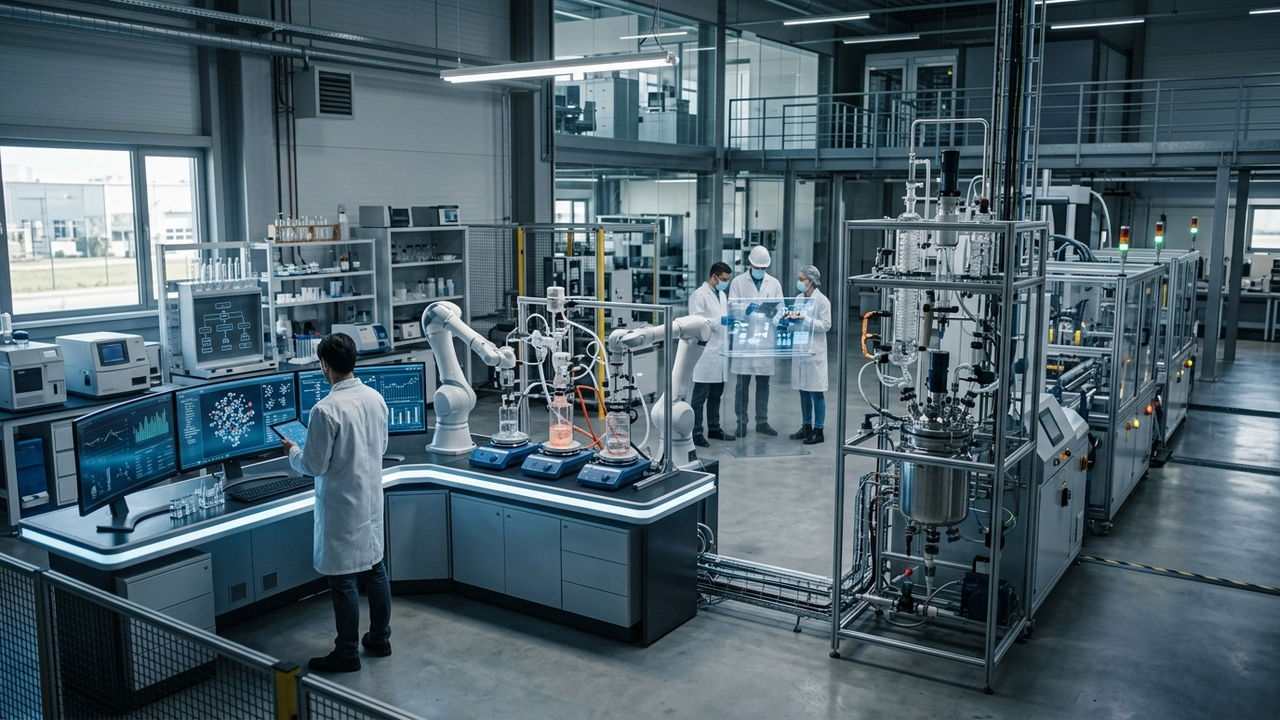
In the field of materials science, AI-driven strategies are gaining traction for addressing the challenge of manufacturability, extending beyond mere material property prediction. Specifically, Large Language Models (LLMs) have demonstrated the potential to directly and autonomously generate complex chemical synthesis protocols, promising to dramatically accelerate the transition from laboratory discovery to large-scale industrial production—the ‘lab-to-fab’ gap.
Technical / Clinical Details
This review explores the potential of LLMs to generate chemical synthesis procedures by viewing chemistry as a ‘language translation’ task. LLMs learn from vast datasets of existing chemical literature, reaction data, and synthesis protocols. Based on specific objectives (e.g., synthesizing a particular functional nanoparticle, manufacturing a polymeric material), they can generate detailed synthesis recipes, including reagent selection, reaction conditions (temperature, pressure, time), and purification methods, in natural language or code format. This allows AI to propose multiple synthesis pathways in minutes, a task that would take skilled chemists extensive trial and error. This technology significantly reduces the search space and development time, especially for novel materials or those with complex molecular structures. However, the review emphasizes that LLM-generated procedures carry a risk of ‘hallucination’ (generating non-functional or dangerous steps), necessitating extensive fine-tuning and rigorous validation by experienced chemists.
Background & Context
Material discovery often begins with small-scale laboratory synthesis, but scaling these processes for economic industrial production presents numerous challenges. This ‘lab-to-fab’ gap has been a major factor delaying the commercialization of new materials. The emergence of AI, particularly LLMs, offers a potential solution. LLMs can integrate human expert knowledge and propose creative synthesis pathways, potentially uncovering efficient production routes that might be overlooked by conventional methods. This represents a revolutionary advancement for broad chemical and materials industries, including pharmaceuticals, electronic materials, catalysts, and polymers.
Strategic Significance & Outlook
The autonomous generation of synthesis protocols by LLMs holds the potential to fundamentally transform the R&D process in materials manufacturing. In the future, ‘closed-loop manufacturing’ systems are envisioned, where AI-proposed synthesis pathways are automatically executed and optimized by autonomous laboratory robots, with results fed back to the AI. This is expected to dramatically shorten time-to-market for new materials and significantly reduce manufacturing costs. Further research needs to focus on improving LLM chemical reasoning capabilities, rigorously incorporating safety constraints, and integrating synthesis information across different scales (from molecular to process levels). Through these advancements, AI will establish itself as an ‘intelligent manufacturing assistant’ in materials science, enhancing industrial competitiveness.
Source: https://www.mdpi.com/3042-6723/1/3/14
Get our weekly technology intelligence — free
Receive an infographic that lets you judge at a glance whether each field’s analysis report is worth reading.
Subscribe Free — Weekly Tech Intelligence
By subscribing, you’ll receive Troy-Technical’s weekly technology intelligence newsletter.
- Your email and selected fields are used only to deliver the newsletter.
- We never share your information with third parties.
- You can unsubscribe anytime via the link in each email.
See our Privacy Policy for details.
Takes about a minute · Unsubscribe anytime









Comments