Key Findings
A research team at Tohoku University’s Advanced Institute for Materials Research (AIMR) has proposed a groundbreaking framework that fundamentally addresses long-standing bottlenecks in the polymer materials discovery process by integrating artificial intelligence (AI) with autonomous experimental systems. This innovative approach comprehensively tackles existing challenges such as fragmented polymer databases, inadequate incorporation of physical laws in AI predictive models, and the lack of seamless integration between simulation modules. The proposed self-automating workflow provides a complete blueprint for a closed-loop polymer discovery ecosystem, synergistically linking polymer databases, high-fidelity predictive models, intelligent AI agents, and automated laboratories.
Technical / Clinical Details
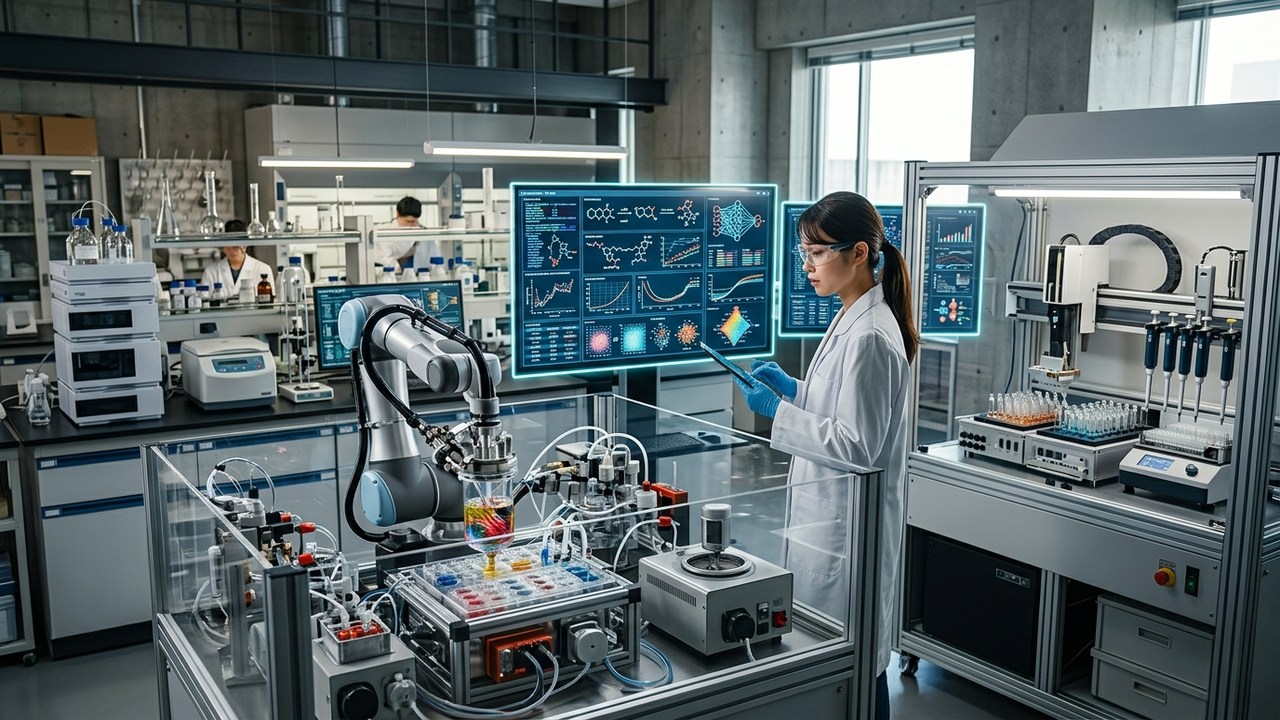
The framework is designed as a complex system where multiple components operate in concert. Firstly, data on existing polymer structures and properties are accumulated in an integrated, standardized database. Secondly, AI predictive models, trained on this data, propose novel polymer structures with specific target properties (e.g., mechanical strength, thermal stability, conductivity). These AI models are designed with embedded physicochemical constraints to generate only physically plausible and stable structures. Proposed structures are then validated through advanced simulation modules, such as molecular dynamics (MD) simulations and first-principles calculations, for detailed property evaluation. Subsequently, intelligent AI agents, informed by simulation results and historical experimental data, determine synthesis pathways and conditions for the next experimental round. Following these decisions, automated laboratories (robotic synthesis platforms, high-throughput characterization systems) execute the actual polymer synthesis and evaluation. The results are fed back into the database and used to further train and refine the AI models, completing a continuous feedback loop that accelerates discovery and minimizes human intervention to identify target polymers within shorter timeframes.
Background & Context
Polymer materials are indispensable in all sectors of modern society, including electronics, automotive, medicine, and construction. However, their design and discovery have traditionally been time-consuming and costly due to the immense number of chemical combinations and the complexity of synthesis conditions. Conventional polymer research heavily relied on manual processes and empirical rules, constituting a significant bottleneck hindering the development of new high-performance polymers. This framework, by integrating AI and automation technologies, aims to break through this bottleneck, dramatically improving R&D efficiency. This is expected to accelerate the development of next-generation innovative polymer products, such as bioplastics, smart polymers, and high-performance composites, thereby contributing significantly to sustainable societal development and strengthening industrial competitiveness.
Strategic Significance & Outlook
This AI-driven polymer discovery framework holds the potential to usher in a new era for polymer science. Future research will likely focus on refining AI models for broader types of polymers (e.g., copolymers, block copolymers) and for simultaneously optimizing multiple complex properties. Furthermore, extensive data sharing and the establishment of standardized protocols will be crucial for the widespread adoption and further development of this ecosystem. Ultimately, this technology is expected to be applied to other materials science domains, leading to the creation of fully autonomous material discovery lab networks, capable of providing material solutions to various global challenges at an unprecedented pace.
Source: https://www.eurekalert.org/news-releases/1142722
Get our weekly technology intelligence — free
Receive an infographic that lets you judge at a glance whether each field’s analysis report is worth reading.
Subscribe Free — Weekly Tech Intelligence
By subscribing, you’ll receive Troy-Technical’s weekly technology intelligence newsletter.
- Your email and selected fields are used only to deliver the newsletter.
- We never share your information with third parties.
- You can unsubscribe anytime via the link in each email.
See our Privacy Policy for details.
Takes about a minute · Unsubscribe anytime









Comments