Key Findings
The path to realizing commercial-scale induced pluripotent stem cell (iPSC)-derived cell therapies, while still presenting numerous challenges, is witnessing remarkable progress through technological innovation. Key accelerators in this field include the transition from personalized therapies to allogeneic, ‘off-the-shelf’ treatments, advanced gene-editing techniques to mitigate immunogenicity, and critical efforts to reduce raw material manufacturing costs.
Technical and Clinical Details
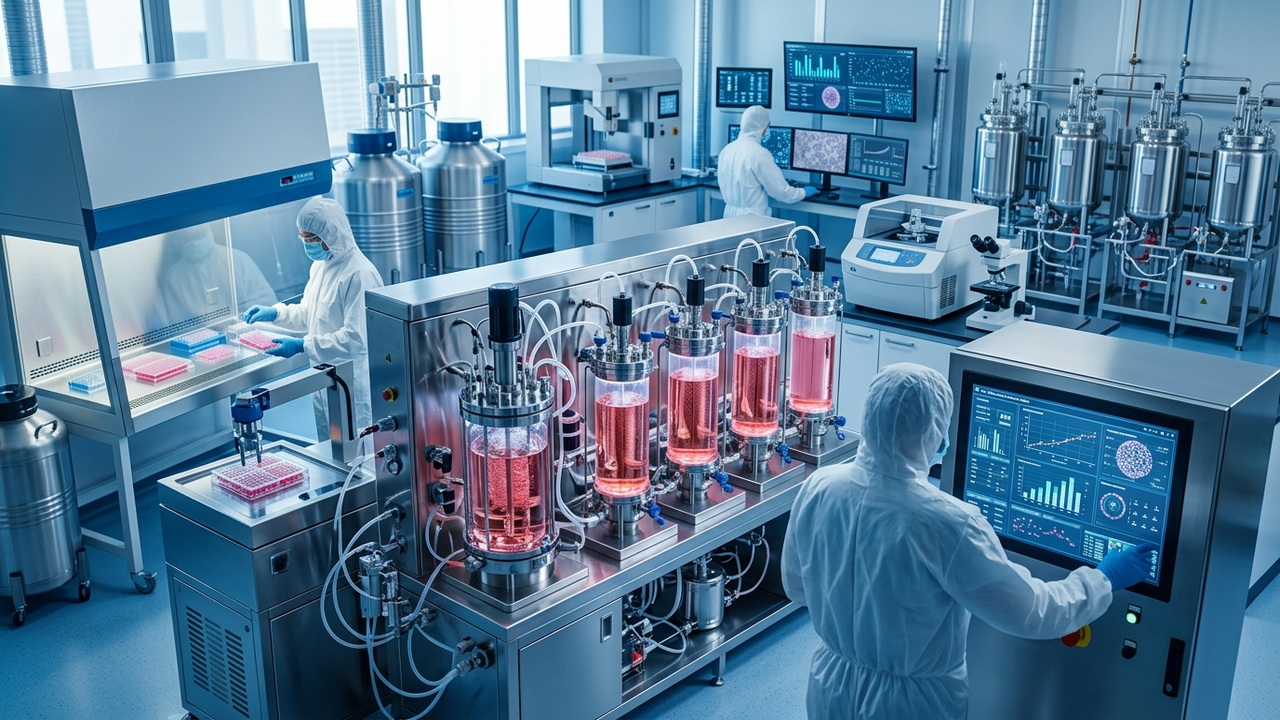
For commercial iPSC cell therapy, it is imperative to manufacture homogeneous, high-quality cells at large scale with high reproducibility. Allogeneic iPSC-derived cell therapies offer advantages in consistency and cost-efficiency compared to autologous therapies that use a patient’s own cells. However, allogeneic cells pose a risk of immune rejection, making gene-editing approaches—such as suppressing major histocompatibility complex (MHC) expression or introducing immunosuppressive molecules—crucial for reducing immunogenicity. The manufacturing costs of essential raw materials like cytokines also represent a significant barrier to commercialization, necessitating the development of efficient production methods and alternative components. The integration of automated cell processing technologies is also vital for both cost reduction and quality improvement.
Background and Industry Context
The regenerative medicine, particularly the cell therapy market, is experiencing rapid growth, with the allogeneic cell therapy market projected to reach $1.97 billion by 2026. This growth is underpinned by advancements in stem cell and immune cell engineering, increased funding for manufacturing infrastructure, and the adoption of automation technologies. Japan leads the world in iPSC development, exemplified by its conditional approvals for iPSC-derived products ‘Amchepry’ for Parkinson’s disease and ‘RiHEART’ for severe heart failure. However, the ultra-high prices of these therapies (exceeding 50 to 70 million yen per course) pose significant healthcare economic challenges. Globally, clinical applications of iPSC technology are accelerating, with XellSmart’s iPSC-derived cell therapy ‘XS411’ for Parkinson’s disease receiving FDA fast-track designation.
Future Outlook
For the commercial success of iPSC cell therapies, further reductions in manufacturing costs and innovative technological developments to overcome immunogenicity challenges are indispensable. Automated technologies, such as the Livit ACE continuous adherent cell expansion platform introduced through a partnership between Getinge and CellRev, will contribute to scaling up cell production and improving efficiency. In the future, the development of gene-edited ‘universal donor’ iPSC cell lines may enable the supply of off-the-shelf therapies for a broader patient population. Although iPSC cell banking services are available, as of August 2026, neither the PMDA nor the FDA has approved therapies derived from individually banked iPS cells. Resolving these challenges and making iPSC cell therapies more affordable and accessible to a wider patient base will be key to unlocking the true potential of this technology.
Get our weekly technology intelligence — free
Receive an infographic that lets you judge at a glance whether each field’s analysis report is worth reading.
Subscribe Free — Weekly Tech Intelligence
By subscribing, you’ll receive Troy-Technical’s weekly technology intelligence newsletter.
- Your email and selected fields are used only to deliver the newsletter.
- We never share your information with third parties.
- You can unsubscribe anytime via the link in each email.
See our Privacy Policy for details.
Takes about a minute · Unsubscribe anytime