Background
Perovskite light-emitting diodes (PeLEDs) are highly promising for next-generation displays and lighting due to their high color purity, narrow emission linewidths, and potentially low manufacturing costs. Among the primary colors, achieving high-efficiency and spectrally stable pure-blue emission remains the most significant challenge. Blue PeLEDs typically suffer from lower efficiencies and poorer stability compared to their green and red counterparts. This limitation is largely attributed to a high density of non-radiative defects, particularly halide vacancies, and detrimental ion migration within the perovskite lattice and at its interfaces. These issues lead to rapid efficiency droop and spectral shifts, hindering the commercial viability of blue PeLEDs. Therefore, effective passivation strategies that address both internal and surface defects, as well as ion migration, are urgently needed.
Key Findings
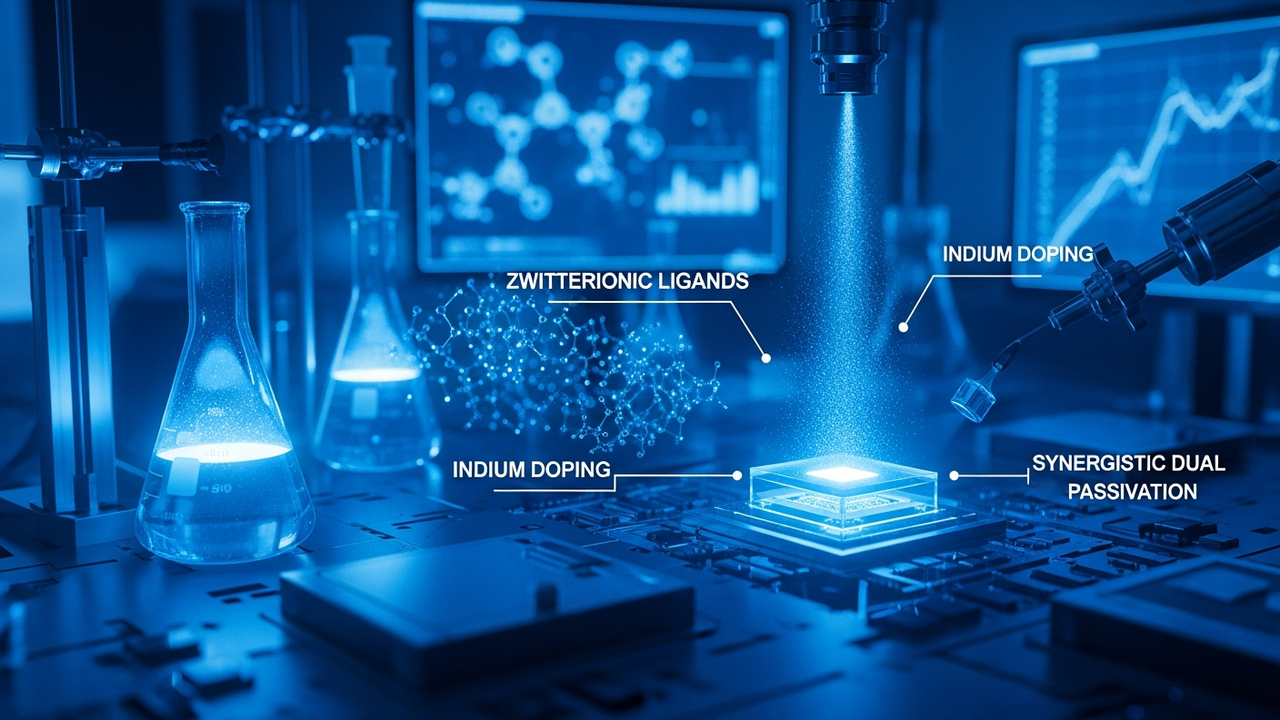
A research team has devised an innovative synergistic dual-passivation strategy to significantly improve the performance of pure-blue perovskite light-emitting diodes based on CsPb(Br/Cl)₃ nanocrystals. This approach integrates two distinct yet complementary passivation mechanisms to tackle the inherent challenges of blue PeLEDs.
- Indium (In³⁺) Doping: The researchers incorporated indium (In³⁺) ions into the perovskite lattice. In³⁺ ions act as effective defect-fillers, particularly for halide vacancies (Cl⁻ and Br⁻ vacancies), which are prevalent non-radiative recombination centers. By occupying these vacant sites, In³⁺ doping reduces the density of traps, thereby suppressing non-radiative recombination and improving the intrinsic photoluminescence quantum yield (PLQY) of the perovskite material.
- Zwitterionic Ligand (SB3-10) Modification: Simultaneously, a zwitterionic ligand, 3-(decyldimethylazaniumyl)propane-1-sulfonate (SB3-10), was introduced to modify the surface of the perovskite nanocrystals. Zwitterionic molecules possess both positive and negative charges within a single molecule, allowing them to effectively bind to and passivate surface defects. Critically, the bulky nature and strong dipolar fields of SB3-10 also sterically hinder and electrostatically repel halide ion migration, which is a major cause of spectral instability and degradation.
- Synergistic Passivation: The combination of In³⁺ doping (addressing bulk defects) and SB3-10 surface modification (addressing surface defects and ion migration) results in a powerful synergistic passivation effect. This comprehensive defect management leads to a dramatic enhancement in the PLQY and significantly improved spectral stability, which are crucial for high-performance PeLEDs.
Technical Significance & Outlook
This dual-passivation strategy represents a critical breakthrough for pure-blue PeLED technology. By effectively mitigating the dominant defect and instability issues, it paves the way for the development of high-efficiency and spectrally stable blue emitters, which are essential for enabling full-color, ultra-high-definition displays (e.g., micro-LEDs, flexible displays) and high-quality white lighting. The ability to precisely control defect states and ion migration through such molecular engineering approaches is fundamental for the commercial viability of PeLEDs. The systematic understanding of how In³⁺ doping interacts with zwitterionic ligands offers a robust design principle for future material development. Future research will focus on scaling these highly efficient blue PeLEDs to larger device areas, demonstrating long-term operational stability under industrial stress conditions, and integrating them into full-color display prototypes. This research significantly advances the field of perovskite optoelectronics, pushing PeLEDs closer to market readiness.








Comments