Background
Perovskite quantum dot solar cells (PQDSCs) are emerging as a promising class of next-generation photovoltaics due to their unique optoelectronic properties, including strong light absorption, high exciton binding energy, and solution processability. Specifically, CsPbI₃ quantum dots offer potential for high efficiencies. However, the performance and stability of PQDSCs are often limited by charge recombination losses and inefficient charge extraction at the interface between the electron transport layer (ETL), typically TiO₂, and the perovskite quantum dot active layer. Interfacial defects can act as carrier trapping sites, reducing the lifetime of photogenerated charge carriers and diminishing overall device performance. Therefore, effective interface engineering strategies are crucial to address these challenges and improve charge transport efficiency.
Key Findings / Results
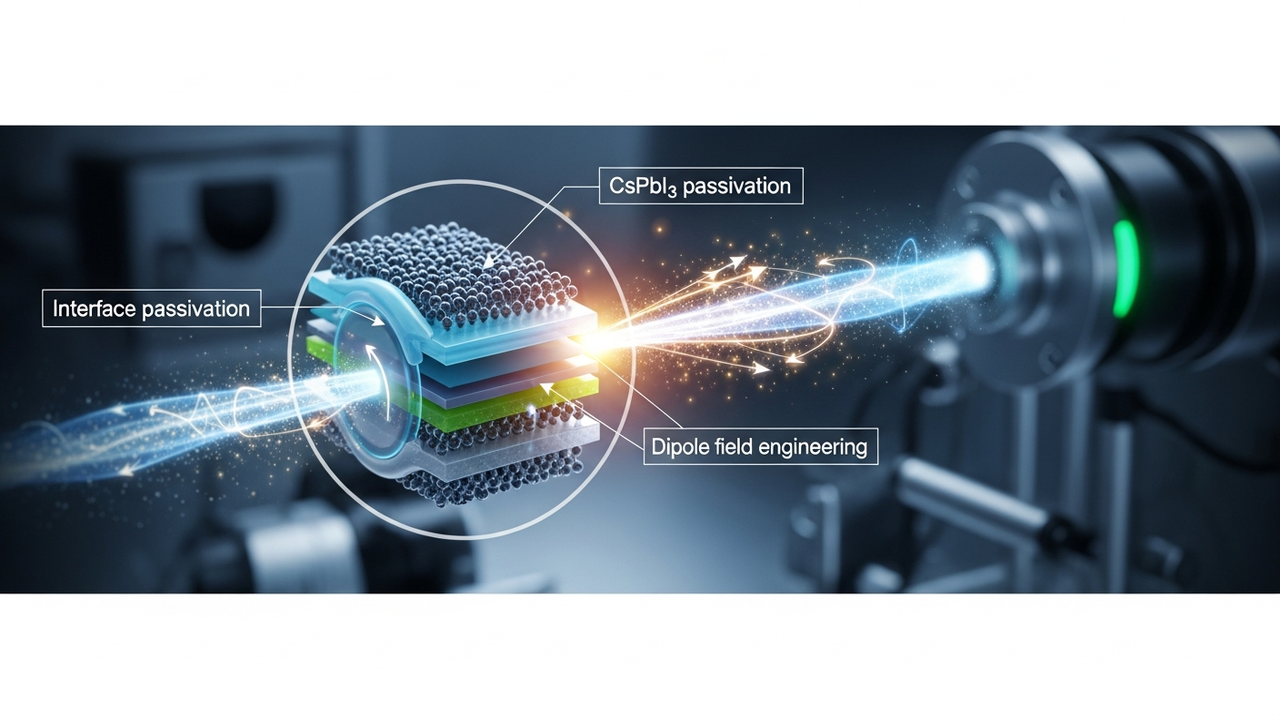
In this study, researchers developed an innovative synergistic interface engineering strategy aimed at boosting the efficiency of CsPbI₃ perovskite quantum dot solar cells. Their novel approach involves the strategic introduction of 6-aminonicotinic acid (AMC) molecules at the crucial interface between the TiO₂ electron transport layer and the CsPbI₃ perovskite quantum dot active layer.
- AMC Molecule Introduction: AMC molecules possess functional groups that enable them to interact effectively with both the TiO₂ surface and the PQD layer. This dual interaction allows for the effective passivation of interfacial defects, reducing trapping states for charge carriers.
- Dual Functionality – Passivation and Dipole Field Engineering: The AMC molecules demonstrate a dual functionality. Not only do they passivate defects, but they also induce a dipole electric field at the interface. This intrinsic dipole field actively promotes the separation and transport of charge carriers, directing electrons more efficiently into the ETL and holes towards the hole transport layer.
- Synergistic Enhancement: The simultaneous action of defect passivation and dipole-field-induced charge transport creates a synergistic effect. This dramatically suppresses interfacial charge recombination and significantly enhances charge extraction efficiency, leading to a more efficient device.
- Efficiency Improvement: As a direct consequence of this strategy, the power conversion efficiency of the CsPbI₃ perovskite quantum dot solar cells improved from an initial 13.1% to a notable 15%.
Technical Significance & Outlook
This interface engineering strategy represents a significant breakthrough in enhancing the performance of PQDSCs. Particularly, the dual functionality of AMC molecules, simultaneously passivating defects and facilitating charge transport through dipole fields, offers a robust and elegant solution to critical interfacial challenges. The improvement to 15% efficiency is an important step towards the practical application of PQDSCs, contributing to the development of more efficient and stable quantum dot solar cells. For experienced engineers, this work highlights the critical role of precise interface control in optimizing optoelectronic devices. Future work will focus on scaling this strategy to larger-area devices, validating long-term stability under various environmental conditions, and exploring its applicability to other perovskite compositions and quantum dot sizes to further broaden its impact. This research provides fundamental insights into interface design, which is paramount for the continued advancement of next-generation photovoltaic technologies.









Comments