Background
Formamidinium lead iodide (FAPbI₃) perovskite is one of the most promising active layer materials for perovskite solar cells (PSCs) due to its ideal bandgap of approximately 1.47 eV, which theoretically allows for very high single-junction efficiencies. However, a major bottleneck preventing its widespread commercialization has been its inherent phase instability. FAPbI₃ tends to transition from its desirable photoactive α-phase to an undesirable non-photoactive δ-phase under operational conditions, largely driven by the excessive rotational freedom of the organic FA⁺ cations and associated entropy effects. This phase transition leads to rapid degradation in performance and limits device longevity, making the development of robust stabilization strategies critical for practical applications.
Key Findings / Results
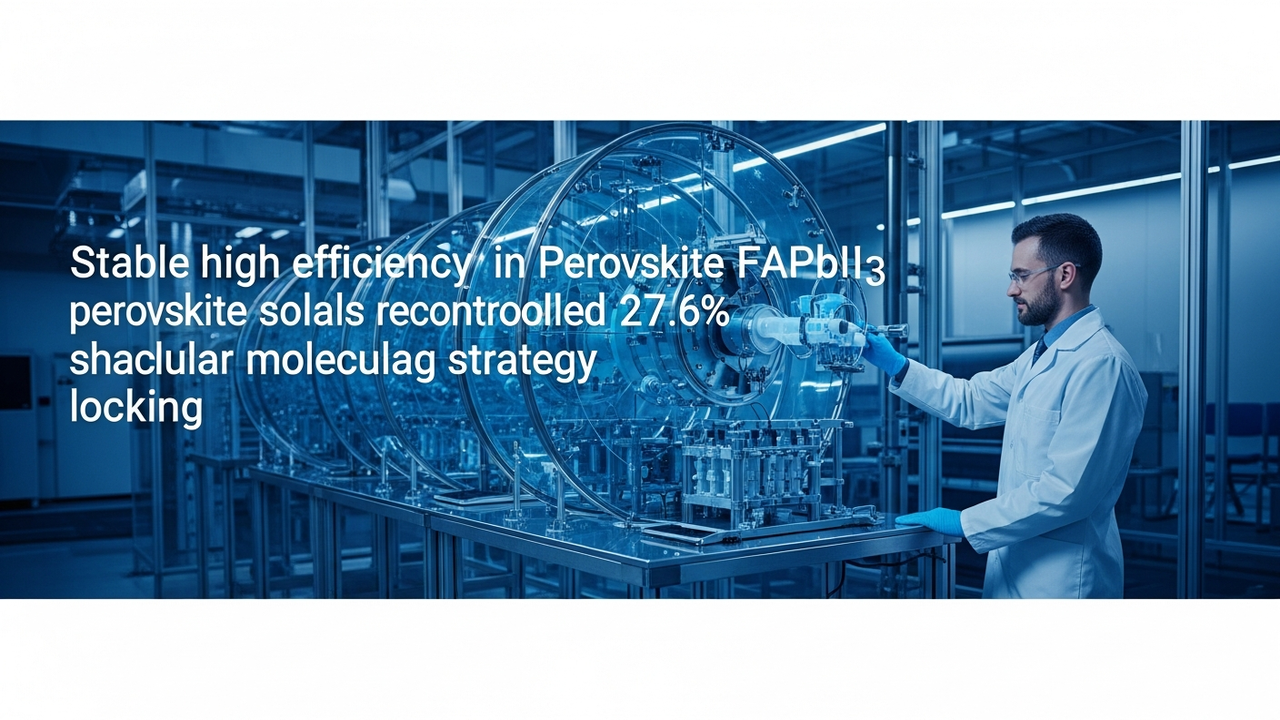
An international collaboration of researchers from China, South Korea, and Russia has introduced a groundbreaking “entropy-regulated molecular-lock” strategy that effectively addresses the phase instability of FAPbI₃ perovskite solar cells. This innovative molecular-level approach has enabled the achievement of a stable, record-breaking power conversion efficiency (PCE) of 27.6% for single-junction perovskite devices.
- Molecular-Lock Additive: The core of the strategy involves the incorporation of a novel organic additive, 1-pyridin-3-ylmethyl-piperazine hydrochloride (3-PMPCl), into the FAPbI₃ perovskite precursor solution.
- Restricting Cation Rotation: The 3-PMPCl molecules interact with the FA⁺ cations within the perovskite lattice, effectively restricting their rotational freedom. This molecular “locking” mechanism reduces the entropy associated with the organic cations’ movement.
- Suppression of Entropy-Driven Phase Transition: By limiting the rotational freedom, the entropy-driven phase transition from the photoactive α-phase to the detrimental δ-phase is significantly suppressed. This dramatically enhances the long-term phase stability of the FAPbI₃ perovskite film under operational conditions.
- Record Efficiency and Stability: The implementation of this molecular-lock strategy resulted in FAPbI₃ PSCs achieving a remarkable 27.6% PCE, placing it among the highest reported efficiencies for single-junction perovskite solar cells. Crucially, the devices also exhibited significantly improved long-term stability, a vital step towards practical deployment.
Technical Significance & Outlook
This entropy-regulated molecular-lock strategy represents a transformative advancement for FAPbI₃ perovskite solar cells, resolving a longstanding challenge in phase stability. The record 27.6% efficiency not only surpasses most current commercial silicon technologies but also approaches their theoretical limits (around 29.4%), underscoring perovskites’ potential as a dominant future PV technology. For experienced engineers, ensuring the intrinsic stability of FAPbI₃ is paramount for outdoor reliability and commercialization, and this molecular engineering approach provides a robust solution. This breakthrough significantly enhances the viability of high-performance FAPbI₃ PSCs for a wide range of applications. Future work will focus on further optimizing the molecular-lock additive, scaling up the fabrication process to large areas, and conducting rigorous long-term outdoor field tests to meet international certification standards. This international collaborative research is a critical step forward in both the fundamental chemistry and applied physics of perovskite materials, with profound implications for the global solar energy industry.








Comments