Key Findings
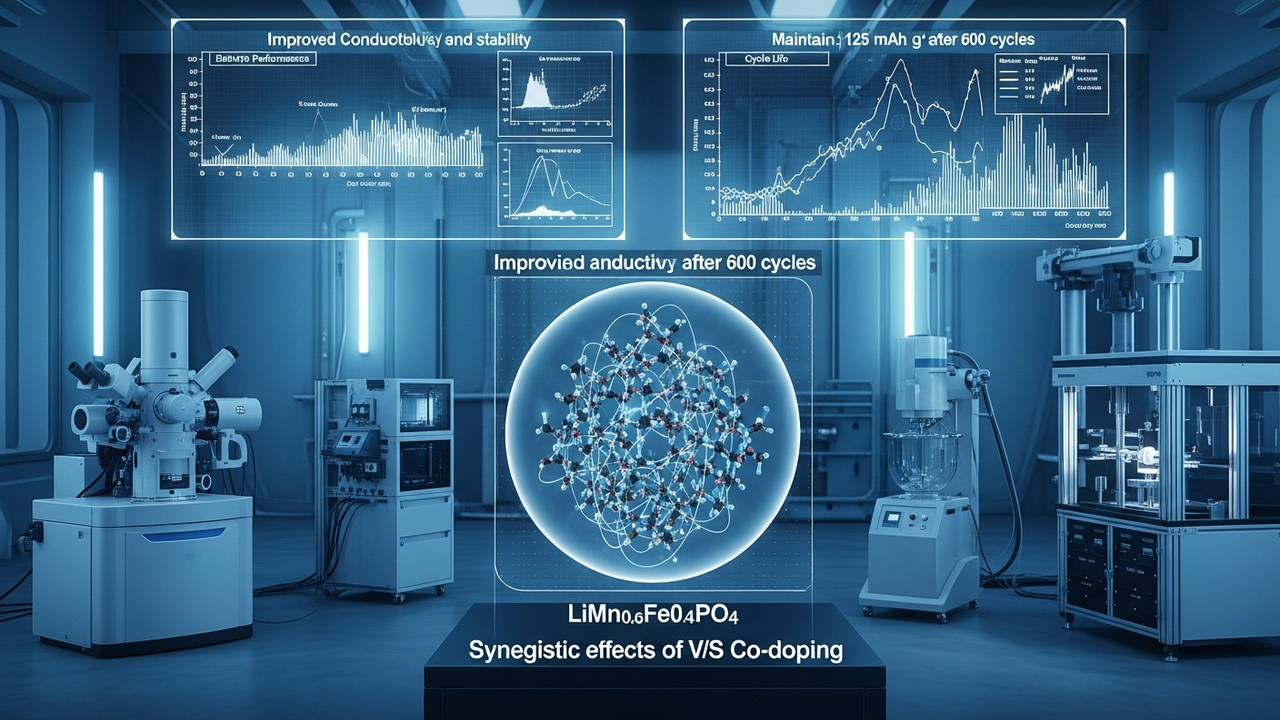
Academic research has conclusively demonstrated that co-doping with vanadium (V) and sulfur (S) dramatically enhances the electrochemical performance of LiMn0.6Fe0.4PO4 (LMFP) cathode materials for lithium-ion batteries (LIBs). Specifically, this VS-LMFP cathode achieved an impressive initial discharge capacity of 156.7 mAh g^-1 at a low rate of 0.1C. Furthermore, it successfully maintained a high capacity of 125 mAh g^-1 even after 600 cycles at a practical rate of 1C, showcasing remarkable rate performance and long-term cycle stability.
Technical Details and Mechanism
LMFP is an attractive cathode material due to its promising features: high voltage (approximately 4.1V vs Li/Li+), high safety, low cost, and good power characteristics. However, its practical implementation has been hindered primarily by low electrical conductivity and structural instability caused by the Jahn-Teller distortion associated with manganese (Mn). The synergistic co-doping of V and S in this study provides a multi-faceted solution to these challenges:
- Improved Li+ Diffusion Kinetics: The introduction of V and S ions into the LMFP crystal lattice optimizes the diffusion pathways for lithium ions (Li+), leading to enhanced diffusion kinetics. This allows lithium ions to efficiently intercalate and de-intercalate within the active material, particularly during fast charge/discharge (high-rate performance).
- Structural Stabilization Against Jahn-Teller Distortion: Manganese-containing materials are prone to structural instabilities known as Jahn-Teller distortion during cycling. The co-doping of V and S strengthens the interatomic bonds within the crystal structure, suppressing this distortion and improving the overall structural stability of the material. This mitigates electrode degradation and extends cycle life.
- Reduced Charge Transfer Resistance: V and S doping also enhances the electronic conductivity of the LMFP material. Improved electronic conduction pathways reduce charge transfer resistance between active material particles and the current collector, enabling more efficient electron exchange. This directly contributes to the battery’s overall power and efficiency.
- Performance Metrics: The initial discharge capacity of 156.7 mAh g^-1 at 0.1C is a high value, close to the theoretical capacity (approximately 170 mAh g^-1), indicating high utilization efficiency of the active material. Maintaining 125 mAh g^-1 after 600 cycles at 1C, with a capacity retention exceeding 80% (125/156.7), is an excellent result demonstrating long-term reliability.
Background & Industry Context
With the increasing demand for electric vehicles (EVs) and stationary energy storage systems (ESS), high-performance, safe, and inexpensive cathode materials are indispensable. Lithium iron phosphate (LFP) is already widely adopted, but for markets demanding higher energy density, LMFP is emerging as a strong next candidate. However, material engineering approaches to overcome the performance limitations of LMFP have been a challenge. This research, using a straightforward V and S co-doping method, addresses key weaknesses of LMFP, significantly paving the way for its commercialization. Strategies like upcycling spent LiFePO4 (LFP) cathode material to high-performance LMFP are also gaining attention from a resource circularity perspective.
Strategic Significance & Outlook
The performance enhancement of LMFP cathodes through V and S co-doping represents a significant breakthrough for high-performance lithium-ion batteries. Future challenges will include validating the industrial scalability, cost-effectiveness, and long-term stability of this doping technology across different cell formats. If commercialized, this technology is expected to contribute to the realization of EV batteries and grid-scale ESS with higher energy density and superior cycle stability, playing an indispensable role in achieving global energy transition goals.