
The Imperative of Quantum Hardware Development and Accelerated R&D Investment
The commercialization of quantum computing is intrinsically linked to the continuous improvement of hardware performance, specifically qubit stability, scalability, and error rates. The trapped-ion modality, in particular, holds significant promise due to its potential for high-fidelity qubit control and long coherence times. However, building large-scale, fault-tolerant systems necessitates sophisticated advancements in quantum chip design and fabrication technologies, as well as the surrounding control infrastructure. Recognizing these critical needs, quantum computing companies are accelerating strategic investments in hardware R&D, establishing dedicated facilities to expedite innovation cycles and overcome engineering hurdles.
IonQ’s Boulder R&D Lab: Establishment and Objectives
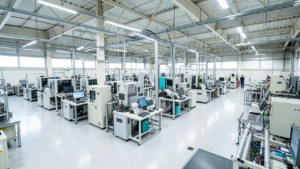
IonQ has inaugurated a cutting-edge quantum computing R&D laboratory in Boulder, Colorado. The primary objective of this new facility is to accelerate the development of core technologies for IonQ’s future generations of quantum computing systems. The lab is outfitted with advanced equipment for semiconductor chip design, fabrication, and testing, with a strong emphasis on optimizing the manufacturing processes for ion-trap chips to enhance qubit performance and integration density. Specifically, research and development efforts will focus on improving the precision of fundamental operations like laser cooling, quantum gate manipulation, and quantum state readout, in addition to exploring new architectures for efficiently integrating a greater number of qubits. Boulder’s ecosystem, home to institutions like the National Institute of Standards and Technology (NIST) and the University of Colorado Boulder, offers strategic advantages in talent acquisition and collaborative research.
Impact on Quantum Technology Evolution and Industry Landscape
The establishment of this R&D lab is a cornerstone of IonQ’s strategy to further solidify its leadership in the quantum computing sector. The advancements in ion-trap chip technology and the subsequent performance enhancements in IonQ’s quantum computers are expected to broaden the applicability of quantum computing, enabling solutions for increasingly complex problems. Potential applications include higher-fidelity molecular modeling in quantum chemistry simulations, accelerated optimization problems in financial modeling, and improved materials property prediction for novel material discovery. Furthermore, hardware evolution typically stimulates progress in software and algorithm development, fostering the growth of the entire quantum ecosystem. This investment represents a crucial step towards achieving “practical quantum advantage” sooner, serving as a catalyst for innovation across diverse industries such as healthcare, energy, and aerospace. IonQ’s Boulder lab is poised to become a pivotal hub in shaping the future trajectory of quantum technology.








Comments