Key Findings
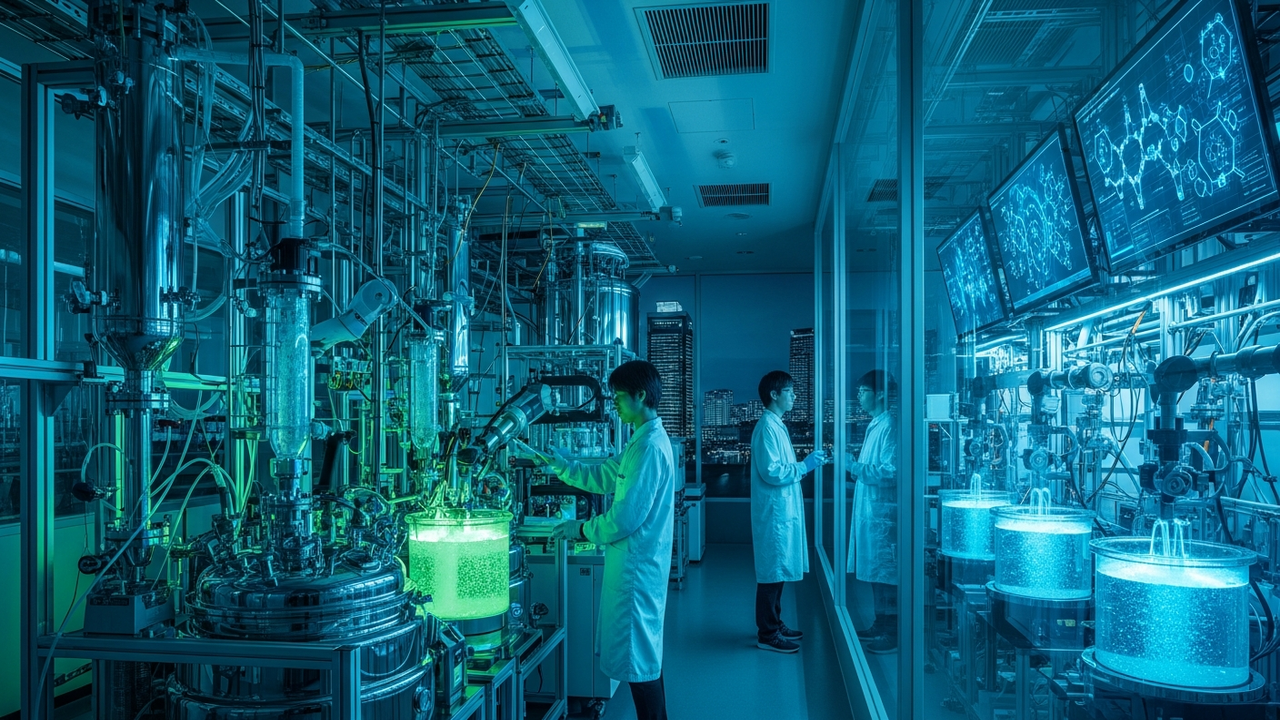
JGC Holdings Corporation has officially opened its inaugural bio-manufacturing research facility, “JBX1,” on Kobe Port Island. This advanced facility aims to produce chemicals and various materials from non-fossil resources, with gas fermentation technology at its core. Particularly noteworthy is its ambitious goal: to develop groundbreaking technology for the direct synthesis of polymers from carbon dioxide (CO2) using microorganisms. This is a powerful collaborative project with Bacchus Bio Innovation, Kaneka, and Shimadzu Corporation, supported by the New Energy and Industrial Technology Development Organization’s (NEDO) Green Innovation Fund. This initiative marks a crucial strategic step for Japan towards realizing a carbon-neutral society.
Technical Details
The primary technological focus of the JBX1 research facility is bio-manufacturing processes that directly utilize CO2 to produce valuable chemicals and materials. In contrast to conventional chemical manufacturing processes that rely on fossil fuels and emit substantial CO2, this gas fermentation technology converts CO2 from exhaust gases through the metabolic activities of microorganisms.
- Gas Fermentation Technology: This technology harnesses the ability of specialized microorganisms to consume gaseous carbon sources such as CO2, CO (carbon monoxide), and H2 (hydrogen) to produce compounds like acetic acid, ethanol, or more complex chemicals. At JBX1, the goal is to optimize this microbial platform to directly generate polymer precursors or monomers.
- Direct Polymer Synthesis from CO2: The ultimate objective of the project is to establish a technology where microorganisms directly uptake CO2 and synthesize biopolymers (e.g., polyhydroxyalkanoates, PHAs) or monomers that serve as raw materials for conventional petroleum-derived polymers (e.g., polyethylene, polypropylene). This approach reuses CO2 not as a waste product but as a valuable resource.
- Multi-Company Collaboration: JGC Holdings provides expertise in plant engineering and know-how in the design, construction, and operation of bio-manufacturing facilities. Bacchus Bio Innovation contributes proprietary microbial development and fermentation process optimization technologies. Kaneka offers insights into polymer manufacturing, and Shimadzu Corporation supports the project with advanced analytical and measurement technologies. This multifaceted collaboration accelerates complex technological development.
The facility is equipped to conduct integrated research, from basic science to validation of scale-up technologies, serving as a critical bridge towards commercialization.
Background & Industry Context
To achieve global decarbonization targets under the Paris Agreement, industries worldwide urgently need to reduce CO2 emissions and transition to a circular economy. The chemical industry, in particular, is one of the major sources of CO2 emissions and is strongly urged to shift towards sustainable raw materials as alternatives to fossil fuels. NEDO’s Green Innovation Fund is a large-scale national project aimed at supporting Japan’s goal of carbon neutrality by 2050 while maintaining industrial competitiveness. In this context, JGC Holdings’ initiative to directly synthesize polymers from CO2 holds the potential to redefine the future of the chemical industry.
Strategic Significance & Outlook
Successful technological development at the JBX1 research facility would position it at the forefront of Carbon Capture and Utilization (CCU) technologies that capture and utilize CO2 at emission sources. This could significantly impact a wide range of industries, including automotive, packaging, construction, and electronics, by reducing reliance on fossil resources and establishing sustainable material supply chains. For investors, it offers long-term investment opportunities in the growing fields of decarbonization and the bioeconomy. For engineers and researchers, it will be an exciting place to contribute to the development of innovative bio-manufacturing processes using CO2 as a raw material. The facility is expected to become a symbolic entity for Japan’s scientific and technological contributions to solving global environmental challenges.
Source: https://zenbird.media/new-kobe-research-centre-converts-carbon-dioxide-for-bio-manufacturing/
Get our weekly technology intelligence — free
Receive an infographic that lets you judge at a glance whether each field’s analysis report is worth reading.
Subscribe Free — Weekly Tech Intelligence
By subscribing, you’ll receive Troy-Technical’s weekly technology intelligence newsletter.
- Your email and selected fields are used only to deliver the newsletter.
- We never share your information with third parties.
- You can unsubscribe anytime via the link in each email.
See our Privacy Policy for details.
Takes about a minute · Unsubscribe anytime






Comments