Background
The rapid evolution of additive manufacturing (3D printing) has expanded its reach from prototyping to functional end-part production across various industries. However, specific sectors like electronics, aerospace, and automotive demand materials with specialized properties to ensure safety and performance. Historically, achieving both high flame retardancy (to prevent fire propagation) and electrostatic discharge (ESD) safety (to protect sensitive electronic components) in 3D printable resins has presented a significant technical challenge, limiting the widespread adoption of additive manufacturing in these critical applications.
Key Findings / Results
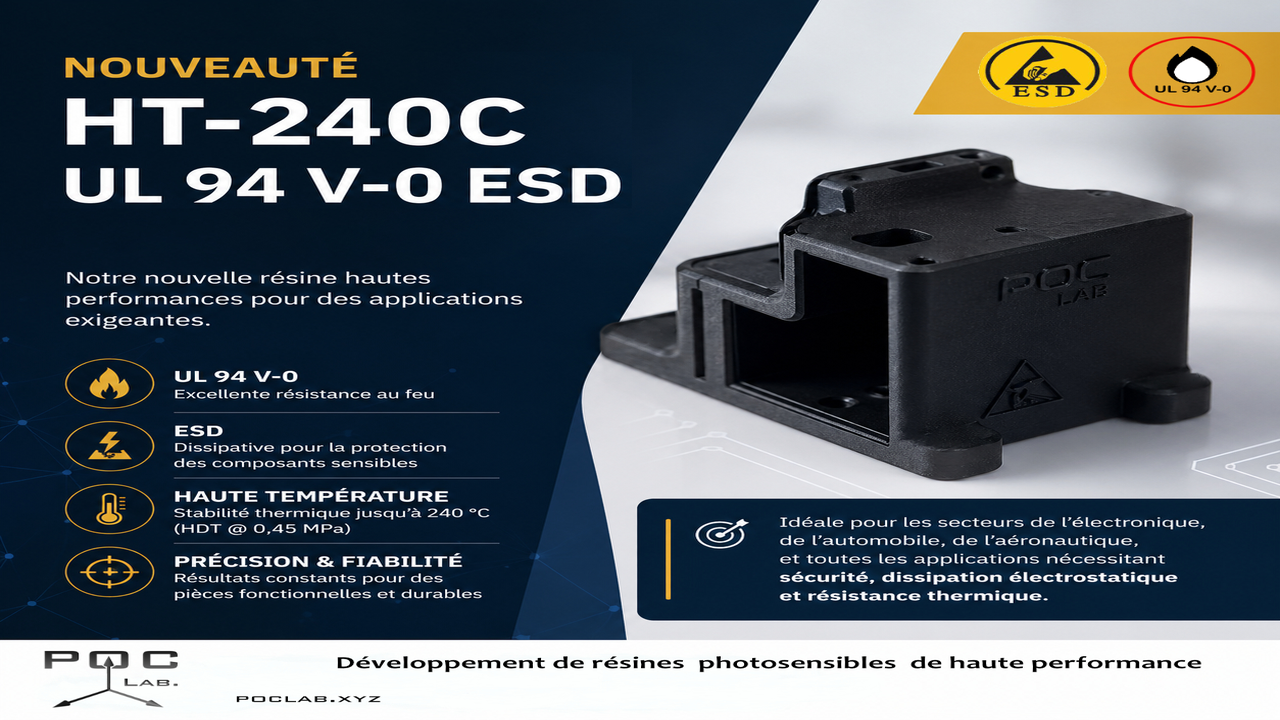
POC Lab has engineered and launched two innovative photopolymer resins designed to meet these stringent industrial requirements. These new resins are certified to UL94 V-0, indicating excellent flame-retardant properties, and simultaneously provide robust ESD protection. A standout product, the HT-240C UL94 V-0 ESD resin, offers an exceptional heat deflection temperature of 240°C. Critically, it delivers isotropic ESD performance across the printed object, meaning its electrostatic dissipative properties are uniform regardless of print orientation. This combination of thermal stability, flame retardancy, and consistent ESD performance makes it ideal for manufacturing sophisticated functional components such, as electronic housings, fixtures, and jigs, especially those operating in high-temperature environments. The second resin in the series offers similar capabilities, broadening the material selection for demanding applications.
Technical Significance & Outlook
The introduction of these advanced resins from POC Lab is poised to significantly impact the professional additive manufacturing landscape. By integrating critical properties like flame retardancy and ESD safety into 3D printable materials, the technology can now produce safer and more reliable functional parts for high-stakes applications. This opens new avenues in the electronics sector for intricate casings and connectors, in aerospace for lightweight yet fire-safe structural components, and in automotive for heat-resistant interior parts. The ability to fulfill these dual requirements expands the addressable market for industrial 3D printing, offering engineers greater design freedom and enhancing the performance and safety profiles of final products in critical industries. These materials represent a crucial step in maturing additive manufacturing for highly regulated and performance-driven environments, potentially leading to faster development cycles and customized solutions.








Comments