Key Findings
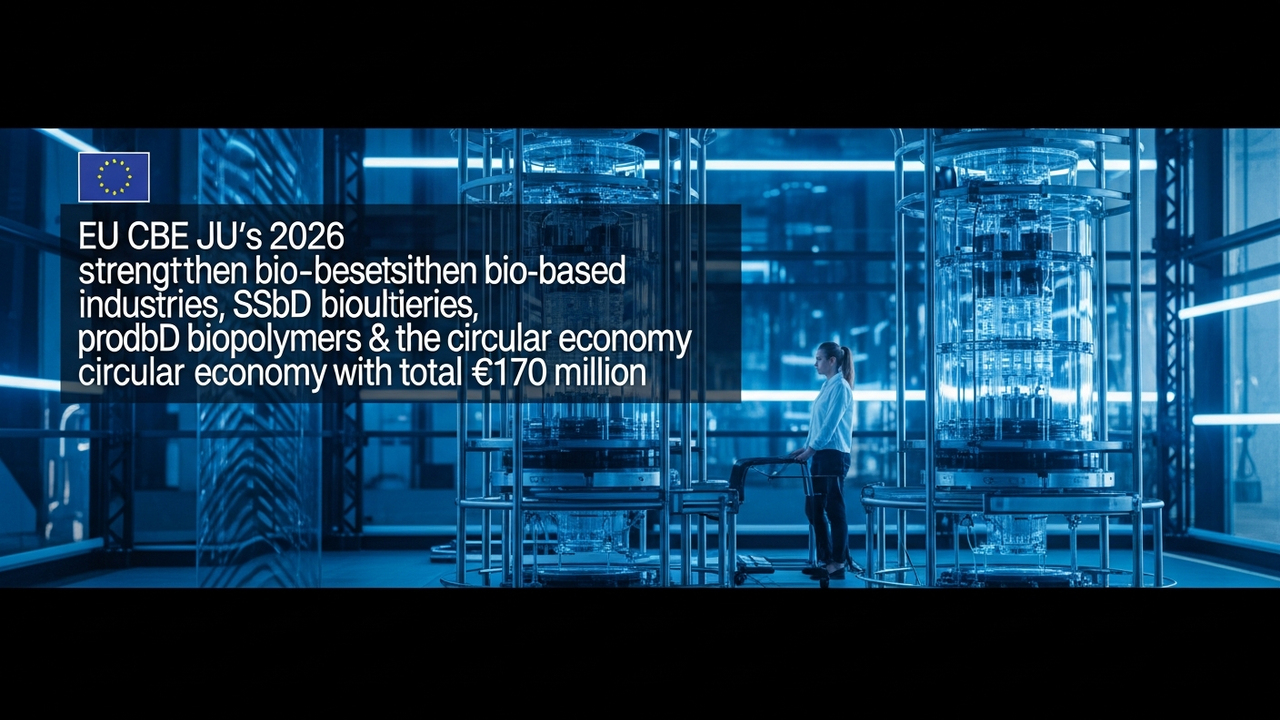
The European Union’s Circular Bio-based Europe Joint Undertaking (CBE JU) has announced its 2026 annual work program and launched a substantial call for project proposals, committing a total of €170.7 million across 13 distinct topics. This initiative is designed to accelerate the development and scaling-up of a competitive circular bio-based industry within Europe. Key focuses include diversifying sustainable feedstocks for bio-based polymers, developing efficient and scalable processes (Technology Readiness Level 5: TRL 5) for SSbD (Safe and Sustainable by Design) bio-based polymers from non-agricultural and non-forestry alternative sources, and expanding the portfolio of high-performance bio-based polymers.
Technical / Clinical Details
To drive the bioeconomy from research to industrial deployment, the call outlines 13 specific thematic areas. A central objective is the creation of bio-based polymers that integrate both sustainability and safety. This involves supporting the technological development for efficiently synthesizing and extracting high-performance bio-based polymers from non-agricultural and non-forestry alternative raw materials—such as industrial waste or microbial biomass—through innovative chemical and biological conversion processes. The requirement for TRL 5 process development signifies a critical step in translating laboratory insights into commercial-scale applications. The resulting polymers must not only demonstrate high functionality but also adhere to ‘Safe and Sustainable by Design’ principles, encompassing environmental safety, biodegradability, and recyclability.
Background & Context
As part of its Green Deal policy, the European Union is strongly committed to reducing its reliance on fossil resources and transitioning towards a circular economy. The bio-based industry plays a pivotal role in achieving this objective by providing sustainable material sources and fostering new job creation. CBE JU, a public-private partnership, comprehensively supports bio-based solutions from R&D to market introduction, and this call represents a continued execution of Europe’s bioeconomy strategy. Against a backdrop of tightening PFAS regulations, among other factors, demand for high-performance, low-environmental-impact polymers is rapidly increasing.
Strategic Significance & Outlook
The CBE JU’s 2026 call is expected to further strengthen Europe’s bio-based industry innovation ecosystem, accelerating regional investment and job creation. Project funding of up to €20 million, with potential funding rates of 60% for companies and 100% for non-profit organizations, is designed to encourage broad participation from stakeholders ranging from research institutions to SMEs and large corporations. This will facilitate the commercialization of next-generation bio-based polymer technologies, leading to the provision of more sustainable and high-performance products across various industrial sectors (e.g., packaging, automotive, construction, consumer goods). Through these efforts, Europe aims to solidify its leadership position in the global bio-based industry.
Source: https://cbe.europa.eu/
Get our weekly technology intelligence — free
Receive an infographic that lets you judge at a glance whether each field’s analysis report is worth reading.
Subscribe Free — Weekly Tech Intelligence
By subscribing, you’ll receive Troy-Technical’s weekly technology intelligence newsletter.
- Your email and selected fields are used only to deliver the newsletter.
- We never share your information with third parties.
- You can unsubscribe anytime via the link in each email.
See our Privacy Policy for details.
Takes about a minute · Unsubscribe anytime






Comments