Background: The Bottleneck of Catalysis in Green Hydrogen Production
The global imperative for clean energy has positioned green hydrogen production via water electrolysis as a cornerstone technology for decarbonization. However, the widespread adoption of this technology has been severely hampered by the high cost and scarcity of noble metal catalysts, such as platinum for the hydrogen evolution reaction (HER) and ruthenium/iridium oxides for the oxygen evolution reaction (OER). These catalysts are essential for overcoming the kinetic sluggishness of both half-reactions, particularly the OER, which represents a significant energy barrier. Developing cost-effective, highly efficient, and stable alternatives to these precious metal catalysts is thus a critical challenge for realizing a sustainable hydrogen economy.
Key Findings / Results: A Synergistic Heterojunction Catalyst for Water Splitting
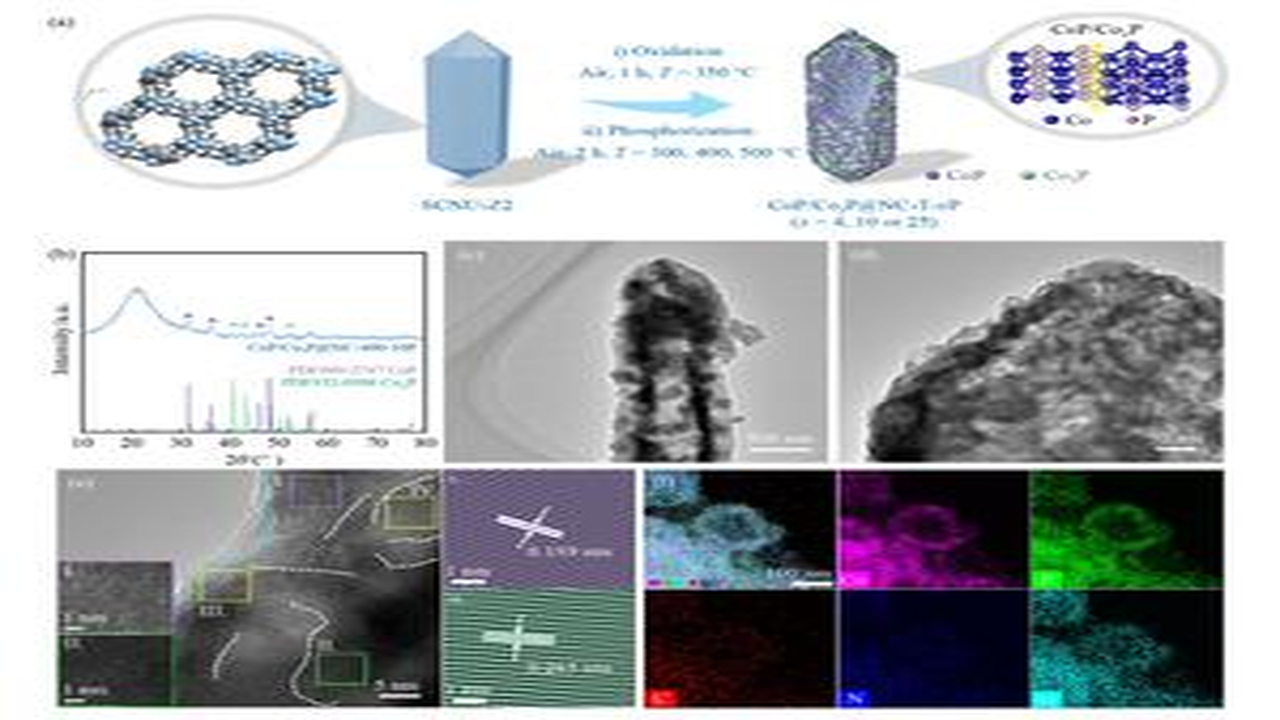
Researchers at Fuzhou University have achieved a significant breakthrough by synthesizing a novel bifunctional electrocatalyst that addresses these challenges. Their innovative design features cobalt phosphide (CoP/Co2P) heterojunctions precisely anchored onto nitrogen and phosphorus-doped hollow carbon nanorods (N,P-HCNRs). This unique nanostructure leverages the synergistic effects between the metallic phosphides and the carbon support to enhance catalytic activity and stability. The catalyst exhibited remarkably low overpotentials in alkaline conditions for both HER and OER, requiring only 127.6 mV and 279.4 mV, respectively, to achieve a current density of 10 mA/cm². When integrated into a full water-splitting cell, the system demonstrated exceptional performance, needing only 1.63 V to reach the same current density. Crucially, the catalyst maintained its high activity for over 20 hours of continuous operation without significant degradation, showcasing its robust long-term stability—a paramount concern for industrial applications. This performance far surpasses many state-of-the-art non-noble metal catalysts and approaches that of expensive platinum-group materials.
Technical Significance & Outlook: Paving the Way for Economical Green Hydrogen
This development carries profound technical significance for the future of green hydrogen production. By replacing costly noble metals with abundant and inexpensive cobalt and carbon materials, the catalyst significantly reduces the capital expenditure associated with water electrolysis, making green hydrogen economically more viable. The successful integration of synergistic heterojunctions on engineered carbon nanostructures provides a powerful blueprint for rational design of next-generation electrocatalysts with enhanced active sites and optimized electronic structures for efficient charge transfer. The remarkable stability achieved is also critical, addressing a major hurdle for practical applications where sustained operation is essential. Looking forward, this catalyst design principle could be extended to other transition metal compounds and nanostructures, accelerating the discovery of new high-performance materials for various electrochemical energy conversion systems. The Fuzhou University breakthrough represents a substantial stride towards scalable, low-cost, and sustainable green hydrogen production, directly contributing to global decarbonization efforts and the transition to a cleaner energy landscape.






Comments